
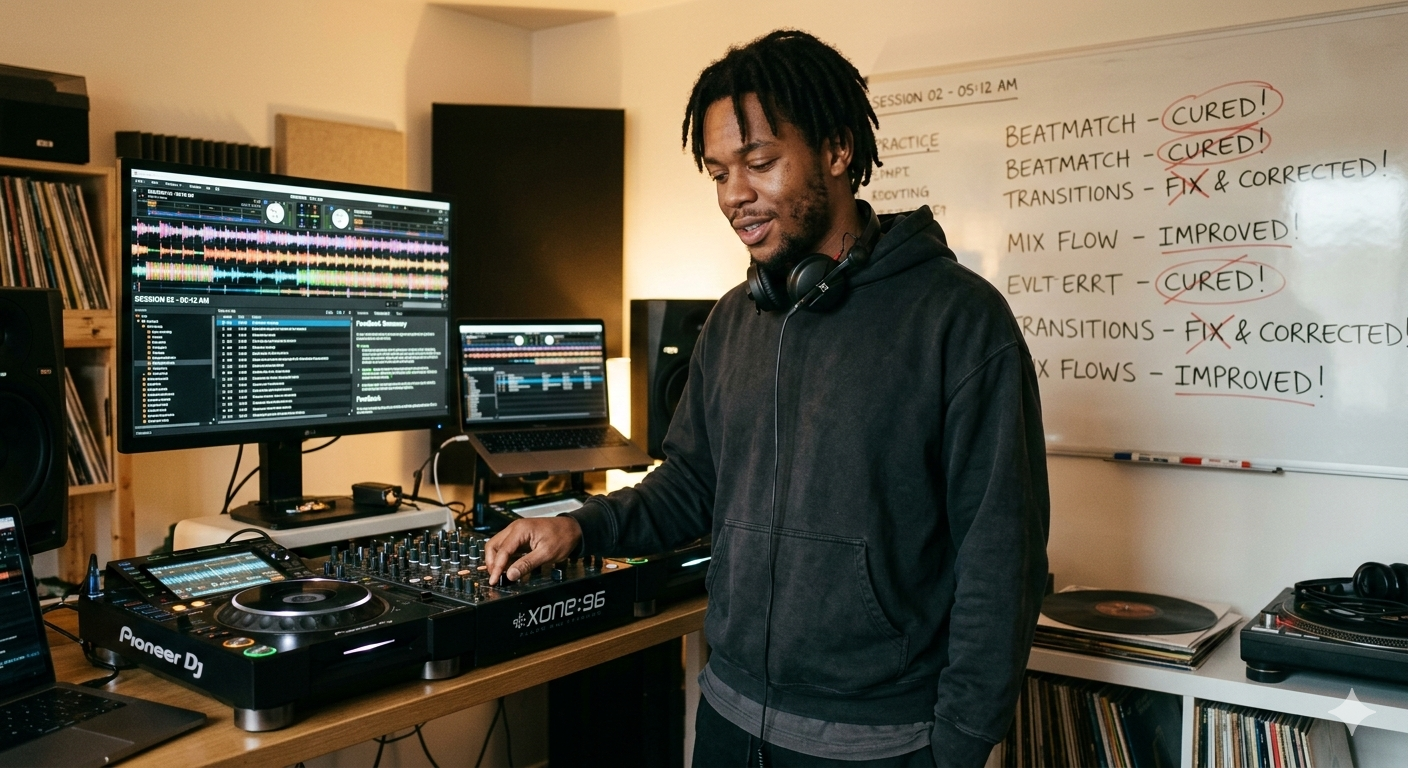
The DJ role isn’t disappearing. It’s mutating — stretching into shapes most DJs haven’t even thought to prepare for. And honestly, that’s either the most exciting thing happening in music right now, or the most terrifying. Depends on where you’re standing.
The Role Was Already Shifting Before Any of This
Let me be honest about something. DJs stopped being just music selectors years ago — quietly, without ceremony, without anyone sending a memo. The job expanded. Suddenly you were expected to be a content creator, a brand, an audio engineer, a social media presence, a business. All at once. Nobody asked if you were ready.
AI didn’t start this. It just — accelerated it, in that way a small crack in a wall becomes a structural problem after one bad winter.
What’s being added now is a new layer on top of everything already there: the DJ as systems architect. Someone who doesn’t just curate music but designs the intelligent workflows that make everything else possible. It sounds abstract. It isn’t. And the DJs who grasp this early? They’ll absorb responsibilities others won’t even see coming until it’s too late.
What the Job Actually Looks Like Now
1. Curation Stops Being Grunt Work
Here’s something I think about a lot — manual track discovery used to be the skill. Hours in the crates, ears on new releases, filtering by feel and instinct and caffeine. That was the work. Legitimate, earned, slow.
AI doesn’t erase that. It compresses the labor side of it so aggressively that the strategic layer — the why behind your selections — becomes the only thing that actually matters anymore.
With Rekordbox’s intelligent suggestions and metadata-driven curation workflows, a DJ can now process 200 new releases in roughly 20 minutes. What used to take a Sunday afternoon. The question stops being “did you find the track” and becomes something harder: do you actually know why that track belongs in that specific set, at that specific moment?
Taste becomes the differentiator. The legwork just becomes… expected.
Practical steps — start here:
- Stop measuring effort by hours spent digging
- Build a pre-filter system before you touch new music — BPM range, key, energy level, set context
- Let AI handle the sorting; use your ears for the final 20%
2. Performance Gets More Human, Not Less
This is where people get it completely wrong and it kind of drives me crazy.
The assumption is that AI in the booth strips out the human element. Like it hollows the performance from the inside. But that’s — no. What it removes is the mechanical layer. Which is a different thing entirely.
Think about sync technology. Beatmatching by ear was a real skill. It was also, honestly, a constraint — cognitive overhead that ate into what you could actually focus on during a set. When sync arrived and DJs stopped having to manually ride the pitch fader, the ceiling on what you could do musically went up. Phrasing got tighter. Layering got more interesting. Energy management became deliberate instead of reactive.
AI assistance follows the same logic, just one layer up. When harmonic compatibility gets handled in real time — when the software flags that the track you’re about to drop is a tritone away from the current key — your full attention goes to arc, tension, the emotional shape of the hour. That’s not less human. That’s more room to be human.
💡 PRO TIP: The DJs who’ll actually benefit from AI performance tools are the ones who already understand energy arc and arrangement — not just mixing mechanics. If that foundation isn’t there yet, build it before the tools arrive. AI accelerates what you have. It doesn’t install what’s missing.
3. You’re a Content Operator Now. Accept It.
One set. One output. That was the model for a long time — perform, go home, maybe post a clip if you remembered to hit record. Economically and strategically? That model is thin. Almost reckless in 2025.
I remember loading up after a warehouse gig once — sweaty, ears ringing, that specific exhaustion that only a long set produces — and realizing I had nothing to show for it outside of the room. No clip, no recording, no content. Just a memory and a handshake. It stung more than it should have.
The same 2-hour set now has the infrastructure to generate 10–15 distinct content outputs. Mix recording. Short-form highlight clips. Behind-the-scenes footage. A track breakdown post. A setlist thread. With tools like Opus Clip auto-generating highlights, Descript handling transcription and captions, Gling cutting dead air from recordings — most of the production labor is already handled.
None of these tools were built specifically for DJs. Doesn’t matter. The workflow application is direct and obvious.
Four steps to build the system:
- Record everything — audio minimum, video where possible
- Run recordings through Opus Clip immediately after the gig
- Use Descript to pull captions and a written set breakdown
- Schedule platform-specific cuts across TikTok, Instagram Reels, YouTube Shorts
The DJ with this system compounds visibility with every performance. The one without it is, functionally, performing in private.
⚠️ COMMON MISTAKE: Automating content volume before defining a brand framework. More output without direction isn’t a strategy — it’s just faster noise. Figure out your niche and aesthetic first. Then automate.
4. Brand Is Now a Core Part of the Job Description
This one still surprises people when I say it directly. But — the technical barriers to consistent branding don’t really exist anymore. AI tools generate visuals, write copy, schedule posts, maintain tone across platforms. The infrastructure is there for everyone.
Which means inconsistency isn’t a resource problem in 2025. It’s a choice. Conscious or not.
Every DJ now has access to tools that can sustain a coherent visual identity, a consistent posting cadence, a recognizable voice. The ones who still don’t have that aren’t being held back by budget or time or technical skill. They just haven’t decided what they stand for yet. That’s the actual bottleneck.
What you play is still important. What you represent — clearly, consistently, across every touchpoint — is what builds something durable.
5. Data Literacy. Yeah, This One’s Real.
Okay — this is the one that catches most DJs off guard, and I get why. It sounds like a corporate skill. Something for marketing departments and spreadsheet people. Not for someone who got into this because they loved music.
But here’s the reality: AI tools generate data. Rekordbox session logs. TikTok analytics. Spotify for Artists dashboards. Content engagement patterns across platforms. That data exists whether you look at it or not. The DJs who look at it — who develop enough literacy to extract decisions from it rather than just observations — have a structural edge over the ones who don’t.
This isn’t about becoming an analyst. It’s about knowing which three numbers actually matter and ignoring the rest.
Fyanso’s Take
The entire discourse around AI and DJs is framed around the wrong question. Everyone keeps asking whether AI will replace DJs — as if the binary answer to that tells you anything actionable.
Here’s the more honest framing: which kind of DJ gets replaced, and which doesn’t?
The one who gets replaced — and look, this might sting slightly — is the DJ whose entire value proposition is mechanical. Basic transitions, BPM matching, showing up with a hard drive and a playlist. That role was commoditized before AI existed. AI just makes the commoditization more visible, more accelerated. It removes the cover.
The DJ who doesn’t get replaced operates. Curates with intention. Builds systems. Creates content. Compounds their presence across multiple surfaces over time. That DJ was always going to win. AI just tightens the timeline. Moves the reckoning forward.
🔧 WORKFLOW: Rekordbox 6 + Notion + Opus Clip — Fifteen minutes after every gig. That’s the commitment. Export your session log from Rekordbox, drop your key observations into a Notion set template (energy arc, transitions that worked, one thing you’d change), and queue the recording in Opus Clip for auto-clipping overnight. Do this for 12 months and you have a performance and content database that most DJs will never build. Small habit. Compounding return. That gap is your edge.
The System Recap
- Curation shifts from labor to judgment — AI handles the volume, your taste becomes the differentiator
- Performance ceilings go up — AI absorbs the mechanical layer, you own the intentional layer
- Content production is now part of the role — one set should generate multiple outputs across multiple platforms
- Brand consistency is a decision problem, not a resource problem — the tools exist, the framework has to come from you
- Data literacy is the quiet skill gap — the DJs who extract decisions from metrics will outmaneuver the ones who don’t
- The role expands — it doesn’t shrink — operators compound, performers without systems plateau
One thing. Do it today: Open Notion — or a Google Doc, honestly whatever you’ll actually use — and build a simple set log template. Date, venue, three observations, one thing to change. Fill it in after your next gig. That’s the foundation. Everything else gets built on top of it.