
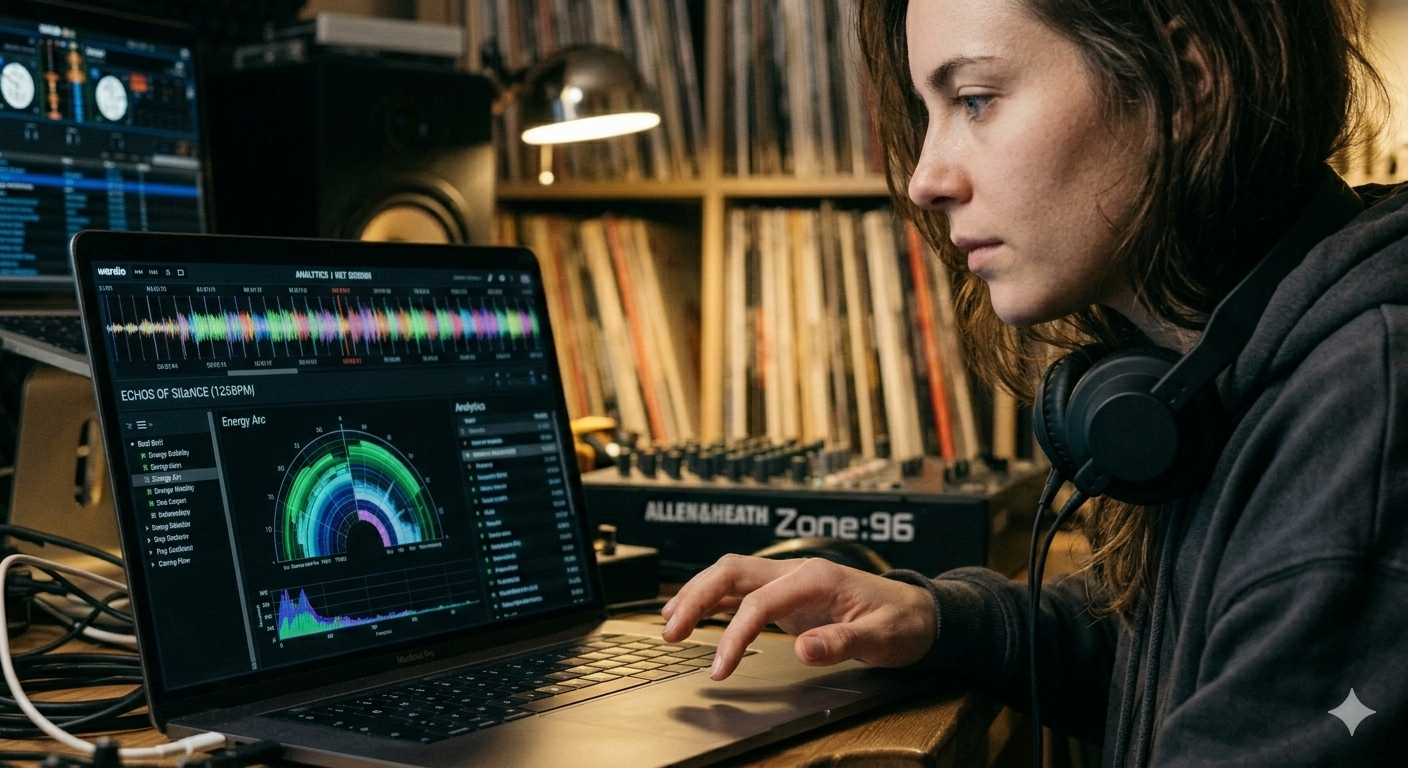
The mixing tools you’re using today are already smarter than the ones from five years ago. What’s being built right now will make them look like a calculator next to a laptop. And the DJs who understand the trajectory before it ships — not after — are the ones who’ll absorb it fastest, build around it first, and frankly, make everyone else look slow by comparison.
Why This Is Moving Faster Than Anyone Expected
Beatmatching was solved, technically, a while back. Sync made tempo alignment a single button. Harmonic mixing became accessible when Mixed In Key turned key detection into something anyone could run on a Tuesday night without a music degree. Both got resisted — loudly, emotionally, with a kind of territorial fury that feels almost quaint now — then adopted, then completely normalized.
That cycle is still happening. It’s just faster now. Compressed, almost.
The next layer isn’t about fixing mechanical problems anymore — those are largely handled. It’s about solving musical problems. Transitions that feel inevitable. Energy arcs a room sustains without ever consciously noticing why. Flow states that hold for two hours and leave people unable to explain exactly what just happened to them. Those are harder. Genuinely harder. And the tooling being constructed to address them is architecturally different from anything currently sitting in your DJ setup.
Understanding what’s being built — before it lands in a changelog you’ll skim at 11pm — is how you position ahead of it rather than scramble to catch up.
Three Algorithmic Shifts That Will Change How You Mix
1. Beatmatching Grows Up — From Tempo Sync to Phrase Intelligence
Current sync technology does one thing well. It aligns BPM. Accurately, instantly, without drama. What it doesn’t do — and this gap is bigger than most DJs realize until someone points it out — is understand where in a phrase a track actually is at any given moment.
Whether that downbeat you just synced to is the opening of an 8-bar phrase or the awkward middle of one. It doesn’t know. It just locks tempo and hands the rest back to you.
Phrase-aware beatmatching changes this at the structural level. Next-generation algorithms analyze musical architecture in real time — identifying verse, chorus, breakdown, build, and release sections — then suggest or outright automate transitions that align phrase boundaries, not just beats. It’s the difference between two trains running at the same speed and two trains running at the same speed on parallel tracks that actually connect.
Algoriddim’s Djay Pro has been iterating in this direction — their Neural Mix engine, which got meaningful updates through late 2024 — is one of the clearest public signals of where this goes. Expect deeper implementations inside Pioneer CDJ firmware and Serato DJ Pro within 18 to 24 months. When it lands natively, the transition quality floor rises across the whole industry at once. Not for some DJs. For all of them, simultaneously.
Adjust your prep now — before the tool does it for you:
- Shift cue point placement from beat-accurate to phrase-accurate — mark section openings, not just drop points
- Start planning transitions structurally — which sections connect, not which BPMs match
- Practice identifying phrase structure in familiar tracks by ear — it’s trainable, and the DJs who’ve trained it will use phrase-aware tools far more intelligently than the ones who just let it run on auto
2. Harmonic Mixing Gets Dynamic — and the Camelot Wheel Gets More Complicated
Mixed In Key 10 detects key accurately. The Camelot Wheel tells you which keys sit adjacent without clashing. The system works — it’s worked for over a decade — and there’s something almost comforting about how reliable it is, like a tool that never complains and always shows up.
Here’s the catch though.
It’s static. It analyzes the key of an entire track and returns a single value. What it can’t do — what no current consumer DJ tool does properly — is account for the fact that tracks move. They modulate. They drift tonally across their own runtime, landing in a different harmonic space by the outro than they occupied in the intro. A track tagged 6A isn’t uniformly, consistently 6A for its entire six minutes. It just averaged out to 6A.
Dynamic harmonic analysis — mapping key movement across the full timeline of a track rather than collapsing it to a single number — is the next evolution. Early implementations exist in research environments and some DAW-adjacent plugins. The DJ-specific version means transition suggestions stop matching starting keys to starting keys. They start matching ending keys to starting keys, section to section, handoff to handoff.
Stack that on top of phrase-aware beatmatching and the algorithmic support for seamless transitions becomes — honestly — startlingly good.
Prep your library for what’s coming:
- In Mixed In Key 10, pay specific attention to tracks flagged with low Energy scores — these often have significant tonal movement the algorithm averaged over
- Manually tag outro key for tracks where you know the harmonic center shifts — use the Comments field in Rekordbox, it’s underused and perfect for this
- Build transition pairs based on outro-to-intro key matching rather than overall key matching — test it on five tracks you already know well and you’ll hear the difference within the first listen
💡 PRO TIP: Start treating the final 30 seconds of every track as a separate listening exercise — divorced from how you engage with the full track. The outro harmonic center is the actual handoff point. Most DJs have never consciously mapped it. Most DJs also wonder why some of their technically “correct” transitions feel slightly off.
3. Flow Analysis — The Layer Nobody’s Really Discussing Yet
Okay so. Beatmatching solves tempo. Harmonic mixing solves key. Both are — relatively — understood problems now, or becoming understood. Flow analysis is the third variable. The one that’s harder to name, harder to quantify, and somehow more important than either of the other two once you understand what it actually addresses.
Flow algorithms model the emotional and energetic trajectory of music using spectral analysis, dynamic range data, rhythmic density, vocal presence markers — a composite profile of how a track moves, where it builds tension, how and when it releases. The output isn’t a BPM or a Camelot number. It’s an energy signature. A shape.
Applied to DJ workflow in real time, flow analysis enables something that currently doesn’t exist outside of a DJ’s own intuition: a live energy map of your set that projects forward. Not just “these two tracks are technically compatible” — but “these two tracks create the correct energy sequence given the last 25 minutes of what you’ve played and the direction your crates suggest you’re heading.”
Spotify has been running proprietary versions of flow modeling for years — it’s a significant part of why their algorithmic playlists feel cohesive rather than just technically adjacent. Pioneer has filed patents in this general area. Serato’s research output has touched adjacent problems around set-level analysis. The DJ-specific implementation is being assembled, piece by piece, in the background.
It will arrive. Probably before most DJs expect it.
Build the manual version now — while the automated one is still in development:
- Tag every track in your library with an Energy value from 1–5 — not BPM, not genre, pure perceived energy as you experience it
- Add a Set Position tag: Opener, Builder, Peak, Sustain, Closer — these are functional descriptors, not aesthetic ones
- When sequencing crates, prioritize energy tag first, key second, BPM third — this mirrors the logic flow analysis will eventually automate, so you’re training your instinct against the same framework before the software exists
⚠️ COMMON MISTAKE: Tagging tracks by genre instead of energy function. Genre describes what a track is. Energy and set position describe what a track does — which is, frankly, the only variable that actually matters when you’re sequencing a 90-minute set at 1am and the room has a particular kind of momentum you don’t want to interrupt.
What Happens When These Three Systems Converge
Phrase intelligence. Dynamic harmonic analysis. Flow modeling. Separately, each one is a meaningful upgrade over what exists today. Together — and they will converge, because they’re solving facets of the same underlying problem — they form something categorically different from current mixing assistance.
The problem they’re jointly solving is this: making algorithmic support operate at the level of musical intention, not just technical compatibility. The gap between “these tracks won’t create a key clash” and “this sequence will genuinely move a room” is enormous. Current tools address the first. The tools in development are reaching for the second.
I remember — and this is specific enough that it still stings a little — a gig maybe four years ago where every technical decision I made was correct. BPMs matched. Keys were adjacent. Transitions were clean. And the room just… didn’t move. Something was wrong in the sequencing that no current tool would have flagged. The energy logic was broken even though the technical logic was fine. Flow analysis is being built to catch exactly that failure mode.
When that gap closes — and it will — the entire competitive landscape around technical mixing ability resets again.
Fyanso’s Take
Here’s what the trajectory of mixing algorithms actually means, and why most analysis of it gets the conclusion backwards.
The ceiling on algorithmic mixing quality is rising. True. But the floor is rising faster — and that’s the more consequential development. The floor rising means the average technically competent mix improves across the whole industry simultaneously the moment new tools ship. That’s not an advantage for anyone in particular. It’s a baseline reset that compresses the gap between average and good, which makes the space between good and genuinely distinctive the only place left worth competing.
Better tools don’t produce better DJs. They raise the minimum standard and tighten the margin for technical differentiation. If your entire proposition is technical execution — clean transitions, accurate key mixing, solid BPM management — that margin tightening should probably keep you up at night. If your proposition is curatorial intelligence, narrative construction, and a sound identity that AI can assist but not replicate — better tools just liberate more bandwidth to express those things. Same tools, completely different implications depending on what you’ve actually built.
🔧 WORKFLOW: Mixed In Key 10 + Rekordbox 6 Custom Tags — Three new columns in Rekordbox, added today: Energy (1–5), Set Position (Opener / Builder / Peak / Sustain / Closer), and Outro Key — manually entered after a dedicated listen to the track’s final 30 seconds. Run every new track through Mixed In Key 10 for standard detection, then spend 60 seconds adding the other three fields. Over three months, this constructs a library you can query by energy function and transition logic — something no AI curation tool can build from your metadata alone, because the intelligence behind it is yours.
The System Recap
- Phrase-aware beatmatching is the nearest shift — mark phrase boundaries in cue points now, before the feature automates the decision for you
- Dynamic harmonic analysis supersedes static key values — manually tagging outro keys builds the habit that future algorithms will systematize
- Flow analysis is the third layer arriving — Energy and Set Position tags are the manual version; build it while the automated one develops
- All three converge into one system — algorithmic support for musical intention, not just technical compatibility
- The floor rising faster than the ceiling is the real story — technical differentiation compresses; creative and curatorial differentiation is where the remaining space lives
- Your library metadata is load-bearing infrastructure — every future AI improvement runs on top of it, which means the quality of your tagging determines the quality of your results
One thing. Today. Open Rekordbox. Add three custom tag columns — Energy, Set Position, Outro Key. Tag 20 tracks you already know well. The library you’re building right now is the foundation every coming algorithm improvement either runs smoothly on — or doesn’t.