
Most DJs are still learning the same way they did fifteen years ago. YouTube tutorials, trial and error, the occasional piece of advice from someone more experienced who had exactly four minutes to spare before soundcheck. That’s not a learning system. It’s organised chaos with better lighting.
AI-driven education tools are restructuring how skills get built — not someday, right now — and the DJs who update their learning approach in the next 12 months will compress years of development into something that actually fits inside a real life.
Why the Way DJs Learn Is Quietly Broken
Three problems. Unstructured, unresponsive, passive. That’s the traditional DJ learning path in six words and none of them are flattering.
You watch a tutorial. You attempt the technique. You fail in a direction the tutorial never anticipated — because tutorials are built for an imaginary average learner who doesn’t actually exist — and then you go searching for another video that might, maybe, address the specific way you failed. The feedback loop is broken at the structural level. Not because DJs aren’t trying hard enough. Because the infrastructure was never built for real learning in the first place.
Classical musicians, jazz students, producers coming through formal programs — they have graded curricula, real-time coaching, adaptive instruction that responds to their specific gaps, not a generic syllabus. DJs have comment sections. The disparity, when you look at it directly, is almost absurd.
Four Ways AI Changes the Learning Structure
1. Simulated Practice Replaces Passive Watching
The most important shift isn’t a specific tool. It’s a category change — from consuming instructional content to practicing inside responsive environments that react to what you actually do.
Algoriddim’s Djay Pro already contains early versions of this. Real-time feedback on harmonic clashes, timing inconsistencies — flagged as they happen, not after you’ve repeated the mistake forty more times. Mixed In Key’s integration roadmap includes coaching features that identify when your track selections are working against the energy arc you’ve been building. These aren’t complete products yet. But the architecture is being laid, piece by piece.
The practical implication right now — and this matters more than any specific tool — is that watching is not learning. Watching is exposure. Learning requires doing, failing, getting immediate feedback on the failure, and adjusting. Build your practice sessions around that loop or accept that you’re not really practicing at all.
Start here:
- Set one specific technical target before every session — one technique, not a vague “work on mixing”
- Record every session, audio minimum
- Review it immediately after and identify one concrete error
- Track that error across the next four sessions — is it reducing, staying consistent, or morphing into something new?
2. AI Feedback Fills the Mentor Gap
I remember spending maybe eight months convinced I was improving — genuinely convinced, with real confidence — before someone I respected listened to a mix and told me my transitions were consistently half a phrase off. Eight months. That information took thirty seconds to deliver and would have taken me another year to figure out alone.
That’s the mentor gap. And it’s where most self-taught DJs lose the most time.
Mixonset analyzes recorded mixes and returns structured, timestamp-specific feedback on transition quality, harmonic flow, energy arc consistency, and timing accuracy. Not generic notes — specific moments, specific problems. The functional experience is closer to having a coach in the room than anything previously available to a DJ working alone.
The three-session feedback loop:
- Record three consecutive practice sessions
- Upload each to Mixonset for analysis
- Identify the errors that appear across all three — not the one-off mistakes, the patterns
- Build your next fortnight of practice exclusively around fixing those two or three recurring issues
💡 PRO TIP: A mistake you make once is noise. A mistake you make in seven out of ten transitions is a structural gap. AI analysis surfaces patterns that honest self-review almost never catches — because self-review is filtered through ego in ways you don’t always notice.
3. Personalized Curriculum Over Generic Tutorial Sequences
Generic tutorial content is calibrated for nobody in particular. You either already know most of what’s being covered, or you’re missing foundational context that makes the rest confusing. Both are inefficient in different ways, and both are frustrating in the same one.
AI-driven curriculum tools sequence learning around your current level, your specific gear, and the actual gap between where you are and where you’re trying to be. Early implementations exist inside Algoriddim’s education suite. More complete versions are in development — think Duolingo’s adaptive logic applied to DJ technique. Spaced repetition, skill-gap identification, content that responds to demonstrated performance rather than assumed linear progression.
Build your own adaptive curriculum manually while the automated version develops:
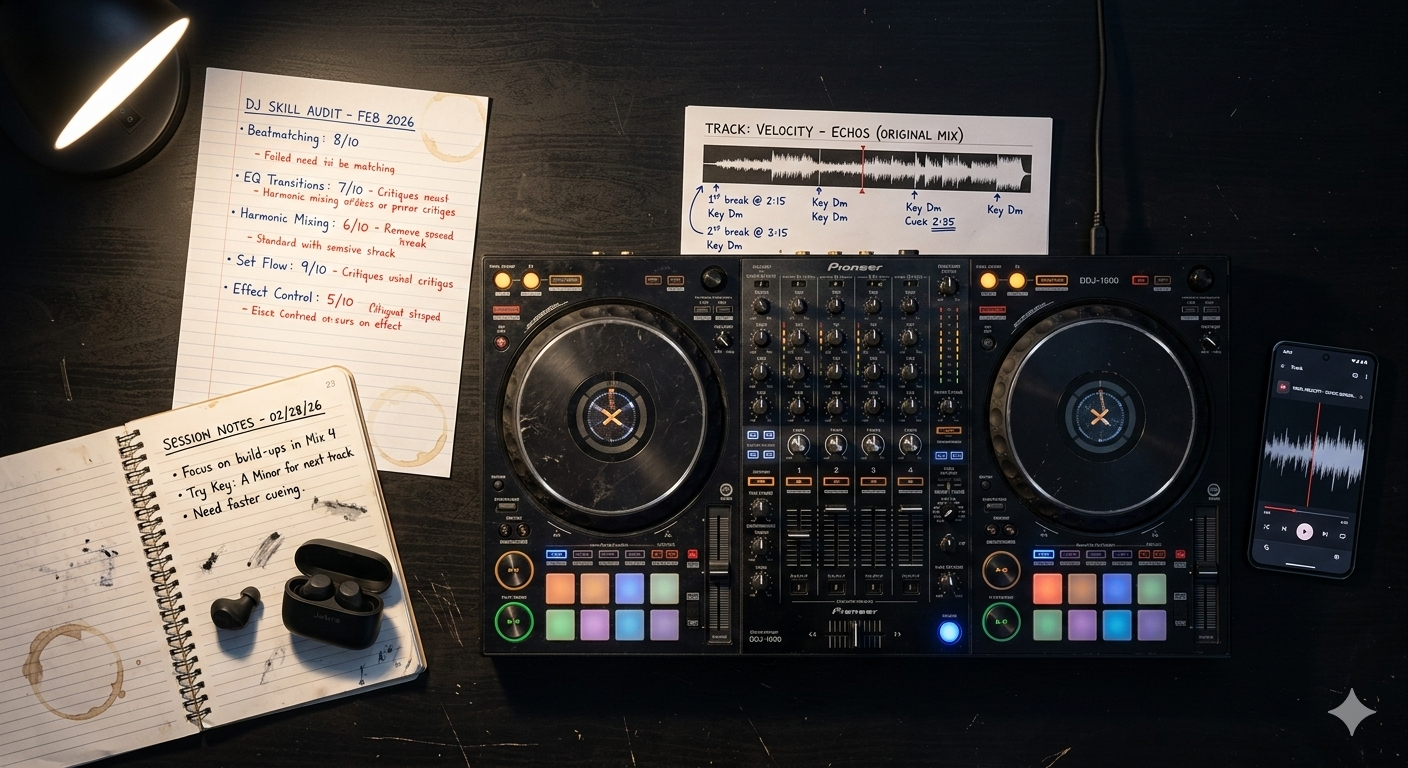
- Audit your skill level honestly across six areas — beatmatching, phrasing, harmonic mixing, energy management, EQ technique, effects use
- Score each from 1–5, no generosity
- Your two lowest scores are your entire curriculum for the next 30 days
- Touch nothing else until those scores demonstrably improve
⚠️ COMMON MISTAKE: Practicing what you’re already good at. Comfortable practice feels productive and produces almost nothing. The techniques that feel difficult — the ones that make you want to switch to something easier after ten minutes — those are the ones worth staying inside. Frustration in practice is information, not a reason to stop.
4. Performance Analytics Close the Loop Between Practice and Gigs
Here’s the gap nobody really talks about. You improve in practice sessions. You get to a gig and the improvement doesn’t show up the way you expected. The feedback infrastructure that’s starting to exist in practice environments — it doesn’t carry through to live performance. Not yet.
Post-gig analysis tools in platforms like DJ.Studio and Rekordbox’s session logging are beginning to address this. Transition data, sequencing patterns, energy arc behavior across a full set — structured performance profiles rather than just recordings. Over time this builds a longitudinal dataset of your own development. Patterns emerge across gigs that individual session reviews will never surface.
The DJs building that dataset now — logging consistently, reviewing structurally — will have something real to feed AI coaching tools when they’re fully integrated. Most DJs won’t have built it. That gap compounds.
Fyanso’s Take
There’s a belief in DJ culture that the slow, painful, figure-it-out-yourself path is what produces legitimate skill. I held this belief for years. Defended it, actually — with real conviction.
It’s wrong. Or more accurately, it was a post-hoc justification for the absence of better tools, not a genuine learning philosophy. Musicians in structured programs don’t develop faster because they suffer differently. They develop faster because they have adaptive feedback, deliberate practice frameworks, and instruction calibrated to their specific gaps. AI is bringing that infrastructure to DJ education for the first time. Using it isn’t a shortcut. It’s finally having access to what every other serious musician already had.
🔧 WORKFLOW: Mixonset + Rekordbox Session Logging + Notion Skill Tracker — Record every practice session, upload to Mixonset, log the two most consistent errors into a Notion tracker with a target fix date. Review weekly — are they reducing, persisting, shifting? Three tools, fifteen minutes of review, compounding feedback loop over 12 months. Most DJs will never build this. That absence is your edge if you do.
The System Recap
- Simulation over passive watching — active, feedback-driven practice compounds skill faster than tutorial consumption at any volume
- AI feedback fills the mentor gap — Mixonset provides timestamp-specific error identification that self-review consistently misses
- Target your lowest scores — 30-day cycles focused exclusively on genuine skill gaps, not comfortable reinforcement of existing strengths
- Post-gig analytics close the practice-to-performance loop — build the dataset now so AI coaching tools have something real to work with when they arrive
- Frustration in practice is the signal — the techniques that feel hardest are precisely the ones worth staying inside longest
- The infrastructure is being built right now — DJs with structured feedback systems will integrate AI coaching faster and more effectively than everyone else
One thing. Right now. Record your next practice session. Review it immediately after. Write down the single most consistent error you hear — specific, honest, timestamped. That one observation is worth more developmental leverage than three hours of tutorial consumption.