
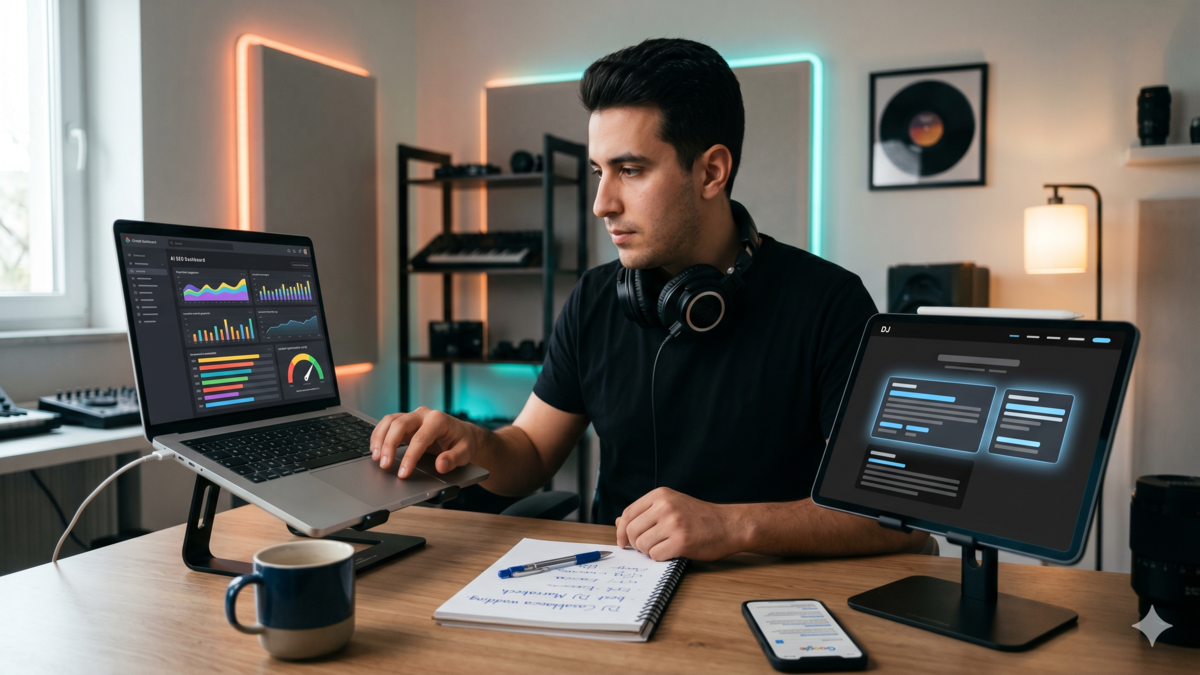
Let me tell you something that took me longer to accept than it should have. You can be genuinely, demonstrably good at this — years of craft, an ear that took real time to develop, a sound that people specifically request — and still be completely invisible to the person sitting at their desk right now, searching for a DJ for their daughter’s wedding or their company’s annual party or whatever event is about to generate a booking that goes to someone else. Not because that someone else is better. Because their website showed up and yours didn’t. Because Google’s particular, opaque, continuously shifting understanding of relevance decided, for reasons that feel almost personal, that they exist and you don’t.
It is — and I want to be honest about this — an almost uniquely demoralizing form of professional invisibility. The skill is real. The effort is real. And none of it matters to an algorithm that never heard you play.
In 2026, discoverability isn’t a bonus feature of a DJ career. It’s load-bearing infrastructure. A 2025 study by Digital Beats Research found that over 60% of event planners and private clients begin their search for a DJ on major search engines — not on booking platforms, not through personal recommendations, on search engines — and that the top three results capture the overwhelming majority of the clicks that follow. If you’re not in that window, you’re functionally nonexistent to a majority of the people who would hire you. That’s a hard number to sit with. The good news, and it genuinely is good news, is that AI has arrived into this specific problem with tools that are operational, accessible, and working now. This is a core component of what serious professionals are building through DJ Career Growth & AI Tools, and it’s more immediately practical than people tend to assume.
The Search Visibility Challenge for DJs
Traditional SEO — the discipline of making your website legible and appealing to search engines — has always been complicated enough to feel like a second career. Keywords and content quality and technical site performance and backlink profiles and algorithm updates that arrive without warning and invalidate strategies you’ve spent months building. It demands constant attention from someone with specialized knowledge and available time, and DJs are, categorically, people with neither of those things to spare. So the website gets built once, the “about” page gets written in a slightly aspirational hurry, and then it sits there, largely unchanged, slowly becoming less competitive as everyone else’s presence evolves and yours doesn’t.
The consequence is exactly what you’d expect. A prospective client in your city types “wedding DJ [city name]” or “corporate event DJ [neighbourhood]” and finds a list that doesn’t include you. The search has specificity — local relevance, genre signals, the particular language of whatever event they’re planning — and if your site hasn’t been built to speak that language, the algorithm simply moves on. Every uncaptured search is a booking you never got the chance to pitch for. Multiply that across a year and the invisible cost becomes, potentially, significant.
AI SEO tools change this dynamic by automating the analysis that was previously too time-intensive for an individual to sustain. They’re not magic — nothing is — but they compress weeks of manual research into something manageable, and they identify opportunities that manual analysis would almost certainly miss.
How AI SEO Tools Transform DJ Marketing
The core function is data processing at a scale no human matches. These systems analyze billions of search queries, content performance metrics across comparable sites, algorithm behavior patterns — and they distill that into actionable guidance specific to your situation. Not general best practices, your keywords, your competitors, your site’s specific technical vulnerabilities. A data-driven blueprint for improving your position, delivered without requiring you to become an SEO specialist.
Which — and this matters — you shouldn’t have to become. You’re a DJ. The tools exist so that you don’t have to.
Key Applications for DJs: Precision in Practice
Advanced keyword research is where most DJs find the most immediate value, and where AI most clearly outperforms what you’d produce manually. Beyond basic terms, AI tools identify long-tail keywords — the specific, multi-word phrases that reflect actual search behavior: “upbeat house DJ for corporate launch event,” “wedding DJ with live saxophone option,” “silent disco DJ hire Manchester.” These longer phrases tend to have lower competition and higher intent — the person searching them knows what they want and is closer to booking. AI identifies which of these terms your target audience actually uses, traces the semantic connections between related searches, and flags emerging trends before they become saturated. You stop guessing what language your clients use and start knowing.
Content generation and optimization — this one connects directly to the content creation discussion we’ve been having throughout, which is not a coincidence. AI writing assistants integrated with SEO data can generate drafts that are simultaneously readable and structurally optimized for search: right keyword density without the awkward over-stuffing that reads like a robot wrote it (which, yes, is ironic), appropriate heading structures, readability calibrated to keep people on the page. The AI might suggest “Top 5 Mistakes to Avoid When Booking a Wedding DJ in [Your City]” as a content opportunity — a topic with demonstrable search demand and low existing competition — and then help structure and draft it. You refine, you add your specific voice and experience, you publish something that both humans and search engines respond to. The efficiency gain is real.
Technical SEO is the area most DJs genuinely never look at, which is understandable and also quietly costing them. Page load speed — especially on mobile, where a significant portion of searches now originate — has a direct relationship with search ranking. Broken links, missing schema markup, suboptimal site structure: these are invisible to you as the site owner and visible, unfavorably, to search algorithms. AI tools scan your site continuously, identify these technical issues specifically rather than vaguely, and suggest precise remediation. Often the fixes are smaller than you’d imagine; the barrier was always knowing where to look.
Competitor analysis, done properly, is less about imitation and more about intelligence gathering. AI tools reveal what keywords your highest-ranking competitors are capturing, what content is performing well for them, where their backlink authority comes from. You see the landscape of what’s working in your market. Then — and this is the move — you identify the gaps they’re not addressing. The long-tail terms nobody’s optimizing for, the content angles nobody’s covering, the local search territory nobody’s claimed. You build into the uncrowded spaces rather than competing head-on for positions that are already contested.
Local SEO specifically deserves its own emphasis, because for most DJs — not all, but most — local search is where the actual bookings originate. An optimized, consistent, actively maintained Google Business Profile; accurate and uniform information across directories; genuine review management; visibility in “near me” searches. These are the mechanisms that translate local search intent into direct contact. AI platforms handle the maintenance and optimization of this layer continuously, flagging inconsistencies and opportunities that would otherwise require regular manual attention.
Choosing the Right Tools: What to Look For
Not all AI SEO platforms are equivalent, and the differences matter. For keyword research and competitive analysis, Semrush remains a comprehensive and well-regarded option — it covers a broad suite of functionality and is used by serious marketing professionals across industries. Surfer SEO has a particular strength in content optimization, scoring your drafts in real time against competing pages and suggesting adjustments that improve ranking potential without sacrificing readability. Clearscope specializes in content relevance and semantic depth, useful for ensuring your articles actually address the full range of what searchers are looking for on a given topic.
What you want from any platform: semantic analysis that goes beyond raw keyword lists, content intelligence that tells you where your site has gaps, technical audit functionality that produces actionable recommendations rather than just error reports, and an interface that doesn’t require a marketing degree to navigate. You’re a DJ. Complexity that can’t be translated into clear action is just noise.
Integration capabilities matter too — platforms that connect with your analytics tools, your social media, ideally your booking software, save the time that would otherwise go to manually reconciling data from multiple siloed systems.
Beyond SEO: An Integrated Approach to Your DJ Business
Here’s the thing about improving your search visibility — it works. And when it works, the downstream consequences are real and require their own infrastructure. More leads means more communication to manage. More bookings means more administrative overhead. The cascade effect of a genuinely effective online presence runs through the entire operation, which is why thinking about SEO in isolation, as a discrete project rather than part of a connected system, tends to produce results that create new bottlenecks rather than just solving the original one.
This is where the tools discussed elsewhere in this series connect. The leads that your improved visibility generates need efficient handling — scheduling, communication, invoicing — of the kind covered at Streamlining DJ Business Admin with AI Assistants. The bookings those leads produce need sound legal foundations — contracts that protect your interests, payment terms that actually get enforced — which is the territory of AI for DJ Contract Management and Legal Protection. The whole architecture is interdependent. SEO attracts clients. Administration manages them. Legal frameworks protect you. Each component enables the others, and the system as a whole is what allows you to focus on the actual music rather than constantly firefighting the business around it.
Conclusion: The Future is Searchable
The “set it and forget it” approach to online presence has been obsolete for years — it just took a while for the consequences to become undeniable. In 2026, the digital competition for DJ visibility is real, active, and won by people who treat their online presence as a living thing that requires attention rather than a box to check. AI SEO tools make that attention achievable for a working DJ without a marketing team, without a specialist budget, without the hours that sustained manual optimization would require.
This isn’t about chasing algorithmic fashion. It’s about implementing a proven mechanism for being found by the people who are already looking for exactly what you do. Your music deserves an audience. The craft deserves to be heard. For the broader context on how search technology continues to evolve and what that means for content visibility — Wikipedia’s overview of Search Engine Optimization provides solid foundational grounding, and CNBC’s reporting on AI’s impact on content discovery and SEO trends tracks where the field is currently moving. The tools are here. The audience is searching. The only question is whether they find you or someone else.