
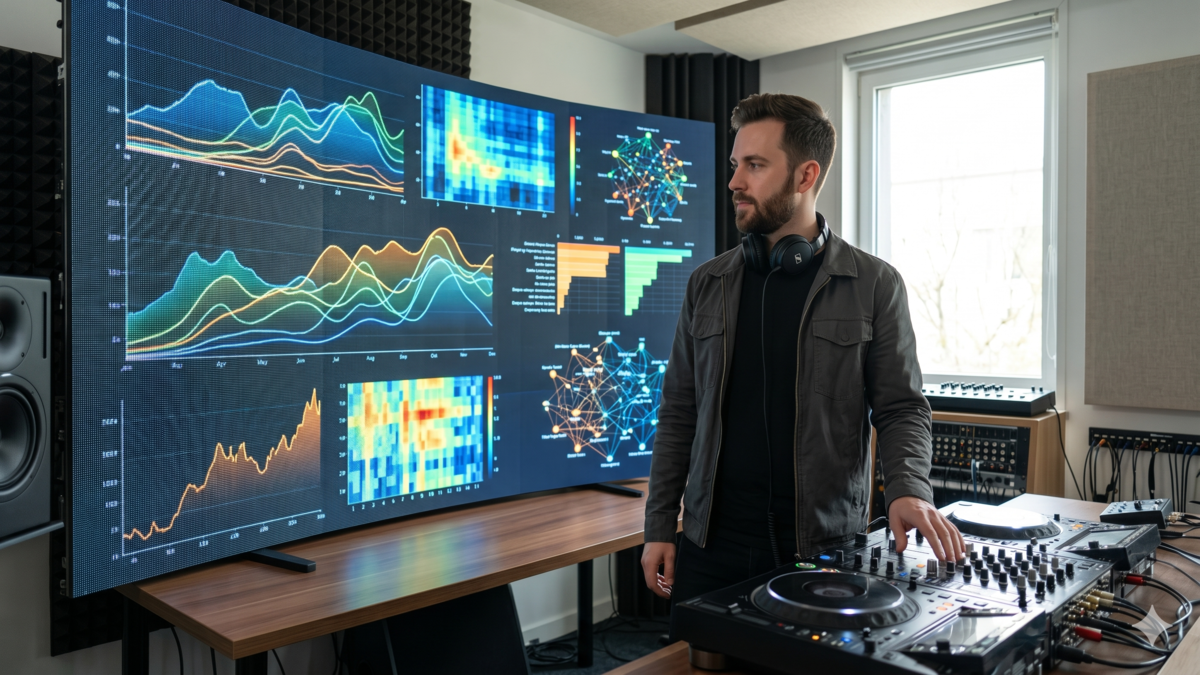
There’s a particular kind of DJ mythology that gets passed around — the idea of the selector with the gift, the one who just *knows*. Who plays the record that nobody’s heard yet and watches a room transform in real time, who seems to operate on some frequency slightly ahead of everyone else’s present tense. I’ve met a few people like this. Been in rooms where it happened. And for a long time I filed it under “intuition” the same way you file unexplained things when you don’t have a better category — as something real but fundamentally unteachable, the product of years and ears and some irreducible personal mystery.
What I’ve come to understand, slowly and with some resistance, is that intuition is mostly pattern recognition operating below conscious articulation. The best DJs don’t have supernatural foresight — they have deeply trained nervous systems that have processed enormous amounts of musical information and learned to extract signal from noise faster than most people can consciously track. That’s not mystical. That’s actually exactly what machine learning does, at a scale and speed that human nervous systems cannot match. Which means the gap between “gifted selector” and “analytically informed selector” is closing in a direction that should be interesting rather than threatening. And for anyone serious about their craft and their position in a competitive industry — the integration of predictive analytics is increasingly less optional. It threads through advanced DJ mixing and reaches into every layer of DJ Career Growth & AI Tools in ways that reward early engagement.
The Data Deluge: Fueling Predictive Models
The sheer volume of music consumption data being generated in 2026 is — honestly, it’s hard to actually conceptualize. Billions of data points, daily. Streaming play counts. Social media mentions and sentiment. Shazam tags geo-located to specific venues and neighborhoods. Online store sales figures broken down by region. Playlist additions and removals. Skips — which are arguably more informative than plays, because a skip is a vote of no confidence that doesn’t lie. Every interaction a listener has with music anywhere online leaves a trace, and the aggregate of those traces, processed at scale, contains information about where musical taste is moving that no individual human observer could possibly extract manually.
A person cannot track what’s being played across a hundred thousand online radio stations simultaneously. Cannot monitor emerging sentiment in seventeen language-specific music communities at once. Cannot correlate a subtle shift in harmonic preference among a influential sub-community in one city with similar micro-movements in three other cities and project what happens when those threads converge. An AI can do all of this continuously, without fatigue, without the selection bias that makes human trend-watching unreliable. It sifts. It identifies nascent correlations that are invisible until they’re obvious — and by the time they’re obvious, you’ve missed the window.
How AI Spots the Next Big Track or Genre
The process is worth understanding even at a non-technical level, because understanding it helps you use the outputs intelligently rather than just accepting them on faith.
Data aggregation comes first — AI systems pulling from streaming engagement metrics, social media sentiment analysis across platforms (the positive-to-negative comment ratio on a track in its first week tells you something, apparently, about its longevity), music sales across regions, forum discussions in niche communities, music blog coverage volume and tone. The breadth of sources matters because any single source has biases; the aggregate is more reliable than any individual signal.
Then the processing layer — machine learning algorithms applying time-series analysis and natural language processing to find what’s actually happening underneath the surface. What they’re looking for: statistically significant spikes in listenership among specific demographics, sudden increases in particular production characteristics appearing across multiple releases, micro-movements in a niche community that historically precede broader adoption. The pattern that matters isn’t “this track got a million streams” — that’s already mainstream, already past the interesting moment. The pattern that matters is “this specific tempo range combined with this synthesis texture is appearing with increasing frequency in a highly influential sub-community online, three months before that community’s tastes typically diffuse outward.”
That lag — three months, six months, whatever the specific diffusion timeline for a particular scene — is the window. The AI identifies you inside it. Most people encounter it after it closes.
What Predictive Analytics Can Actually Tell You
Granular. That’s the word. The insights aren’t “house music is popular” — you knew that — they’re specifically actionable in ways that change how you prepare and perform.
Emerging genre momentum before mainstream crossover: Afro-Tech House gaining measurable traction in specific European cities before it’s on any English-language radar. Deconstructed Club finding new audiences in North American markets that had no previous exposure to it. The AI sees the gradient of growth, not just the peak. Track velocity and longevity signals — which matters enormously, because a track that rises fast and collapses in three weeks serves a different function in your library than one showing strong indicators of sustained relevance. Dropping a viral moment feels good once; building a reputation for having records that matter for a season feels better.
Key and tempo preference shifts across specific scenes. Artist discovery — producers whose work is showing consistent exponential growth in listenership before they have the profile that would bring them to your attention otherwise. Geographic trend hotspots that inform touring strategy: if a particular sound is demonstrably accelerating in a specific city, you have a data-backed reason to pursue relationships with venues and promoters there, not just a hunch. Audience segmentation by venue type and crowd profile, predicting what specific gatherings will respond to based on their known listening behavior and the current trend trajectory.
This is predicting *future* relevance, not reporting current popularity. The distinction is significant enough that I want to say it twice: current popularity is already in every chart, available to every DJ. Future relevance is the thing that separates the ones who arrive somewhere first from the ones who arrive after it’s already familiar.
The Competitive Edge: Proactive Curation
I’ll be direct about what this actually looks like in practice, because the abstract version can feel remote from the actual experience of preparing for a gig.
You refine your music library with direction rather than hope — focusing discovery efforts on what’s predicted to be relevant to your specific audience and market rather than spending equivalent time on releases that won’t serve you. The economics of music discovery time improve substantially. You construct setlists that feel forward-looking rather than reactive — not because you’re chasing trends but because you’ve identified which emerging sounds are already resonating with your audience before they can articulate the preference themselves. That quality — of giving people something they didn’t know they wanted until they heard it — is what builds the reputation that separates DJs in saturated markets.
Strategic marketing becomes more precise: promoting mixes featuring sounds that are predicted to peak gives you a timing advantage that’s genuinely hard to manufacture any other way. And venue selection — if a particular genre is showing strong growth signals in specific cities, you have a concrete basis for targeting promoters there that’s more persuasive than “I think this might work.” Data changes the pitch.
While other DJs are still catching up to what just became mainstream, you’re already playing what’s next. That distinction, accumulated over time, becomes reputation. And in an industry with no shortage of technically capable people, reputation is the differentiator.
Integration and Interpretation: The Human Element Remains
Worth saying clearly, because the word “algorithm” in a creative context tends to trigger a specific anxiety: none of this means surrendering artistic decision-making to a system that doesn’t understand what a dancefloor feels like.
The AI presents data and probabilistic projections. You then do what only you can do — apply your understanding of crowd psychology, your artistic identity, your particular ear for what connects in your specific context. An AI might identify a 140 BPM UK Garage resurgence with high statistical confidence. A DJ with the right sensibility then asks: what happens if I find records that merge that with melodic techno elements, something that exists in the overlap between those two trend lines? The AI told you *what*. You decided *how* to play it — which is the only decision that actually matters to the people in the room. The parallel to how AI handles contract management and legal protection is genuinely instructive here: the AI manages the analytical mechanics, but strategic judgment remains human.
One caveat that deserves honest emphasis: data reflects past behavior, even when the model is projecting forward. No predictive system is infallible. An unexpected cultural rupture — a political moment, a viral phenomenon, something genuinely unprecedented that shifts collective mood overnight — can invalidate projections that were statistically sound the day before. The models are accurate often enough to be enormously valuable and wrong occasionally enough to remind you why you still need your own judgment operating alongside them. Trust the data. Don’t outsource your instincts to it entirely. The best version of this is the two things working in conversation with each other — the statistical clarity of what the data shows and the felt, embodied knowledge of what a specific room needs on a specific night. That combination is the whole point.
The Future is Now (and Predictive)
The adoption curve is steep and accelerating. AI models processing larger datasets with greater nuance are improving their accuracy in ways that compound — the more data the system ingests, the better its projections become, which means the gap between early adopters and late adopters in this specific capability is growing rather than stabilizing.
And this isn’t exclusively the domain of headliners and festival bookings — the analytics are becoming accessible to local club DJs, mobile selectors, anyone who plays regularly enough to benefit from understanding what their specific audience is moving toward before that movement is obvious. The barrier to entry for sophisticated trend intelligence has dropped significantly, and it will continue to drop.
The romantic version of DJ culture — the lone selector operating purely on instinct and personal mythology — isn’t exactly wrong, it’s just incomplete as a description of what’s now possible. Foresight is a skill. Data is an instrument. And the DJs who learn to play both — who fuse the analytical clarity of predictive intelligence with the irreducibly human act of reading a room in real time — are the ones currently defining what this profession looks like next.
**Sources:**
– Nature Scientific Reports: Machine learning for music trend prediction
– Harvard Gazette: AI tracks and predicts music trends and tastes