
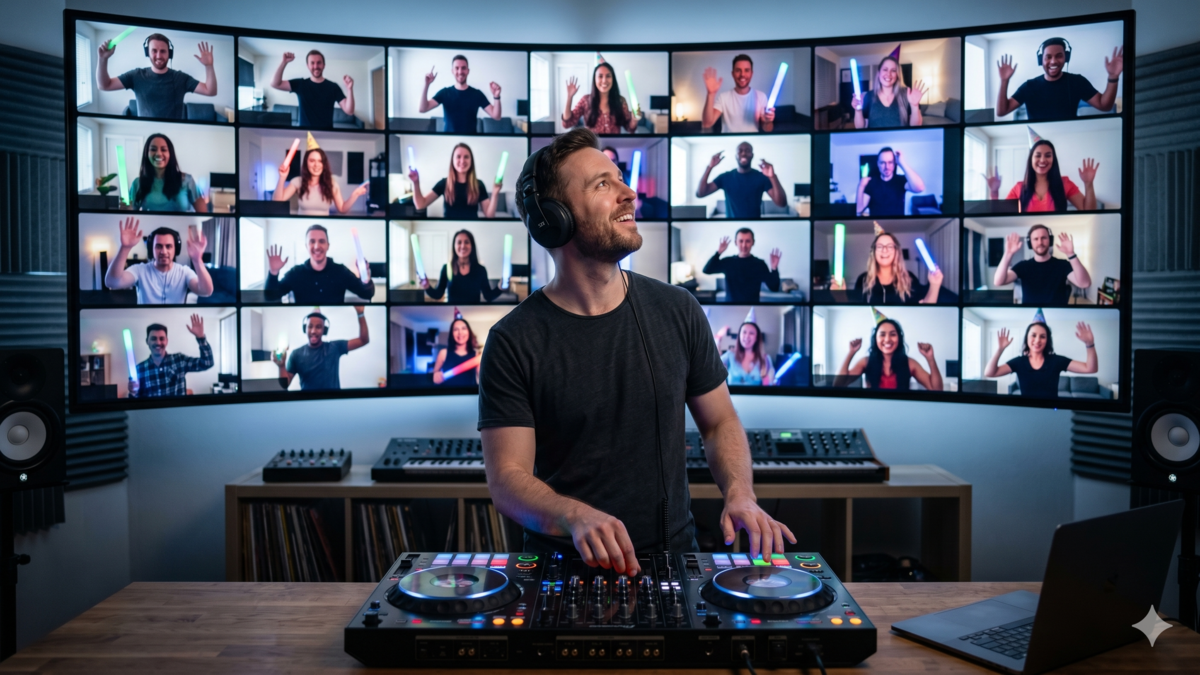
I remember the specific quality of the disorientation the first time I watched a DJ I respected play a genuinely great set from what was clearly a spare bedroom. There was something cognitively unresolvable about it — the music was right, the energy was there, the mix was tight — but the backdrop was someone’s IKEA bookshelf and a ring light that created this strange halo effect, and my brain kept insisting that the context was wrong even as the music kept insisting it wasn’t. That was 2020, maybe early 2021. It felt provisional. Temporary. Like we were all collectively agreeing to pretend this was a reasonable substitute for something else, while we waited for the something else to come back.
What I didn’t understand then — what I think most people didn’t fully grasp — was that it wasn’t a substitute at all. It was a different thing. A thing that would develop its own logic, its own production standards, its own relationship with audience and space that had nothing to do with trying to replicate the physical venue experience. And by 2026, calling remote performance and digital events a “significant portion of the professional DJ’s calendar” is actually underselling it. For many DJs — especially those operating internationally, or building audiences across multiple markets, or simply taking seriously the idea that your reach shouldn’t be bounded by venue capacity — it’s central. Not peripheral. Central. The complete picture of what this means for craft and career is mapped out in our guide on DJ Career Growth & AI Tools, but the specific layer I want to focus on here is AI — which has moved from the margins of this conversation to its structural core.
Virtual DJing itself isn’t new. Software like Virtual DJ and Serato existed decades before any of this became urgent. The digital mixing infrastructure was already there. What the early 2020s forced — rapidly, without the luxury of gradual adoption — was scale. Physical venues inaccessible, performers and audiences both suddenly confronted with the question of whether a digital stage could be a real stage. The early answer was messy. Latency issues that made timing feel unreliable. Audio dropouts that interrupted sets at the worst moments. Visual setups ranging from genuinely impressive to deeply makeshift. The New York Times’ coverage on the future of work documented this kind of rapid pivot across industries, and the DJ world was living the same forced experiment. But the demand didn’t disappear when the urgency did. It persisted. And persistence drove innovation — in platforms, in equipment, in the entire production infrastructure around remote performance — until what had been a temporary workaround calcified into a permanent, viable, increasingly sophisticated channel.
That’s the context in which AI entered this specific conversation. And its contributions are not cosmetic.
Audio Enhancement & Latency Mitigation
The foundational problem with remote DJing — the one that makes every other aspiration conditional — is audio fidelity and synchronization. All the creative ambition in the world is academic if the listener is hearing something that sounds like it’s being transmitted through a wet paper bag over an unreliable connection.
AI is doing substantive work here. Real-time audio processing that cleans environmental noise, applies adaptive EQ, compresses signals in ways that maintain quality rather than just reducing file size. The scenario that used to be genuinely frightening — network congestion causing packet loss mid-set — is now handled differently. Traditional systems degraded noticeably when this happened. AI-driven solutions predict the disruption before it fully materializes, employing predictive buffering and intelligent interpolation to smooth the gaps so the listener doesn’t experience them as gaps. Research from the Acoustical Society of America has demonstrated up to a 30% reduction in perceived latency and audio artifacts in AI-assisted streaming versus traditional methods under comparable network conditions. Thirty percent is — in a domain where the difference between good and professional is measured in small increments — a significant margin.
Automated Setlist Curation & Recommendation
This is where the virtual context creates a specific challenge that physical performance doesn’t have in the same way. In a room, you read the crowd. Constantly, unconsciously, through a hundred physical signals — movement, energy, where people are facing, the sound of the room itself. Remote performance strips most of those signals away. You’re performing into a camera and receiving, at best, a chat stream and some engagement metrics. Which is genuinely different information, requiring genuinely different interpretive skills.
AI assists by filling some of that perceptual gap with data-driven intelligence. It analyzes chat sentiment in real time, tracks viewer engagement metrics, incorporates geographical listener data to identify regional preferences that might shift what connects in a given set. If a significant portion of your live audience at a particular moment is concentrated in a specific region, the AI might flag tracks that historically perform well with that listener profile — not overriding your judgment, surfacing information your judgment can use. It identifies harmonically compatible tracks you might not have considered in the moment, suggests transitions with higher predicted resonance for the specific audience composition you currently have. Similar predictive analytics power the tools discussed in AI-Powered Social Media Strategies for DJs — the underlying logic of audience engagement prediction runs across multiple applications. What it gives back, ultimately, is attention — the attention that would otherwise be split between performing and frantically searching for the right track can go more fully into the performance itself.
Dynamic Visuals & Immersive Experiences
A virtual set without a visual dimension is radio with a camera pointed at your equipment. Which is fine, but it’s not — it’s not what the medium is capable of, and the gap between what’s possible and what most DJs are currently doing is wide enough to represent a real opportunity.
AI visual generators create reactive environments in real time, synchronized to the music’s tempo, key, and emotional register. The bass drop triggers pulsating light patterns. A melodic shift transforms the visual landscape. What was previously a static backdrop becomes something that breathes with the music — and more interestingly, something the audience can influence. Chat commands, emoji reactions, viewer inputs processed by the AI and rendered as immediate visual feedback. The set becomes a dialogue rather than a broadcast. The geographic barrier to feeling present in a shared space doesn’t disappear — I don’t want to oversell this — but it narrows in a way that changes the experience qualitatively, not just technically.
The operational requirements for all of this are worth naming honestly, because none of it works without proper infrastructure. High-bandwidth, stable connectivity — and not in a “probably fine” way, in a dedicated-fiber-or-high-tier-business-plan way, because lossless audio streaming alone consumes several megabits per second before you add video and AI processing overhead. Hardware that can handle the computational load: capable CPUs, dedicated graphics cards, audio interfaces with genuine low-latency performance. Software suites where AI modules are integrated as core components rather than afterthought plugins. This is a higher technical barrier to entry than plugging in CDJs, which is worth acknowledging rather than glossing over. Ongoing education — staying current as the systems evolve — is genuinely part of the work now.
Data security belongs in this conversation too. AI systems running virtual DJ events collect performance data, audience interaction metrics, musical preference profiles. Understanding how your chosen platforms store and use that information isn’t paranoia, it’s basic professional diligence. GDPR compliance and equivalent frameworks matter here, and the onus for verifying that a platform takes this seriously falls on the user, not just the platform.
The benefits, when the infrastructure is right, are genuinely transformative in scale terms. A traditional gig is bounded by venue capacity — maybe a few hundred people if you’re doing well, maybe a few thousand for exceptional circumstances. Virtual platforms remove that ceiling entirely. A DJ can perform simultaneously for audiences distributed across continents, with the kind of reach that builds brand exposure at a pace physical touring simply cannot match. New revenue models follow: ticketed livestreams, subscription access, virtual merchandise, direct fan support mechanisms timed to moments of peak engagement that AI helps identify. The creative freedom expands too — technical burdens handled by the AI leave more cognitive space for genuine artistic experimentation, for the kind of genre-blending and unexpected track choices that feel risky in a room but become explorations when the safety net of AI co-piloting is in place.
The challenges deserve equal honesty though. Over-reliance on AI in a live performance context is a real risk — the specific danger of sets that are technically impeccable and emotionally predictable, where the algorithm’s suggestions have gradually displaced the DJ’s instincts rather than augmenting them. The human connection that makes DJing matter isn’t a feature that can be automated into place. It’s the point, and it requires active protection. The chat stream full of fire emojis is not the same as reading a room, no matter how many engagement metrics surround it. Developing genuine intuition for digital audience response — learning to interpret what the data is actually telling you versus what it appears to be telling you — is a skill that takes time and isn’t solved by better algorithms.
Where this goes from here is — honestly, still being written. Deeper AI integration, more personalized virtual experiences that adapt to individual audience members in real time, persistent virtual venues in metaverse environments where a DJ’s presence has continuity across performances rather than resetting with each stream. The lines between physical and digital performance will continue to blur in ways that generate both opportunity and complexity simultaneously. As we explored in From Hobby to Career: Scaling Your DJ Business with AI, adapting to these shifts is increasingly what separates sustainable careers from stalling ones.
The practical guidance, distilled: invest in the infrastructure before worrying about the advanced features — your foundation defines your ceiling. Learn your tools at a level that goes beyond default settings; understand the AI’s capabilities and its limitations, both. Use the automation to enhance your workflow without letting it colonize your artistic judgment. Engage your digital audience with the same intentionality you’d bring to a physical room — respond to the chat, build interactive elements, make the technology serve connection rather than substitute for it. Monitor the data, but interpret it with the critical distance it deserves.
Virtual DJing augmented by AI is not a compromise version of the real thing. It’s a distinct performance context with its own demands, its own possibilities, its own developing aesthetics. The DJs building fluency in it now — technically, creatively, in terms of audience relationship — are the ones who will define what it becomes. The physical stage and the digital stage are not in competition. They’re parallel territories, each with its own rewards. For strategies on building the financial architecture around all of this: Securing Sponsorships and Brand Deals as a DJ with AI Insights covers the monetization layer in depth. The virtual stage is real. Learning to perform on it — properly, with everything that implies — is just the current version of mastering the craft.