
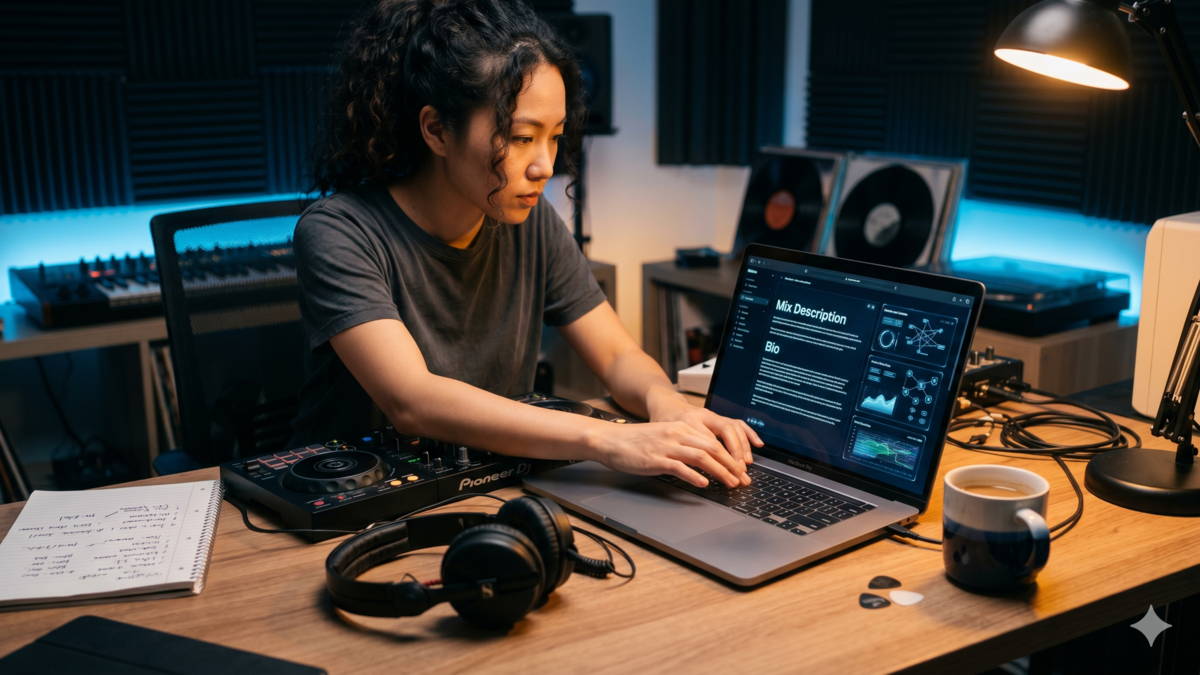
The particular agony of finishing a mix you’re genuinely proud of — hours of work, transitions that landed exactly right, EQ choices that elevated rather than just corrected, the whole thing flowing with a coherence you struggled to achieve and finally did — and then realizing you now have to *describe* it in words is something every DJ has experienced and nobody adequately prepares you for. You’re a sound person. You think in frequencies and rhythms and emotional arcs that exist outside language. And now you’re staring at a blank text field asking for a bio or a mix description, and the specific paralysis of knowing your sound but not knowing how to articulate it without sounding either generic or pretentious is — it’s genuinely, disproportionately stressful.
Most DJs are masters of audio, not prose. That’s not a personal failing, it’s just a mismatch of skill sets. But in 2026, that mismatch no longer has to be a bottleneck, because AI has become a genuinely useful assistant for generating the descriptive text that promotional work demands. Not replacing your voice — I want to be clear about that upfront, because the fear of sounding robotic or inauthentic is legitimate — but augmenting your capacity to communicate what you do in writing.
And the stakes are real here. Industry data from leading talent platforms shows profiles with detailed, engaging descriptions receive upwards of 30% more engagement compared to sparse entries. Mix descriptions that accurately convey mood and genre tend to achieve higher listenership retention. This isn’t abstract — these are observed patterns with measurable impact on who finds you and whether they stick around.
Crafting the Compelling DJ Bio with AI
Your bio is your sonic handshake, your first impression to anyone encountering you digitally — which is increasingly the first encounter, period. And for a lot of DJs, writing it has been an awkward, perpetually postponed task sitting in the “I should really update that” mental folder for months. You know your sound intimately. Translating that knowledge into the specific kind of promotional language a bio requires is a different skill entirely.
AI functions here like a sophisticated interviewer who never gets tired of revising. You provide the raw material — your primary genres, what makes your approach distinctive, your influences, notable gigs, the energy you bring — and the AI processes that against vast linguistic models trained on millions of artist statements and promotional texts, then generates options for you to work from.
The practical approach looks something like this: be specific with your inputs. Not “I play house music” — that tells the AI almost nothing useful. “Deep, soulful house with acid undertones, focusing on percussive grooves and extended breakdowns” gives the system something concrete to work with. Mention specific labels, clubs you’ve played, artists you’ve opened for. The granularity of your input determines the usefulness of the output. Define your brand voice explicitly — edgy? Sophisticated? Conversational? Professional? A DJ commanding premium corporate rates needs different linguistic texture than someone building an underground warehouse following. These are different registers, and you need to specify which one you want.
Then iterate. Generate multiple versions. AI rarely nails it on the first pass, but it produces raw material worth sculpting. Take the best phrases from different outputs, combine them, rephrase the awkward sections, inject the personal details only you would know to include. The AI provides the framework; you finish the structure. This approach dissolves the blank-page paralysis that stops most people from writing bios altogether.
Generating Engaging Mix Descriptions
A mix description is more than a tracklist — though a shocking number of DJs still just post the tracks and consider the job done. It’s a narrative invitation. It tells potential listeners what journey they’re being offered, sets the mood, evokes the specific experience you created. The difference between a mix that gets played once and forgotten and one that gets saved and returned to often lives in whether people understand what they’re getting into before they press play.
AI changes the economics of creating these descriptions. Feed it your tracklist, key BPM ranges, genre blends, notes on the emotional arc — “starts introspective, builds to euphoric peak around 30 minutes, then resolves into something contemplative” — and it weaves that information into actual prose using vocabulary that resonates with your target audience without you having to agonize over every word choice.
Genre fusion language is where this gets particularly useful. When you’re blending obscure sub-genres, finding the right descriptive vocabulary without either sounding generic or incomprehensibly niche is genuinely difficult. AI, trained on vast textual datasets, can suggest evocative combinations: “a journey through Detroit techno’s industrial severity, softened by the melodic sensibility of progressive house” — the kind of phrase that communicates clearly without flattening the complexity. Highlighting key moments within the mix becomes simpler too: “Notice the 17-minute mark, where a classic breakbeat dissolves into a modern synthwave passage” — directing attention to what you’re proud of without the self-consciousness that makes this hard to do in your own voice.
And SEO optimization, which sounds technical but is actually just — making sure the words you use match the words people search for. AI can suggest keywords and phrases that improve discoverability on Mixcloud, SoundCloud, your website, wherever the mix lives. The efficiency gain is substantial. What used to consume an hour of staring and second-guessing now takes minutes, returning time for making music. This mirrors the advantages discussed in scaling your DJ business with AI — administrative and promotional friction reduced, creative and client-facing energy preserved.
Best Practices for AI Integration
Using AI for descriptive content requires active engagement, not passive acceptance of whatever the system produces. It’s a tool. Like any tool, the results depend substantially on how you use it.
Master prompt engineering — the skill of writing clear, detailed instructions that produce useful outputs. Think of it as directing a human assistant: vague commands produce vague results. Define your purpose, target audience, desired tone, approximate length, and the specific information points you want covered. Experiment with different phrasings. This is genuinely a skill worth developing in 2026; the gap between people who can prompt AI effectively and those who can’t is producing increasingly visible differences in output quality.
Human oversight is non-negotiable. AI generates text, but it doesn’t possess lived experience, genuine emotion, or the intuition that makes writing feel personal rather than algorithmic. Always review, edit, personalize. Your unique voice must come through. Unedited AI text tends toward a specific kind of competent blandness that’s recognizable once you know what to look for. The authenticity is what you add.
Use the AI output as foundation, not finished product. Consider it a strong first draft or a brainstorming partner. It provides structures, vocabulary, sentence templates you might not have considered. You build on that foundation — injecting personality, correcting factual errors, ensuring everything aligns with your actual brand rather than a statistically probable approximation of it.
And ethical considerations: don’t just copy-paste. Use AI to inspire and accelerate your writing process, not to plagiarize or produce content that doesn’t actually represent you. Your authenticity is the irreplaceable asset. The AI is a tool for expressing that authenticity more efficiently, not a substitute for having something authentic to express.
The industry is evolving fast, and competitive advantage increasingly goes to DJs who understand how to use these tools strategically. The comprehensive picture of how all these technologies interconnect is at DJ Career Growth & AI Tools, but the specific layer of promotional content generation deserves attention because it’s one of the highest-leverage applications: small time investment, disproportionate impact on discoverability and audience growth.
The ability to articulate your brand and your work effectively isn’t a luxury. It’s infrastructure for market visibility and attracting the engagements you actually want rather than just the ones that happen to find you. NielsenIQ’s Media & Entertainment analysis consistently emphasizes the importance of digital presence and engaging content in audience capture — a principle that applies directly to independent DJs competing for attention in saturated markets. And broader analyses like Harvard Business Review’s coverage of generative AI underscore the strategic value of well-crafted descriptive content across creative industries.
AI becomes another instrument in your creative arsenal — alongside the decks, the mixer, the production software. An extension of your marketing capacity, available whenever you need it. The DJs who embrace this thoughtfully, who learn to direct AI toward outcomes that serve their specific artistic vision rather than just accepting generic outputs, are the ones building sustainable visibility in an environment that rewards both quality and volume. Less time struggling with words. More time delivering the sets that make the promotional work worth doing in the first place. That’s the actual value proposition, and it’s available now.