
AI for Event Promotion: Driving Attendance for Your DJ Gigs
There’s a specific kind of pre-gig anxiety that has nothing to do with your set and everything to do with the question: will anyone actually show up? You’ve booked the venue, confirmed the date, put together a set you’re excited about — and now you’re staring at advance ticket numbers that are, let’s be generous, underwhelming. The promotional work you did — the social posts, the email blast, the ad budget you allocated based more on hope than strategy — feels like shouting into a void that occasionally shouts back but mostly just absorbs your efforts without visible reaction. This particular stress, the gap between the event you’ve planned and the attendance you need to justify having planned it, is something every working DJ knows intimately and nobody really teaches you how to manage systematically.
In 2026, though, the competitive landscape demands more than just posting a flyer and hoping the algorithm favors you. Getting people through the door, consistently, across different venues and different nights and different seasons, is what separates sustainable careers from perpetual hustle without traction. And AI — which I know sounds like a buzzword until you actually see what it does for attendance figures — offers a tangible, data-driven alternative to the guesswork that defines most event promotion. It’s not magic. It’s precision where there used to be approximation. The full strategic picture is at DJ Career Growth & AI Tools, but let’s focus specifically on the promotional layer, because this is where small improvements compound into genuinely different attendance outcomes.
Understanding Your Audience: Precision Targeting with AI
Traditional event promotion is basically spray-and-pray. You post across social platforms, buy a few ads with rough demographic targeting, maybe send an email to your list, and hope the combination reaches enough of the right people at the right moment. This works sometimes. It also fails unpredictably, and the failure is expensive both in money spent and opportunity cost of the event that could have filled if the promotion had been smarter.
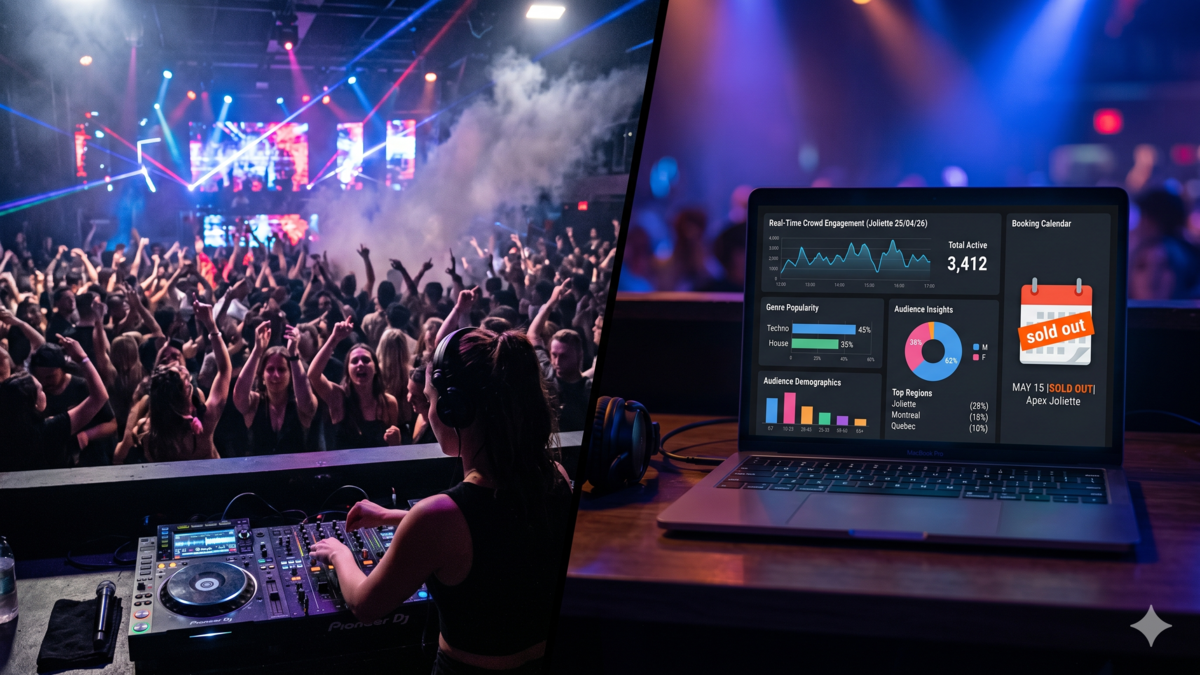
AI replaces the guessing with analysis. It ingests vast datasets — past ticket sales, social media engagement patterns, streaming service listening habits in your geographic area, even publicly available movement data for specific demographics — and builds detailed audience segments that wouldn’t be visible to manual analysis. An AI system might identify, for instance, a cluster of 25-34 year olds within a 10-mile radius of the venue who frequently engage with tech-house artists on Instagram, stream comparable genres on Spotify, and attend live events twice monthly, typically on Fridays. That’s not a broad demographic guess — it’s a specific, behaviorally-defined audience segment you can target with surgical precision.
The value isn’t just knowing who they are. It’s knowing where to find them, what messaging resonates, when they make purchase decisions. You allocate promotional budget to the channels and formats that statistically convert for that specific segment rather than spreading it thin across generic placements. This is probabilistic modeling applied to the concrete problem of filling a room, and the difference in return on ad spend can be — honestly, it can be dramatic enough to feel slightly unfair to DJs still promoting the old way.
Crafting Compelling Narratives: AI-Assisted Content Generation
The message itself matters as much as who sees it — maybe more, because the right message to the wrong audience wastes less money than the wrong message to the right audience. Writing compelling ad copy, designing visuals that stop the scroll, creating video snippets that communicate energy and vibe — all of this takes time and creative energy that’s in finite supply when you’re also, you know, actually being a DJ.
AI compresses this production timeline substantially. NLP models — the advanced language systems available in 2026 — can draft multiple ad copy variations from a handful of inputs: genre, venue, headliner, desired atmosphere. It produces options with different hooks, different calls to action, different tonal registers. You select, refine, combine the best pieces. Visual generation tools work similarly — input branding guidelines and event details, receive social banners, flyer designs, even short animated clips. Not necessarily final-quality without human refinement, but solid starting points that reduce production time from days to hours.
And the real advantage is iteration speed. AI lets you test different content variations against specific audience segments rapidly, see what performs, double down on what works. The feedback loop that used to take weeks — post something, wait for data, adjust strategy, repeat — now runs in days or even hours. This velocity of learning is genuinely valuable when promotional windows are tight.
Strategic Outreach and Scheduling: Automating Engagement
Getting the right message to the right person matters. Getting it to them at the right *time* — when they’re actually receptive rather than distracted or overwhelmed — is what converts attention into tickets.
AI handles this timing optimization at a scale manual effort cannot match. Automated email campaigns, social posts, SMS reminders become targeted interventions scheduled based on predictive models of when specific audience segments are most active, most receptive to booking decisions. It accounts for time zones, past engagement patterns, local event calendars to avoid competitive conflicts. The system learns that a particular segment tends to purchase Friday night tickets between Tuesday and Wednesday afternoons, and schedules personalized outreach accordingly.
The precision here is — I’ve seen the conversion rate differences firsthand and they’re significant. A major marketing automation firm’s late 2025 study found AI-driven personalized outreach saw roughly 30% higher click-through rates versus manual, untargeted campaigns. That’s not marginal. That’s the difference between an event that hits capacity and one that doesn’t quite fill.
Performance Analysis and Iteration: Learning from Every Gig
Every event generates data. Most of that data goes unused because extracting actionable insight from it manually is time-consuming enough that it rarely happens. AI thrives specifically on this kind of post-event analysis.
After a gig, the system compiles comprehensive performance reports: attendance figures, ticket source attribution, ad spend efficiency by channel and creative, social engagement rates, demographic breakdowns of who actually showed up versus who you targeted. But more importantly — it identifies correlations and causal relationships. Which ad creative worked best with 18-24 year olds in downtown areas? Did Instagram stories outperform Facebook ads for this specific genre? What was the conversion rate from email versus paid social?
These insights feed back into the system, continuously refining future promotional strategy. Each event makes the next one smarter. This iterative learning is probably the single most powerful aspect of AI in promotion — it’s a feedback loop that compounds. You’re not starting from scratch with each event; you’re building on accumulated intelligence about what works for your specific audience and your specific sound. For DJs interested in how this analytical capability extends to broader online visibility: Optimizing Your DJ Online Presence with AI SEO Tools covers the connected territory.
Predictive Analytics: Anticipating Success
Beyond analyzing past performance, AI projects forward — anticipating likely outcomes based on historical patterns across thousands of comparable events. It considers DJ lineup and genre, day of week and time of year, local competitor events, weather forecasts, economic indicators, past performance of similar events at the specific venue. Then it provides data-backed recommendations not just for promotion but for event planning itself.
It might suggest a different night for your niche genre based on patterns showing 15% lower attendance on Tuesdays versus Thursdays historically. Or advise against a particular date due to a confluence of negative factors — competing events, poor weather forecast, local economic data suggesting reduced discretionary spending. This moves AI from promotional tool into strategic partner for the entire event conception. And knowing, with statistical confidence, what’s likely to work before you commit resources — that changes the risk profile of booking decisions substantially.
Implementation and Best Practices
Adopting AI for promotion isn’t passive. It requires thoughtful implementation and ongoing oversight.
Data hygiene matters more than people initially realize — the accuracy of AI outputs correlates directly with input data quality. Ensure customer lists, past event data, social analytics are clean and properly structured. Garbage in, garbage out applies universally. Human oversight remains non-negotiable — AI generates content and suggests strategies, but it lacks intuition and the creative spark that makes promotional material feel genuinely engaging rather than algorithmically competent. Review everything. Adjust to align with your actual brand voice and the specific vibe of each event.
Ethical considerations deserve real attention, not just pro forma acknowledgment. Data privacy, transparent collection practices, adherence to GDPR and CCPA aren’t optional. For deeper exploration of the ethical dimensions: The Ethics of AI in DJing: Copyright, Creativity & Future. And budget allocation requires strategy — AI tools range from free basic options to sophisticated enterprise platforms. Understand your specific promotional challenges and start with tools that address those before expanding.
The Future Is Now: AI as Your Promotional Partner
The promotional landscape has fundamentally shifted. Relying on intuition alone, or basic social media blasts without targeting intelligence, is leaving capability on the table in ways that compound into genuinely different career trajectories over time. AI provides the precision, efficiency, and learning capacity to consistently fill venues and build loyal audiences — transforming promotion from guesswork into data-informed strategy.
McKinsey’s late 2025 analysis demonstrated a 22% increase in ROI for marketing campaigns incorporating advanced AI analytics and personalization (McKinsey & Company) — tangible financial benefit that translates directly to the DJ context. The DJs who understand these tools and integrate them strategically are the ones packing floors year after year. The question isn’t whether AI plays a role in promotion — it already does, for anyone using modern marketing platforms — but how effectively you direct it toward your specific goals.
Maximize attendance. Use the data. Control more of the variables that used to feel uncontrollable. For the complete picture of how this fits into comprehensive career strategy: DJ Career Growth & AI Tools.
**Sources:**
– McKinsey & Company – AI in Marketing: The Big Opportunity
– Wikipedia – Predictive Analytics