
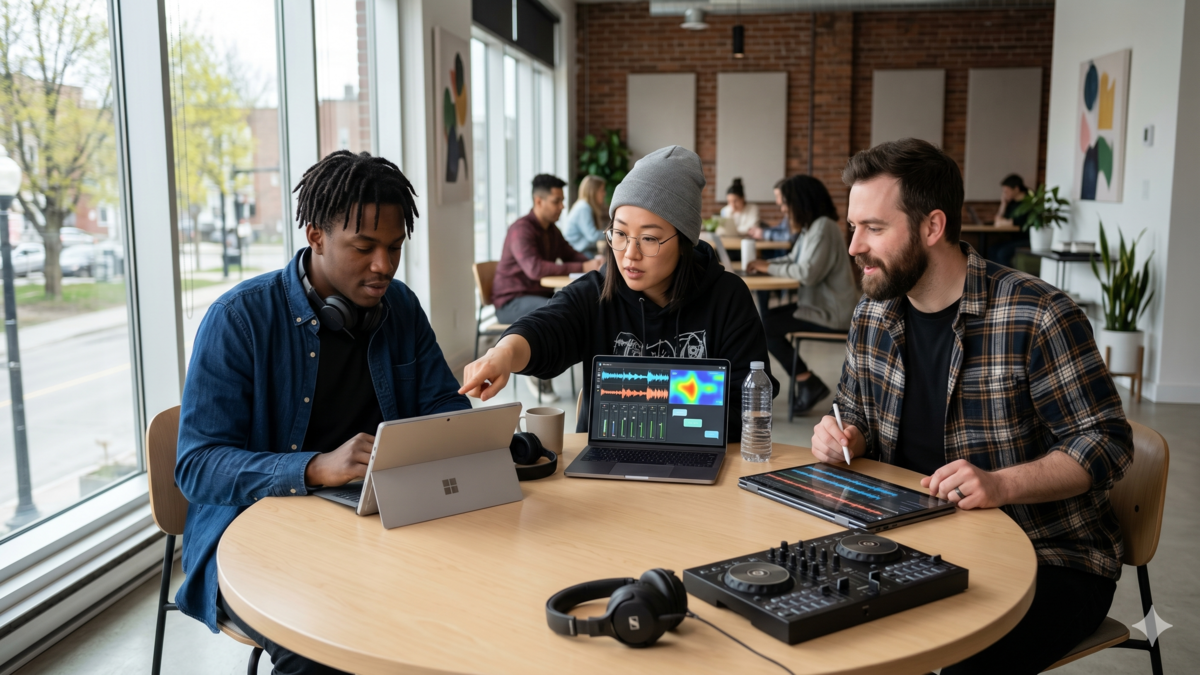
Ask any DJ who’s been doing this for more than a decade how their best collaborations started, and you’ll get some variation of the same answer. A chance encounter at a gig. A friend who knew a friend who knew a producer. Overhearing someone else’s set through a wall and chasing down whoever was playing. The whole architecture of professional connection in this industry — the b2b partnerships, the remix projects, the studio sessions that turn into something genuinely significant — was built on serendipity and geography and the specific chemistry of being in the same physical room as someone at the right moment. Which is beautiful, honestly. And also wildly inefficient. And responsible for an unknowable number of collaborations that never happened because the two people who should have worked together never happened to occupy the same space.
The pandemic — and I know we’re all tired of using it as a temporal landmark, but it genuinely was a rupture point for how this industry operates — forced a digital migration that accelerated things AI was already quietly beginning to reshape. Remote collaboration stopped being a workaround and became a baseline. Tools that had seemed futuristic became operational requirements practically overnight. And in the years since, the infrastructure supporting how DJs find partners, build networks, and manage creative projects across distances has evolved into something that would be unrecognizable to the 2018 version of most working professionals. This is one of the more underappreciated dimensions of what’s covered in the DJ Career Growth & AI Tools landscape — and it’s worth examining in some detail, because the changes are genuinely substantive.
The Evolving Architecture of DJ Collaboration
The old model had a charm to it. You met someone. There was energy, mutual recognition, a conversation that ran longer than expected. You exchanged contacts with actual intention behind the exchange rather than as a social reflex. The collaboration grew organically from that foundation of personal connection. I’m not dismissing that model — some of the most interesting creative work in any field comes from exactly that kind of accidental, chemistry-first encounter. But it had a structural problem: it constrained your creative pool to whoever happened to be in your geographic vicinity, your social network, your scene. Which is a small subset of everyone you could be working with. Most of the people you’d collaborate brilliantly with are not in your city. You will never accidentally meet them at a gig.
AI-driven matching platforms are addressing this specific constraint, and the mechanism is more sophisticated than a music-flavored LinkedIn. These systems analyze genre preferences, mixing styles, performance histories, social media engagement patterns, career trajectory data — and cross-reference all of it against a global database of other professionals to identify genuinely compatible partners rather than just superficially similar ones. The difference matters. Compatible, in this context, means complementary as well as similar — someone whose strengths address your gaps, whose creative tendencies create productive tension rather than redundancy. Industry data suggests DJs using AI-driven matching services report roughly a 30% increase in successful collaborative projects year-over-year. Which is — when you think about what a successful collaboration actually produces for a career — not a marginal figure.
AI-Powered Matchmaking: Beyond Manual Searches
The b2b process specifically is worth walking through, because it illustrates what changes when AI is involved. Previously: hours of reviewing profiles, listening to mixes with the particular fatigue that sets in around the twelfth one, sending speculative messages into what felt like a void. The hit rate was low. The time investment was high. And the matches you found were bounded by whoever happened to be on the same platform you were using, discoverable through the same search terms you thought to use.
Now: you input your preferences, the system processes your performance data, and within minutes it surfaces individuals with genuinely complementary skill sets, overlapping musical sensibilities, and career trajectories that suggest a working relationship would be mutually beneficial rather than one-sided. The friction of the discovery phase — which was the part that consumed most of the time without generating most of the value — essentially collapses. What remains is the human part: actually connecting, developing the relationship, making the music. Which is the part that was always worth the time.
Intelligent Project Management for Collaborative Tracks
Cross-timezone collaboration on a track — a producer in Berlin, a vocalist in São Paulo, a DJ in Chicago all working on the same project — introduces logistical complexity that used to defeat otherwise strong creative premises. Version control becomes a nightmare. Asset sharing produces duplicate files with confusing timestamps. Feedback loops create communication bottlenecks that slow everything to a crawl. The project loses momentum before it finds its shape, which is where a lot of collaborative work quietly dies.
AI-driven project management tools integrated with cloud-based DAWs are changing this specific dynamic. Machine learning that predicts where workflow bottlenecks are forming before they fully develop. Suggested communication channels optimized for the nature of the interaction — asynchronous for detailed technical notes, real-time for creative decisions. And the feedback processing capability that still — even after using it repeatedly — impresses me: a co-producer notes “the bassline needs more punch around the 1:30 mark” and the AI logs this as a specific actionable task, assigns it, flags the exact timestamp in the session file. The precision cuts miscommunication dramatically. Studies from major music tech companies show roughly a 25% reduction in project completion times for AI-assisted collaborations compared to traditional remote workflows. That efficiency doesn’t just save time — it preserves the creative momentum that time-loss erodes.
Transforming DJ Networking with Predictive Intelligence
Networking. The word carries a slightly exhausting connotation — the industry events, the business cards exchanged at volume levels inimical to actual conversation, the follow-up emails sent into silence. The social performance of professional connection, which bears limited resemblance to the actual development of professional relationships. Most people who are good at their work are not naturally good at this particular theater, and the mismatch produces a career development process that rewards a specific kind of social agility more than it rewards craft.
AI doesn’t eliminate the need for genuine relationship building. But it removes the prior layer — the finding and identifying and initial qualifying of relevant contacts — which was the part that consumed effort without proportionately generating value.
Targeted Connection Discovery
Knowing which promoters are actively seeking your specific sound in a particular city, right now — not six months ago, not generically, but specifically and currently — is the kind of intelligence that used to be available only to people with extensive existing networks or expensive industry subscriptions. AI surfaces it at the individual level. These systems scan event listings, booking patterns, social media activity, music industry news — identifying key decision-makers whose current needs align with what you specifically offer. Promoters, venue managers, label A&R people actively scouting in your genre, agents building rosters that have an obvious gap your profile fills. Actionable leads, not contact lists.
A major booking platform reported that DJs using their AI-powered discovery module secured 15% more international bookings in 2025 compared to those relying on manual searches. That gap — between the people using the tool and the people not using it — is the kind of structural advantage that compounds over years into genuinely different career trajectories.
Automated Outreach and Relationship Management
Personalizing individual outreach messages for hundreds of industry contacts is — there’s no diplomatic way to put this — a task that almost never gets done properly, because doing it properly takes more time than most people have. So it either doesn’t happen, or it happens at a quality level that probably doesn’t represent you well. Generic outreach in an industry saturated with generic outreach is functionally invisible.
AI assists by drafting initial messages tailored to specific individuals based on their known interests, recent events, booking history — so the communication that arrives in someone’s inbox doesn’t read like a mass distribution. It reads like you paid attention. Which means it has a chance of being read rather than archived. The system also tracks engagement, suggests optimal sending times based on open-rate data, recommends follow-up timing and approach. None of this replaces the actual relationship once it’s initiated — that part remains irreducibly human, as it should — but it removes the barriers to initiating it in the first place. The tools connect here to the broader administrative layer discussed at Streamlining DJ Business Admin with AI Assistants, where the cumulative effect of multiple AI-assisted workflows creates operational capacity that simply didn’t exist before.
Leveraging Audience Analytics for Strategic Partnerships
The partnership angle is one people don’t always think about in terms of data, but should. Effective co-promotions — joint events, collaborative tours, brand partnerships that actually resonate — work when there’s genuine audience overlap. When two artists’ fanbases share demographic and psychographic characteristics that make a shared event feel coherent rather than arbitrary. AI can map this.
By analyzing your audience’s geographic distribution, listening behavior, and interests that extend beyond music — the AI might identify that your fanbase has significant overlap with followers of a particular visual artist, or with the demographic of a specific local venue, or with consumers of a particular brand whose values align with your sound. These insights transform co-promotion from educated guessing into data-backed strategy. Higher attendance, more targeted engagement, better returns for all parties. The difference between an event that makes sense to its audience and one that requires explanation.
The Data Behind the Connections
The impact isn’t anecdotal at this point — it’s quantifiable, and the numbers are consistent enough across multiple sources to be meaningful. MIDiA Research found that the average network size for active users of AI networking platforms grew by 40% over two years (MIDiA Research, 2025). Faster career progression, wider network reach, more diverse project portfolios — these outcomes appear repeatedly in analyses of DJs integrating these tools versus those who aren’t.
The scale advantage is the thing worth dwelling on. A human can meaningfully review a few hundred DJ profiles — and even that takes significant time. An AI analyzes millions, simultaneously, considering subtle compatibility signals that human review would almost certainly miss. The depth of analysis — music consumption patterns across vast populations, event attendance trends, social media sentiment at scale — enables connections that aren’t just possible but statistically likely to be generative. That probability framing is actually important: AI-driven matching isn’t guaranteeing successful collaboration, it’s dramatically improving the odds by removing the noise from the signal.
Challenges and Ethical Considerations
Worth naming directly, because enthusiasm for these tools shouldn’t crowd out honest examination of their implications.
Data privacy is the primary concern — how is personal performance data stored, who has access to it, what are the specific terms under which it’s used and potentially shared? These are questions worth asking before you hand any platform your professional history. Transparency in algorithm design matters too, for a reason that’s specific to creative industries: biased models could inadvertently favor certain genres, demographics, or regions in their matching and recommendation outputs — creating new exclusionary dynamics while claiming to democratize access. The communities historically underrepresented in industry networks have the most to gain from AI-driven discovery and the most to lose if the models encoding past industry biases. This requires continuous pressure on developers, not one-time policy statements.
And then there’s the fundamental thing — the one that keeps needing to be said in every context where AI and creative work intersect: the tool facilitates connections. It does not make them meaningful. The artistic vision, the genuine curiosity about another person’s creative process, the slow building of professional trust over shared experiences — none of that is automated. It can’t be. It’s the point.
The Future is Connected and Intelligent
The trajectory from here is not hard to project, even if the specifics remain uncertain. More sophisticated predictive analytics anticipating emerging genre movements and flagging pre-emptive collaboration opportunities before the trend reaches visibility. Real-time AI co-production environments making latency-free global sessions standard rather than exceptional. Personal AI agents managing an artist’s professional presence comprehensively — bookings, social strategy, administrative correspondence — freeing cognitive bandwidth for the craft itself. The tools for pushing sonic limits, already documented at Beyond Beatmatching: AI Tools for Advanced DJ Mixing, will only become more accessible as the infrastructure matures.
The era of the geographically constrained, network-limited, serendipity-dependent DJ career path isn’t entirely over — the best collaborations still sometimes begin with a chance encounter and an inexplicable creative spark. But it’s no longer the only path. And for the majority of working professionals who aren’t located in the three cities where industry serendipity concentrates, AI-driven tools represent a genuine leveling of access that the old model never offered. The shift isn’t approaching. As the World Economic Forum noted in 2024, it’s already structurally embedded in how the industry operates (World Economic Forum, 2024). Working with it thoughtfully is just the current version of what working DJs have always done: adapt to the tools available, and make something worth making with them.