
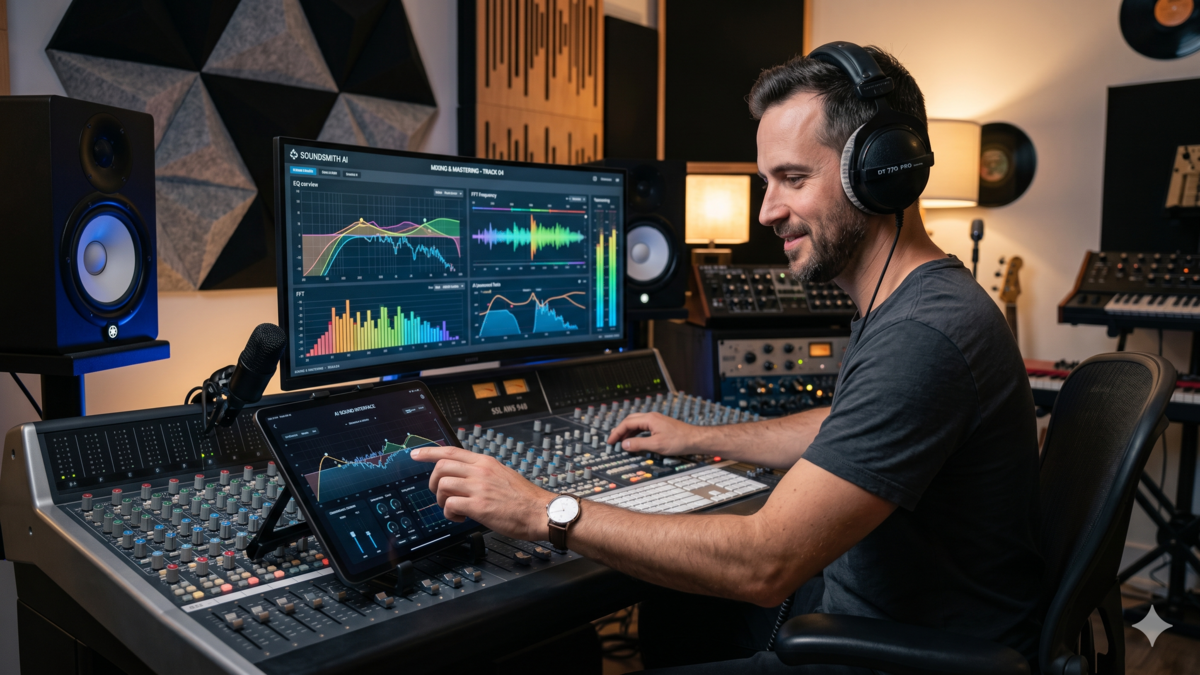
There’s a moment in every DJ’s development — usually happens around the third or fourth year, sometimes earlier if you’re paying close attention — where you realize that the technical quality of your sound matters more than you initially wanted it to. In the beginning, it’s all about track selection and energy and reading the room, and those things never stop mattering, obviously. But somewhere along the way you start noticing the difference between a set that sounds *good* and one that sounds *professional*, and that difference lives almost entirely in the invisible layer of sound engineering that most audiences never consciously register but absolutely feel. For years — decades, really — achieving that professional sound quality required either deep technical expertise accumulated over countless hours, or the budget to hire someone who had it. The specific anxiety of knowing your mix isn’t quite right but not having the technical vocabulary to identify why, let alone fix it — that’s a DJ rite of passage I don’t think anyone enjoys.
By 2026, that equation has shifted in ways that are genuinely difficult to overstate. AI hasn’t eliminated the need for sound engineering knowledge, but it’s dramatically compressed the gap between “I can hear that something’s wrong” and “I can fix it with precision.” This isn’t replacement. It’s augmentation — tools executing complex analytical and corrective tasks with a speed and accuracy that used to be the exclusive domain of specialists. And it’s reshaping the entire workflow from studio preparation to live venue delivery in ways that feed into every other dimension of DJ Career Growth & AI Tools.
The AI Evolution in Audio: Not Just Buzzwords
Traditional audio processing — EQs, compressors, reverbs, the whole signal chain — operates on defined mathematical models. Predictable. Rule-based. You tell the compressor “reduce signals above this threshold by this ratio” and it does exactly that, every time, regardless of context. Which works, until the context matters in ways the static rule can’t accommodate.
AI introduces something categorically different: adaptive, learning systems that analyze vast libraries of audio and extract patterns that traditional signal processing simply cannot see. It’s the difference between following a detailed blueprint and having a system that can design and continuously modify blueprints based on what the specific audio material and acoustic environment actually need. This capability isn’t theoretical anymore — it’s operational across both controlled studio environments and the genuinely chaotic conditions of live performance.
Studio Applications: Precision and Efficiency
The studio is where you sculpt. Where the raw material becomes the thing you’ll actually play. AI has introduced a level of control and velocity here that’s changed the economics of production time.
Intelligent Mixing & Mastering Assistants
Dynamic EQ and spectral balance used to be a manual hunt-and-adjust process — you’d identify a frequency clash between, say, a kick drum and a bassline competing for the same low-mid space, then spend time carving out room for each element through a series of cuts and boosts that hopefully didn’t create new problems elsewhere. AI systems like those from iZotope RX (which have become genuinely impressive for intelligent audio repair) can analyze an entire track or set, identify these clashes automatically, and dynamically adjust frequencies in real time to maintain clarity for each element. Not static EQ — responsive, context-aware processing that adapts moment by moment.
Automated loudness and true peak management addresses a different pain point that’s surprisingly time-consuming: hitting the loudness targets for different platforms — streaming services, clubs, radio all have specific LUFS standards — while preserving dynamic range requires thousands of micro-decisions about compression and limiting. AI mastering assistants analyze the track, predict the final loudness, and apply appropriate processing to meet targets without the iterative back-and-forth that used to consume entire afternoons. Studies suggest this can reduce iteration cycles by 30-40%, which is — when you think about production schedules and creative momentum — substantial.
And the de-clipping and de-reverberation capabilities are borderline miraculous in a way that still catches me off guard. Old recordings, tracks pushed too hard, audio with problems you’d previously have considered unfixable — AI tools trained on massive libraries of clean and damaged audio can reconstruct clipped peaks and reduce excessive room reverb with accuracy that I honestly didn’t believe until I heard the results firsthand. On average, AI-powered de-noising achieves signal-to-noise ratio improvements of 6-10dB without introducing audible artifacts, which is a genuinely significant gain.
Beat Matching & Harmonic Analysis
The beatmatching pride thing is real — a lot of DJs, myself included for a long time, resist anything that feels like it’s automating the foundational skill. But the precision AI offers, particularly for complex transitions or rapid mixes where you’re juggling multiple considerations simultaneously, is worth setting the pride aside for. Advanced software that analyzes not just BPM but key, ensuring harmonic compatibility, suggesting ideal transition points, even recommending subtle pitch adjustments for perfectly in-key blends — this doesn’t replace the skill, it frees cognitive bandwidth for crowd reading and creative performance decisions. The accuracy of harmonic blending creates a smoother sonic journey that audiences feel even if they can’t articulate what changed.
Live Performance: Real-time Correction and Adaptation
Live venues are — there’s no diplomatic way to say this — acoustically hostile environments. Varying crowd densities change how sound behaves in the room. Different sound systems have different characteristics. The whole thing is a constantly shifting set of variables that even experienced sound engineers find challenging. AI is doing genuinely useful work here.
Real-time Acoustic Optimization
Room correction traditionally required serious time: generating pink noise, strategic mic placement, RTA analysis, manual EQ adjustments based on what the measurements showed. The process worked but was slow enough that it often didn’t happen properly, especially for smaller gigs. AI systems now perform multi-point acoustic analysis in minutes, identifying resonant frequencies and phase issues with a precision that’s difficult for human ears to match in real-time conditions. And they adapt as the room fills — the acoustic properties of an empty venue versus a packed one are dramatically different, and the AI adjusts continuously to maintain sonic integrity. Venue engineers report roughly 25% reduction in setup and calibration time using predictive AI acoustic analysis, which is meaningful when setup windows are tight.
Intelligent feedback suppression is solving a problem that’s plagued live performance since amplified sound became a thing. Traditional feedback suppressors just notch out frequencies where feedback occurs, which works but creates audible “holes” in the sound. AI-driven systems predict potential feedback loops based on mic placement, speaker output, and room resonances, then apply surgical, dynamic cuts only when actually needed. The result is cleaner, safer performance conditions without the sonic compromises of static notch filtering.
Adaptive Sound Delivery
This is the edge of what’s currently deployed, and where it gets genuinely interesting: AI analyzing crowd noise, movement patterns (infrared sensors are apparently being used in some high-end installations), even real-time social media sentiment to infer energy levels — and then using that data to inform subtle adjustments to compression, reverb, overall loudness. Creating a sonic environment that adapts to the collective mood of the room rather than remaining static. It’s a step toward performance as genuine dialogue rather than broadcast. This connects naturally to the visual dimension covered at Enhancing DJ Performance Visuals with AI Art Generation — the multisensory synchronization is where the full potential starts to become visible.
The Data Driving AI Audio
The systems only work because they’ve been trained on enormous datasets — millions of hours of professionally mixed tracks, live recordings, acoustic measurements from countless venues. The AI learns what “good” sounds like, what specific problems look like in frequency and time domain, and crucially, what interventions successfully fix those problems. This learning process is ongoing; the algorithms improve continuously as they process more data. Which means the tools available in 2027 will be measurably better than what’s available now, which is already measurably better than what was available two years ago.
The Human Element: Still Indispensable
Here’s the thing that needs saying clearly, because the enthusiasm around these tools can accidentally obscure it: the DJ and the human sound engineer remain absolutely critical. AI is extraordinary at analysis, calculation, execution. It’s genuinely bad at intuition, artistic intent, and the subjective judgment that makes the difference between technically correct and genuinely exceptional. An AI can identify and correct an acoustic problem with surgical precision. It cannot decide whether a specific amount of compression makes a track “feel” more aggressive in the exact way you’re aiming for. It can analyze harmonic compatibility across your entire library. It won’t spontaneously choose to mix two seemingly incompatible tracks because you believe, from experience and instinct, that the emotional impact will land.
The creative vision, the understanding of what this specific crowd in this specific venue on this specific night needs — that’s irreducibly human. What’s changing is our role: from manual execution of every technical detail to intelligent supervision and creative direction. We set the parameters. We make the final calls. We direct the AI’s capabilities toward outcomes that align with artistic intent the algorithm cannot perceive. The discussion often touches the territory explored in The Ethics of AI in DJing: Copyright, Creativity & Future — the importance of maintaining human agency in creative decisions even as the tools become more capable.
The race car analogy is imperfect but useful: advanced traction control, adaptive suspension, intelligent braking systems make the car more capable. But the driver — their skill, their instincts, their feel for the track and the competition — is what wins. AI is the advanced system. The DJ is the driver. Both are necessary. Neither is sufficient alone.
Challenges and Future Outlook
The technology isn’t without legitimate problems that deserve more than glossing acknowledgment. Latency in live systems requires constant optimization — any perceptible delay between input and processed output is unacceptable in performance contexts. The computational demands are genuinely high, requiring hardware investments that smaller operations may struggle to justify. And the ethical questions around data ownership, intellectual property rights when AI has touched the processing chain, algorithmic bias in what the systems consider “good” sound — these are ongoing conversations without settled answers. Who owns the sound created with substantial AI assistance? The industry is actively wrestling with this, not ignoring it.
Looking forward, the sophistication trajectory is steep. Predictive models that anticipate crowd reactions to specific sonic elements and pre-emptively adjust the mix. Personalized soundscapes where individual listeners in a venue experience slightly different sonic profiles optimized for their hearing and location within the space. This isn’t speculative — prototypes exist. The convergence with spatial audio frameworks like those detailed in AES Technical Document TD1007 on spatial audio promises dimensions of immersive sound experience that current stereo delivery can’t approach.
Conclusion
AI-assisted sound engineering in 2026 is operational reality, not future promise. It offers precision, efficiency, and adaptive capability that fundamentally changes what’s achievable within the time and budget constraints most DJs operate under. From studio mastering to live acoustic optimization, AI refines the delivery of sound in ways that reduce technical barriers and expand what’s possible. But the mastery — the thing that makes a performance memorable rather than merely competent — still resides with the human directing the tools. AI makes us better engineers, more efficient producers, more capable performers. It extends our expertise; it doesn’t substitute for our craft or our judgment. Use these tools. Learn them properly. But remember that the human ear, the human heart, and the human connection to an audience — those remain the irreplaceable core of what makes this worth doing.