
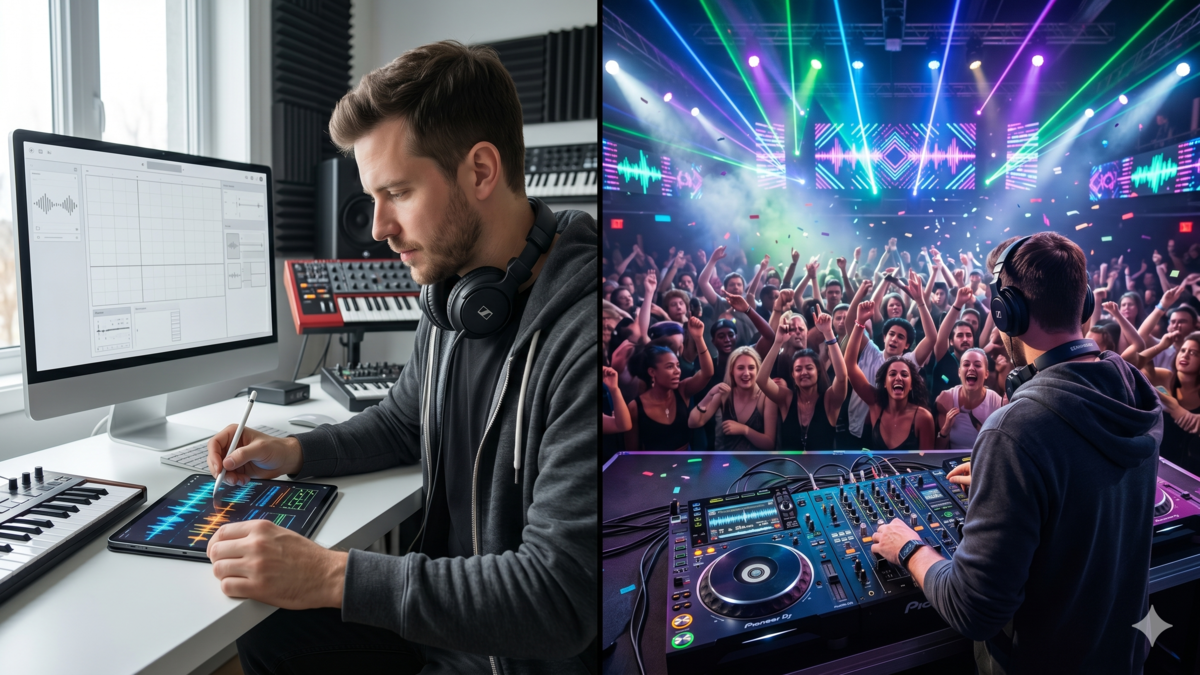
Okay so I need to tell you about the night everything changed for me, production-wise. And I know that sounds dramatic — “the night everything changed” — but bear with me because it genuinely was, and it happened in the most anticlimactic setting imaginable: 1:30am, cold tea, a DAW session that had been open for four hours and contained exactly one synth patch and nothing else. You know that specific creative paralysis where the blank arrangement window just stares at you? Where you’ve got *something* — a texture, a mood, a vague sonic intention — but the path from that something to an actual track feels like trying to cross a canyon on a tightrope in the dark? Yeah. That. I’d been living in that particular canyon for most of a month, and the music that was supposed to be inside me had apparently decided not to show up.
Then I tried AI music generation properly, for the first time, not just dabbling — and I want to be careful here because “it changed my life” is the kind of language that immediately makes me distrust whoever is saying it, but also, it kind of changed my life. At minimum it changed my Tuesday at 1:30am, which at the time felt equivalent. This is a fundamental part of where creative practice is heading — The Future Landscape: AI’s Impact on DJ Culture — and the honest version of that story is messier and more exciting than the marketing suggests.
From a Whispered Idea to a Full-Blown Banger: My AI Journey
Here’s what actually happened. I had this synth patch — ethereal, a little cold, the kind of sound that implies a track without quite being one. No rhythm presenting itself. No melody materializing. Just this floating, ambient thing that clearly wanted to be something and wasn’t communicating what. So I took four bars of it, dropped it into an AI music generator, typed “dark, driving techno with a melodic lead” into the prompt field, and pressed go with the specific low-expectation energy of someone who has been disappointed by software before.
What came back was — I want to say “insane” but that’s imprecise — genuinely surprising in a way that reset my expectations for the session and, honestly, for subsequent sessions. Several variations. One of them had this syncopated drum pattern that I would not have written because it wouldn’t have occurred to me to write it. A bassline that locked into my synth patch with a compatibility that felt almost suspicious, like the AI had listened to the patch rather than just processing it. A melodic top-line — spare, slightly melancholic — that fit the original sound so naturally it seemed like it had always been there, waiting. I tweaked some MIDI notes. Swapped a drum sample. Adjusted a level or two. The core of a track that would have taken me days to even sketch was sitting in my session in minutes.
I want to be precise about what that felt like, because it wasn’t the creative surrender some people imagine when they picture AI-assisted production. It felt like — you know when you’re trying to remember a word and someone says it, and the relief isn’t that they thought for you but that the obstruction cleared and your own thinking could resume? Like that. The AI removed the block. What happened after was still mine.
Building the Beat: Your Rhythmic Wingman
Drum patterns. Every DJ-producer has their defaults — the 909 configurations they return to, the shuffle feel they know works, the hi-hat patterns that feel like home. And the defaults are defaults because they’re good. But defaults are also, by definition, familiar, and familiar accumulates into predictable faster than you’d like. The challenge is generating genuinely fresh rhythmic material without just randomly assembling elements and hoping something clicks — which is tedious in the specific way that randomness-as-strategy always is.
AI is remarkably good at this particular problem. Feed it a kick pattern, a groove reference, a mood descriptor, and it generates variations — a dozen of them, different enough to be genuinely distinct, similar enough to be usable. Some will be immediately deployable. Some will be too strange for the current project but will open a door you file away for later. A few will suggest rhythmic directions you’d never have arrived at through habitual practice, which is arguably the most valuable category of all. It’s the session drummer analogy — not a session drummer replacing your judgment, but one generating raw material for your judgment to work on. You’re still selecting, directing, discarding, choosing. The initial generative labor just isn’t yours anymore. For DJs always digging for distinctive sounds, this connects naturally to how AI in Music Curation Platforms: Reshaping How DJs Discover Tracks has changed the discovery side of things — same principle, different application.
Sonic Alchemy: Transforming Sounds with AI
This is — okay, this is the part I find most genuinely difficult to explain without sounding like I’m overselling it, but I’m going to try because the practical reality is worth communicating.
I had a vocal chop. Liked the energy, the rhythmic character of it. But it was dry in a way that wasn’t minimal-chic, just dry in a way that meant it sat wrong in the mix, contributed nothing to the texture around it. Ran it through an AI audio processing tool with the description “more grit, metallic reverb, subtle pitch variation every four bars.” And here’s the thing — it didn’t just add effects in the way that selecting presets adds effects. It seemed to interpret the request in relation to the source material. The output had grit that felt like it belonged to the original rather than having been applied to it. The reverb had a metallic quality that enhanced the vocal’s existing character rather than obscuring it. The pitch variations appeared at musically meaningful moments. The chop became something I could actually use and — more than that — something that changed the entire mood of the breakdown it sat in.
Another instance. Deep house project, wanted a specific pad — warm, analog-feeling, textured in a way that evolves across the bar rather than sustaining statically. I recorded myself humming a simple four-note phrase. Just humming, into a laptop microphone, probably sounding ridiculous. Fed it to an AI synth engine with “warm analog pad, evolving textures.” What came back was a lush, shifting, genuinely organic-feeling pad sound that I would not have been able to design manually because I don’t have the synthesis knowledge to sculpt something that subtle. My unremarkable humming — transformed. That’s not an exaggeration, it was honestly slightly surreal.
Melody, Harmony, and Arrangement: Your Creative Navigator
Honest self-assessment: melody has always been the place where my production stalls. Rhythm, arrangement, texture — those come more naturally. But a really compelling melodic line — the kind that stays with someone after the track ends, that gives a set its emotional punctuation — that requires a melodic instinct I don’t always have access to when I need it. Which is a frustrating limitation to carry around.
AI has, not eliminated this, but substantially reduced its cost. I can give a tool a chord progression or even just a tonal description — “nostalgic but not sad, energetic but not aggressive” — and receive melodic suggestions that are actually interesting. Not generic arpeggio patterns, but developed lines with real character that I can then modify, fragment, invert, make my own through the editorial process. The ideas aren’t final — they’re starting points, and the work of transforming a starting point into something personal is still the work that matters most. But the starting point is there. The blank page problem, specifically for melody, has basically dissolved.
Arrangement is similar but in a different register — less about inspiration and more about structure. The challenge of taking a great 8-bar loop and building it into a full track that moves, breathes, builds with intention — that’s genuinely difficult and it’s where a lot of productions get abandoned. The loop is good; the track never gets made. AI generates structural blueprints: here’s an intro, here’s where the first drop could land, here’s a breakdown, here’s the second drop, here’s an outro. It’s a storyboard rather than a finished film. The emotional specificity, the particular transitions, the FX choices that make the architecture feel alive — that’s still yours to build. But the architecture itself is sketched. You’re not staring at an empty timeline anymore, which is, speaking from experience, a profoundly different creative state to work from. Especially for newer producers navigating all of this simultaneously — which is why this capability feels like such a meaningful complement to tools discussed at AI Tools for Beginner DJs to Master Their Craft.
It’s YOUR Art, Just Supercharged!
The “AI is replacing musicians” conversation is one I have less and less patience for, which makes me sound dismissive of a concern that I actually think deserves seriousness — so let me try to hold both things. The concern is legitimate. The version of it that applies to what’s described here, specifically, is misplaced.
What we use in production — synthesizers, samplers, drum machines, DAWs — is all technology. All of it was, at some point, the new thing that was supposedly going to undermine the authenticity of real music-making. The 808 was accused of killing real drumming. The sampler was accused of killing real composition. The DAW was accused of killing real performance. And none of those accusations turned out to be true, not because the technology didn’t change music — it changed music profoundly — but because what the technology changed was the *possibilities* available to human creative judgment, not the necessity of that judgment itself.
AI is, in this sense, the same category of thing. A more powerful instrument. One that requires skill and taste and intention to use well, and produces very little of value without those things. You still make every meaningful decision. What to generate, what to keep, what to discard, how to modify, what it means in the context of a set or a track or a statement about who you are as an artist. The AI doesn’t know what your dancefloor needs at 2am. It doesn’t know your sonic identity or the emotional arc you’re building. It generates material. You curate and shape it into meaning. Those are different functions, and the second one — the one that matters most — remains irreducibly yours.
Why This Matters So Much for DJs
The exclusive track angle is the one that resonates most directly with the DJ experience specifically, I think. Playing something in a set that nobody else has — a custom edit, a version you built yourself, something that exists precisely because your ear heard a possibility and your tools let you realize it — that’s a different category of DJ experience than playing from a shared catalog. It marks your sound as genuinely yours. And the velocity at which AI lets you produce these exclusive pieces is — well, it’s changed my output in ways I’m still processing.
Custom intros and outros that serve specific mixing needs. Mashups assembled for a particular moment in a particular set. Remixes that exist because you heard two tracks as one thing and wanted to test whether that hearing was right. All of this, previously, required either significant production skill or significant time, often both. Now it requires significantly less of each, which means it happens. Ideas that would have stayed ideas become actual audio files that show up in sets.
The freshness dimension compounds over time. Consistently producing unique, specifically-yours music means your sets accumulate a character that can’t be easily replicated, because the building blocks are yours. The creative freedom this generates — and I want to be honest that it also generates a kind of creative obligation, more ideas becoming possible means more decisions about which ones to pursue — mostly just means less time stuck and more time making.
And then there’s the part that I suspect is actually the most important and is hardest to quantify: the fun. The specific, slightly giddy excitement of an AI returning something genuinely unexpected — a melodic idea you’d never have written, a rhythmic pattern that reframes everything around it — is addictive in the best way. It keeps reigniting the thing that made you care about music in the first place. Which, after years of the grind, after the thousandth hour of staring at an arrangement window, is worth more than it might sound like.
If you haven’t properly explored this yet — not a quick demo, but actual sustained experimentation — the moment is now. The tools are accessible, the learning curve is gentler than you’d expect, and what waits on the other side of a few serious sessions is a genuinely expanded sense of what you’re capable of making. For broader context on where AI and music intersect: AI in Music on Wikipedia provides solid foundational reading, and The Verge’s coverage of generative AI music tools tracks how the industry is actively responding to and shaping these developments. The dancefloor is waiting. So is the DAW. The only thing missing is you deciding to actually open it.