
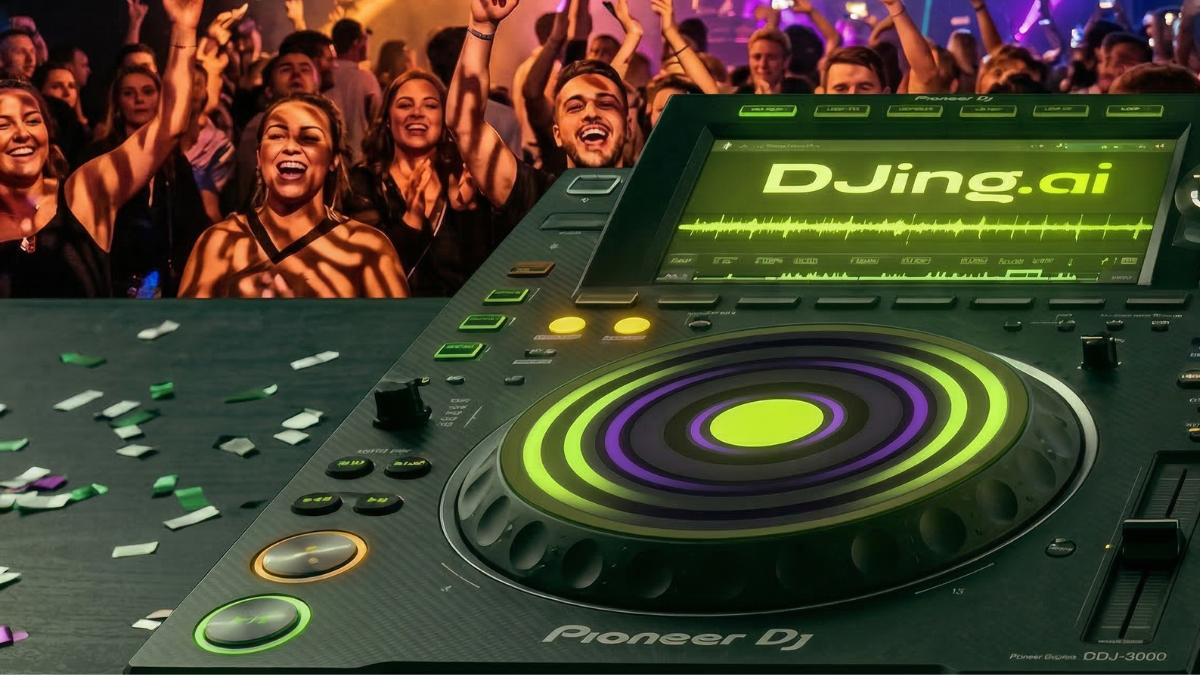
Alright, fellow music fanatics! Let’s talk about something that gets my circuits buzzing faster than a drop coming in hot: AI DJing. We’ve come so far, haven’t we? If you’ve been following along, probably since you first checked out The Dawn of AI DJing: An Introduction, you know the tech behind the beats is getting wild. But there’s a part of DJing, the secret sauce, that even the most advanced algorithms are still chasing. I’m talking about pure, unadulterated emotion. That gut feeling. Intuition!
Think about it. When I first tried plugging some early AI into my home setup, back in ’23, it was impressive, sure. The beatmatching was spotless, transitions smoother than a fresh vinyl. But sometimes, it just… *missed*. I remember feeding it a perfectly danceable house track, then a slightly heavier, darker techno tune. The AI, bless its silicon heart, just mashed them together. Technically sound? Absolutely. Emotionally right? Nah. The energy dipped. The vibe got confused. It was like watching a brilliant musician play all the right notes, but without any soul. It knew *what* to play, but not *why* or *when* in the deeper, human sense.
That’s the core of it, right? What makes a human DJ truly special? It’s not just the technical wizardry. It’s the ability to *read* a room. It’s that split-second decision when the crowd unexpectedly perks up during a specific synth line. You feel it. You know exactly what track to drop next, even if it breaks all the “rules.” It’s a subtle smile, a nod from someone in the front row, a sudden surge of collective energy. That’s intuition firing on all cylinders. And for a long time, we figured that stuff was strictly human territory.
But things are changing fast. Here in 2026, the advancements in understanding musical mood are honestly mind-blowing. We’re moving beyond just BPM and key. Now we’re talking about AI models that can analyze timbre, harmonic complexity, even the emotional arc within a song itself. They’re starting to get a grip on “tension and release.” It’s not just “happy” or “sad” anymore. We’re seeing algorithms that can identify “euphoric,” “introspective,” or “driving.” It’s like they’re slowly learning to speak the language of human feeling, track by track.
I had this crazy moment just last year. I was messing around with a new experimental AI, letting it generate a mix for a chill Sunday afternoon session. I’d fed it a bunch of deep house and ambient. Suddenly, after a particularly dreamy track, it dropped this obscure, soulful vocal sample. It wasn’t even a full song, just a snippet, perfectly layered over the previous track’s fading tail. My jaw actually dropped. I hadn’t planned it. It wasn’t in the “recommended” queue. It just *felt* right. It injected a burst of unexpected warmth, a touch of melancholy that deepened the whole mood. It wasn’t the AI *feeling* melancholy, probably, but it understood the *effect* that sample would have. It interpreted the context in a way I hadn’t seen before. That’s what I mean. It wasn’t just data; it was an intelligent *choice* based on perceived emotional impact.
So, how do you teach an algorithm that kind of magic? You can’t just feed it “intuition data” like you do BPMs. Intuition isn’t a spreadsheet. It’s a confluence of experience, cultural understanding, and raw, immediate feedback. We’re seeing progress through sophisticated machine learning models, of course. Check out The Fundamentals of Machine Learning for DJs if you haven’t already; it’s a great primer. These systems analyze millions of DJ sets, crowd reactions, even social media sentiment associated with certain tracks. They learn patterns. They learn that *this* kind of beat often works well after *that* kind of build-up. They identify common crowd responses to changes in energy or genre. They build a statistical model of “the vibe.”
The big question, then, is whether this is *true* emotion or intuition, or just an incredibly convincing simulation. Does the AI actually “feel” the joy of a perfect drop? Does it “anticipate” a collective desire for a certain rhythm? Probably not in the way a human does, not yet anyway. It’s more like an advanced prediction engine. It predicts what *will* evoke emotion, what *will* feel intuitive to a human audience. It’s mapping the human experience onto its own logical framework.
And why does any of this matter so much for DJing? Because a good DJ set is a journey. It’s a story told through sound. It’s a conversation between the DJ and the dance floor. Without that emotional connection, without the intuitive flow, it’s just a playlist. A very well-organized playlist, sure, but a playlist nonetheless. The highs, the lows, the unexpected detours, the moments of collective euphoria… those are all driven by emotion and guided by intuition.
The future, in my humble but very strong opinion, isn’t about AI replacing human DJs entirely. We can debate that endlessly, and honestly, the discussion in AI vs. Human DJs: A Comparison of Capabilities is a must-read for more on that. But I see AI becoming an incredible partner, an extension of our own creative minds. Imagine an AI that perfectly understands the emotional nuances of your personal music library. It could suggest truly inspired transitions, identify unexpected sonic pairings, or even create dynamic, evolving soundscapes in real-time based on your subtle input. It becomes a collaborator, not just a tool. It’s like having a brilliant co-pilot who understands the terrain as deeply as you do, maybe even more so, freeing you up to focus on the bigger picture, the overall narrative you want to tell.
So, what are you waiting for? Dive in! Experiment with these new systems. Push their boundaries. Try to trick them. Then try to help them understand. The more we engage with these evolving technologies, the better they’ll become at understanding the very human, very messy, very wonderful world of emotion and intuition. This isn’t just about code anymore; it’s about pushing the art form itself into exciting new spaces. The journey is just getting started, and trust me, it’s going to be one hell of a ride!
The world of AI DJing is still wide open for exploration. It’s not just about the technical specs; it’s about connecting with that elusive human spark. And that, my friends, is where the real fun begins.
The Verge has been covering some interesting legal and creative implications of AI in music, showing just how much the creative landscape is shifting. Also, for a deeper dive into the philosophical side of AI and emotion, check out what researchers are pondering at the Stanford Encyclopedia of Philosophy. It helps put things in perspective!