
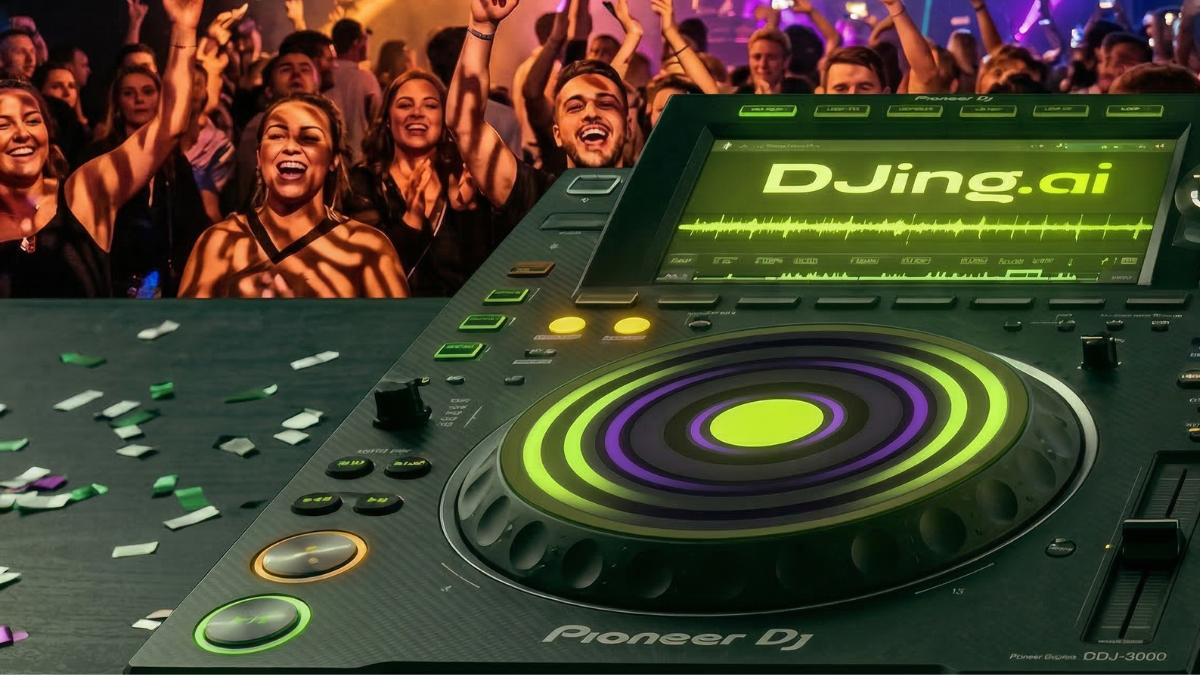
I remember the first time I saw someone talking about AI DJing a few years back. My initial thought? “No way. That’s for robots, not for true artists.” But here we are, 2026, and let me tell you, I was dead wrong! This isn’t about replacing us, it’s about giving us superpowers. It’s about taking the grind out of the technical stuff and letting your soul absolutely DANCE with the music selection and the vibe. If you haven’t dipped your toes into this yet, you are missing out on one of the most exciting shifts in how we make people move. Seriously, it’s electrifying! And trust me, if you want a deeper dive into the whole landscape, check out The Dawn of AI DJing: An Introduction. It sets the stage beautifully.
Your First AI-Assisted Mix: From Skeptic to Super DJ!
I get it. The idea of letting an algorithm touch your carefully curated tracks feels a bit… sacrilegious, right? That’s exactly how I felt. My setup, a trusty pair of decks I’ve had since my early twenties, felt like an extension of my own arms. Beatmatching by ear was my badge of honor. I practiced for hours, drilling those transitions until they were butter. Then, a buddy of mine, always on the hunt for the next big thing, convinced me to just *try* one of the new AI-powered DJ software suites. He practically dared me. “Just load two tracks, man. See what happens.”
My first attempt? It was a mess, honestly. Not because the AI was bad, but because I was resistant. I was fighting it, trying to do everything myself while it was trying to help. It was like trying to drive a car with power steering but still wrestling the wheel like it was a tank. But then, I relaxed. I let go a little. I loaded a deep house track I knew inside and out, then a slightly faster disco-funk number. I hit play on the first. The AI started analyzing, showing me BPM, key, even potential energy levels. Cool. Then I cued the second. I hit the sync button. And that’s when it happened.
The software gently, almost imperceptibly, nudged the second track’s tempo to match. The waveform aligned itself perfectly. I could see it. I could hear it. I pushed the fader up, and… BAM! A flawless beatmatch. No pitch shifting, no fumbling. Just two tracks, locked in. It was like the software reached out, took my hand, and guided me into the most perfect blend I’d ever heard. My jaw dropped. The goosebumps were real. I felt like I’d just discovered a cheat code for pure sonic joy!
Why You NEED to Try This (Seriously)
Look, the biggest misconception is that AI takes the “DJ” out of DJing. Bull! It takes the grunt work out of it. It takes away the endless hours of manual beatmatching practice and frees you up to do what truly matters: finding killer tracks, understanding your audience, building energy, telling a story with sound. It’s an incredible tool for Enhancing Creativity: How AI Tools Empower Human DJs. You get to focus on the art, not just the mechanics.
- Perfect Timing, Every Time: No more stressing about a beat drifting. AI locks it in. You can focus on effects, EQ, and track selection.
- Harmonic Mixing Made Easy: Ever struggled to find tracks that just *fit* together musically? AI can suggest compatible keys, making your mixes sound richer, more professional. It’s like having a music theory wizard sitting next to you.
- Faster Learning Curve: New to DJing? AI assists can help you get started way faster. You learn the principles of mixing without getting bogged down by purely technical aspects right off the bat. Seasoned pro? It opens up new creative avenues you didn’t even know existed.
- Experimentation Without Fear: Want to try mixing two wildly different genres? Go for it! The AI will give you the best possible shot at making it work, letting you push boundaries without the fear of a trainwreck.
Alright, Let’s Get You Started: Your First AI-Assisted Steps!
Ready to jump in? Good! It’s easier than you think. You don’t need a huge budget or a crazy studio setup to start. You just need a computer and some software.
Step 1: Pick Your Poison (Software, That Is!)
There are fantastic options out there now. We’re talking about tools like Serato DJ Pro, rekordbox, VirtualDJ, and even some newer, dedicated AI mixing apps. Most offer free trials. Download one, install it. Don’t overthink it. Just pick one and get familiar with its layout. They all generally have a similar core functionality.
Step 2: Build a Small Playlist
Don’t overwhelm yourself. Grab 4-5 tracks from your favorite genre. Pick songs you know well, songs that make you want to move. Drag them into your software’s library. Let the software analyze them. This is where the magic starts. It’s analyzing BPM, key, maybe even energy levels. This is the AI doing its thing behind the scenes.
Step 3: Load ‘Em Up!
Drag your first track onto Deck A, and your second onto Deck B. You’ll see the waveforms. You’ll see the BPMs. This is where I want you to trust the machine a little. It’s okay! It’s a tool!
Step 4: Engage the AI Assist
Every software handles this a bit differently, but generally, you’ll look for a “Sync” button, or an “Assist” mode, or even an “AutoMix” feature to start. This is the button that essentially tells the AI, “Hey, help me make these sound awesome together.” Hit that button for Deck B (or whichever deck you’re bringing in).
Step 5: Faders Up, Fun On!
Play Deck A. Get a feel for the track. Listen. Then, when you’re ready, gently bring up the volume fader on Deck B. Watch the waveforms. Listen to how the AI has perfectly matched the beats. Play with the EQ (bass, mids, highs) to blend the sounds. You might even find some amazing advice on creating Seamless Transitions: The AI Advantage in Mixing using these techniques.
My first truly *good* AI-assisted mix was a revelation. I remember layering a classic house vocal over an instrumental grime track. Something I would have never dared attempt manually because the tempo and rhythmic differences would have been a nightmare. But the AI just… did it. It found the common ground, stretched and nudged, and suddenly I had this fresh, unexpected fusion. The crowd (my cat, bless her patient soul) was definitely impressed!
My Golden Rules for AI-Assisted Glory
This isn’t just about pressing “sync” and walking away. That’s a myth. It’s about being a *better* DJ. So here are my commandments:
- Don’t Be Lazy: The AI handles the mechanics. Your job is still to *listen*. What tracks work together? What’s the story you’re telling? Use your ears, not just your eyes on the screen.
- Experiment! That’s the real joy here. Mix genres you never thought possible. Layer acapellas over instrumentals from different decades. The AI is your co-pilot for sonic adventure.
- Understand the Fundamentals (Eventually): While AI helps you skip the grunt work, knowing *why* a beatmatch works or *why* certain keys blend is still valuable. Don’t stop learning, just start with more fun.
- It’s YOUR Set: The AI is a tool. You’re the artist. Don’t let the software dictate your creativity. Use its power to execute *your* vision.
- Have Fun! Seriously. This is supposed to be joyous. If it’s not making you grin, you’re doing it wrong. Turn up the tunes and let loose.
One time, I was playing a small backyard party (pre-pandemic, of course, these days it’s more about Twitch streams and VR raves, but the principle holds!) and my laptop decided to be notoriously finicky. The latency was just a nightmare. I switched on the AI assist fully, basically letting it handle all the beat-matching and even some basic looping suggestions. My hands were free to literally dance, interact with the crowd, and just vibe. The music never missed a beat. It was amazing. I could focus on *being present* with the people, not glued to my waveforms. It was a completely different kind of performance, and utterly exhilarating. Sometimes, it’s even about learning how AI in Live Performance: Integrating Smart Tools On Stage can free you up to connect with your audience on a whole new level.
Is it “Cheating”? Who Cares!
This is where some old-school DJs might get huffy. “It’s not real DJing!” they’ll exclaim. My response? Get over it! Did guitarists stop playing because synthesizers came along? Did painters quit when cameras were invented? No! They adapted. They used the new tools. This isn’t about being better than anyone else, it’s about making *your* music experience, and potentially *your audience’s* experience, better. It’s about opening the door to more people who want to share their passion for music.
The beauty of AI-assisted mixing is that it democratizes the art form without diminishing it. It lowers the entry barrier, allowing anyone with a passion for music to create incredible mixes without years of technical training. Think of the new sounds, the fresh perspectives, the unexpected combinations that will emerge! It’s a truly exciting time to be involved with music, period.
The future of DJing isn’t just about algorithms, it’s about the human-AI partnership. It’s about using these incredible advancements to express ourselves in ways we never thought possible. So please, take that leap. Download a free trial. Load some tracks. Hit that assist button. I promise you, you’re in for a wild, joyful ride. Your first AI-assisted mix might just blow your own mind. It certainly blew mine!
Further Reading: The AI-DJing Evolution
If you’re curious about the technical underpinnings of some of these tools, it’s fascinating to look at the historical development of sound processing and machine learning in audio. For example, the evolution of digital signal processing (DSP) and its application in music production is a crucial precursor to modern AI DJing. Even the concepts of automatic beat detection and tempo synchronization have roots going back decades. For some historical context on signal processing, a good place to start is the Wikipedia page on Digital Signal Processing. Understanding the foundation makes the current capabilities even more impressive! Also, for a broader understanding of how AI is being applied in various creative fields, not just music, you can explore resources from institutions like MIT, for instance, this overview of AI and creativity from MIT News on Artificial Intelligence, which often covers new developments in intelligent systems for artistic endeavors.