
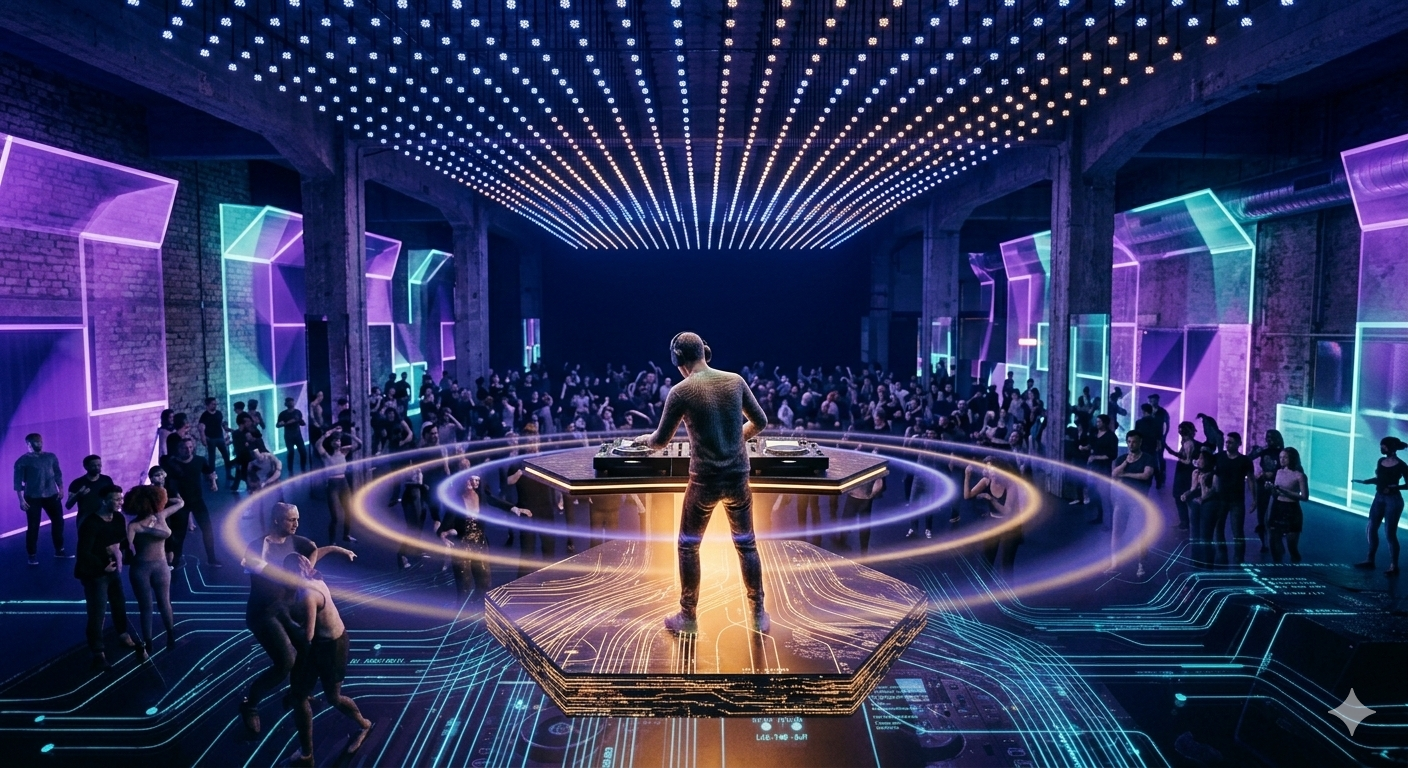
Most DJs still treat virtual performance like a pandemic hangover — something that happened, served its purpose, and should probably be left alone now. That instinct is understandable. It’s also, I think, going to age badly. The infrastructure being quietly assembled underneath virtual venues, avatar ecosystems, and spatial audio environments isn’t a nostalgia project or a tech bro fever dream. It’s the next performance surface. And it doesn’t care whether you’re ready.
Why This Is Happening Now — Not In Five Years, Now
Let me give you the numbers that actually changed how I think about this.
Fortnite’s virtual concerts — Travis Scott, Ariana Grande, others — pulled audiences north of 45 million per event. Not streams. Not replays. Live, concurrent attendees. Roblox hosted DJ sets in 2023 and 2024 that outperformed mid-tier festival headcount by a factor of ten. Decentraland and Spatial.io are running weekly club nights — weekly — with tipping infrastructure, virtual merch drops, and replay monetization that pays out after the event is over. After. The set keeps earning.
This stopped being niche somewhere around 2022 and most DJs missed the memo.
There’s a parallel economy forming here — its own booking logic, its own audience behavior, its own very specific technical demands. And the gap between people who started learning the tools now versus people who wait until it feels “safe enough” — that gap is not going to close easily. It rarely does in any industry when infrastructure shifts. You either get in early and figure it out messily, or you get in late and pay someone who did.
What Virtual Venues Actually Look Like (It’s More Fragmented Than You’d Think)
Four Platforms. Four Completely Different Animals.
I want to be specific here because “virtual venue” gets used as if it’s one thing. It isn’t. There are at least four distinct environments operating right now, and they behave — sonically, socially, economically — almost nothing like each other.
- Game-engine platforms (Fortnite, Roblox, Minecraft) — enormous audiences, sometimes absurdly large, but the DJ has limited control. You’re a guest in someone else’s architecture.
- Blockchain-based worlds (Decentraland, The Sandbox) — smaller crowds honestly, but higher creative ownership and built-in monetization through token systems and NFT ticketing that actually functions
- Social VR platforms (VRChat, AltspaceVR, Horizon Worlds) — mid-size audiences, real-time spatial interaction, avatar-to-avatar proximity audio that creates something genuinely weird and interesting in practice
- Browser-based spaces (Spatial.io, Gather.town) — the lowest barrier to entry by a significant margin, no headset required for your audience, easiest place to run a first event and not completely embarrass yourself
Treating these as interchangeable is — I’ve seen this happen — the single fastest way to burn three weeks of effort on a platform that was completely wrong for what you were trying to do. Each one has a different audience age profile, different audio latency behavior, different monetization ceiling.
Pick one. Learn how it specifically behaves. Then, and only then, start thinking about layering.
Your Avatar. (No, This Part Isn’t Shallow — Hear Me Out.)
Digital Identity Is Performance Infrastructure Now
Okay so — this is the section that sounds like it belongs in a fashion magazine and not a DJ strategy blog. But stay with me.
In a virtual venue, your avatar is literally the only visual thing anyone can see of you. There’s no crowd watching your hands move across CDJs. There’s no body language, no stage energy, no sweat — none of the physical presence signals that do a lot of heavy lifting in a real room. The avatar carries everything. Its design, how it moves, whether it responds expressively to the music — that’s your entire visual identity in that space.
Ready Player Me lets you build a cross-platform avatar that ports across multiple virtual environments without rebuilding from scratch each time. VRChat has a custom avatar commission market — established, active, real — where a fully rigged performance avatar runs somewhere between $200 and $800 depending on complexity and the artist’s queue time.
The DJs building coherent virtual identities right now — consistent visual aesthetic, avatar that moves and reacts in sync with the set — are accumulating brand recognition in a space where most people still show up looking like a default Roblox character from 2015. The equity compounds. Quietly and then suddenly.
⚠️ COMMON MISTAKE: Treating a virtual set like a livestream with better wallpaper. Spatial audio environments expect spatial interaction — crowd-reactive elements, avatar responsiveness, environmental design that responds to the music. A static OBS stream dropped into a 3D room isn’t a virtual DJ set. It’s a video call with architectural ambitions.
The Spatial Audio Problem (And Why It Changes How You Prep)
Here’s the thing nobody really talks about when they discuss VR DJ sets — the sound doesn’t work the same way.
Spatial audio means position. A hi-hat can come from the left. A vocal can move. The bass doesn’t just hit — it comes from somewhere, and that somewhere changes depending on where in the virtual room your audience is standing. Which means — and this actually matters for how you structure a set — standard stereo mixing logic doesn’t fully translate into this environment. Frequency behavior changes. Low-end diffuses differently. Build-ups that hit perfectly in a stereo club system can feel oddly weightless when rendered spatially.
Steam Audio (open source, integrates with Unity and Unreal Engine) and Resonance Audio from Google are the SDKs developers use to build these rooms. You don’t need to build the room yourself — but having a basic conceptual understanding of how spatial audio renders your mix changes the preparation conversation entirely.
Three things to actually do:
- Study how your low-end behaves when diffused spatially — test it, don’t assume
- Think about build-ups and drops from the perspective of someone standing at the back of the virtual room versus the front
- Have a direct conversation with whoever is building the virtual venue about speaker placement logic — this is a real, normal conversation to have and most venue builders will appreciate that you’re asking
💡 PRO TIP: VRChat lets you test audio inside the environment before going live to anyone. Use this without exception. Run a complete set in the empty room first. The spatial rendering will expose mix decisions that sound completely fine in stereo but dissolve into confusion in 3D. Better to find out alone at 2pm than in front of 300 avatars at 10pm.
Fyanso’s Take
Everyone keeps asking whether virtual DJing is “real” performing — and I find that question genuinely exhausting at this point. It’s an ego question dressed up as a philosophical one. The more interesting question — the one that actually produces useful answers — is: what does virtual performance infrastructure structurally allow that physical venues cannot? Global simultaneous audience with no capacity ceiling. Zero venue cost and zero travel overhead. Persistent replay monetization that keeps generating after the event closes. Avatar-based identity separation if you want to run a virtual project that’s sonically disconnected from your physical brand. These aren’t consolation prizes for people who couldn’t book a real gig. These are architectural advantages. The DJs who figure out how to operate fluidly across both physical and virtual surfaces — without treating one as training wheels for the other — are building something genuinely more resilient than a touring career alone can sustain. That’s the play.
🔧 TOOL STACK: Spatial.io + VB-Audio Cable + OBS + Virtual DJ
Lowest-friction path to a working first virtual event:
Spatial.io is where you start. No headset required for your audience — they join from a browser. Route your Virtual DJ or Rekordbox audio output through VB-Audio Cable (free, and it works exactly as described on the tin) into your Spatial.io room’s audio input. Broadcast your visual output — decks, visualizer, whatever — via OBS screen capture mapped onto a virtual display surface inside the room.
Realistic setup time for a basic functional version: two to three hours if you’ve never done it before. Run a test session with ten people before anything public. Pay attention to the latency. Notice how the audio lands spatially from different positions in the room. Adjust. Then scale.
The System, Pulled Straight
- Virtual venues operate across four structurally different platform types — game engines, blockchain worlds, social VR, browser-based spaces — each with distinct audiences, audio behavior, and monetization logic
- Your avatar is your sole visual identity in virtual space — it carries the same strategic weight as stage presence in a physical room
- Spatial audio fundamentally changes mix preparation — standard stereo logic doesn’t fully translate and testing inside the environment before performing is non-negotiable
- Spatial.io, Ready Player Me, VB-Audio Cable — a working virtual setup is achievable in an afternoon with tools that already exist
- The gap between early-fluency operators and late adopters in virtual performance is widening in real time — this is a present-tense window, not a future one
- Physical and virtual performance are complementary revenue channels, not competing philosophies
Your actual next move: Build a Spatial.io room today. Route your audio into it. Get five people in there and run twenty minutes of a set. That one session — messy, imperfect, probably laggy in one spot — will teach you more about virtual performance than reading about it for six months straight.