
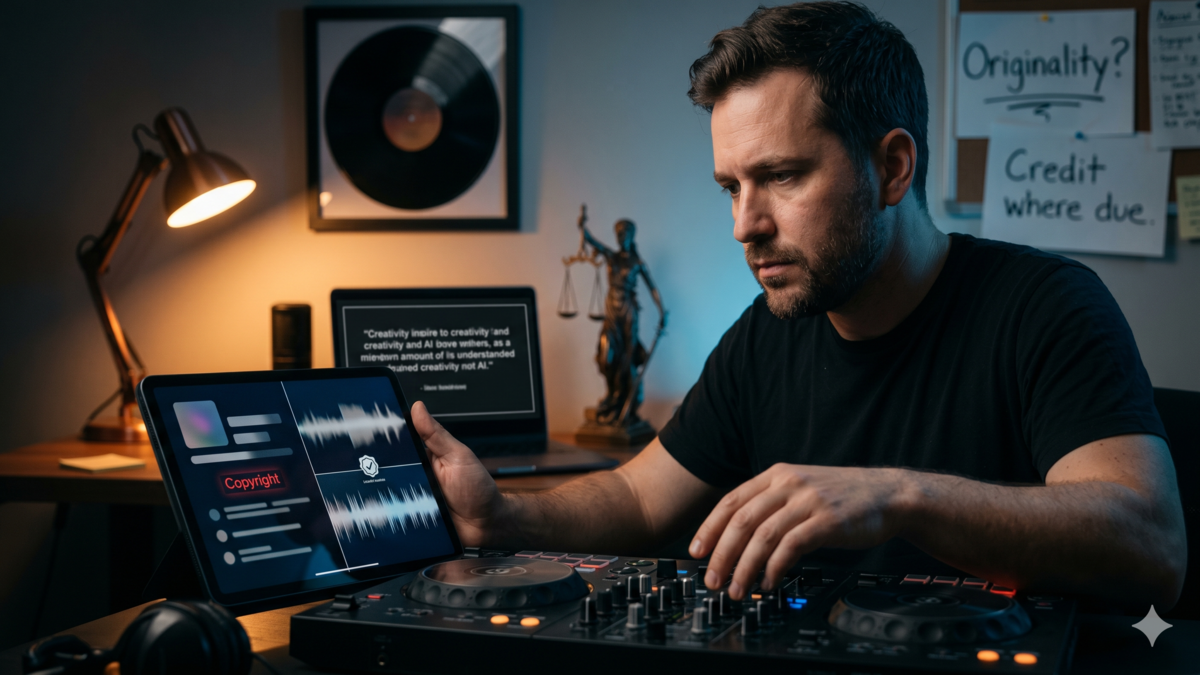
Picture the scene. Lights strobing, bass frequency you feel in your sternum before you consciously register it as sound, a floor packed with bodies moving in that collective, almost biological rhythm that only happens when everything — the room, the music, the moment — aligns just right. Now ask yourself: whose creativity made that happen? In 2026, that question doesn’t have a clean answer anymore. And honestly? The discomfort of sitting with that ambiguity is probably the most important thing the DJ community could be doing right now, instead of either cheerfully embracing AI without examining it or dismissing it defensively without understanding it. Both responses are understandable. Neither is sufficient. This conversation sits at the center of everything happening in DJ Career Growth & AI Tools — the uncomfortable center, the part that doesn’t resolve neatly — and it deserves more than a paragraph.
AI is not, at this point, a peripheral presence in creative industries. It’s generative now — generating entire tracks, refining mixes with architectural precision, predicting crowd responses with a statistical confidence that should either impress or unsettle you, depending on your disposition. Probably both, if you’re paying attention. The ethical questions this raises — around copyright, around what creativity even means, around whether the profession as we understand it survives intact — are not hypothetical anymore. They’re operational. They’re happening in real time, in studios and courtrooms and legislative chambers, and the industry’s response to them will shape not just how DJs make money but what DJing fundamentally *is*.
The Copyright Quandary: Who Owns the Algorithm’s Output?
This is where things get genuinely, structurally murky — and I want to resist the urge to pretend there are clear answers, because there aren’t, and the false clarity is actually more dangerous than the acknowledged confusion.
When an AI generates a track, a remix, a sonic texture that didn’t previously exist — who holds the rights? The programmer who built the model? The entity that provided the training data? The user who wrote the prompt? The AI itself, which some legal academics have begun proposing with varying degrees of seriousness? Current copyright law was designed around a foundational assumption: a human created this thing. That assumption is now broken, and the legal infrastructure hasn’t caught up. The World Intellectual Property Organization (WIPO) has acknowledged this explicitly — existing frameworks are simply ill-equipped for AI-generated works, and the gap between technological reality and legal architecture is widening faster than anyone seems comfortable admitting.
The training data problem is the one that keeps me up at night, if I’m being direct. AI models are built on vast datasets of existing music. Copyrighted music. The model ingests that material, learns its structures and textures and rhythmic vocabularies, and then produces outputs that are — what, exactly? Original? Derivative? A sophisticated recombination of absorbed influences in a way that’s not actually so different from how human musicians learn, except that human musicians don’t process millions of tracks simultaneously and human learning has legal precedent behind it? When an AI generates something “in the style of” a specific artist and the result is close enough that a listener couldn’t distinguish them — that’s not a theoretical edge case. It’s happening. The sampling debates that have shaped DJ culture for decades were complicated enough; AI amplifies those complications exponentially, in ways that are difficult to trace and nearly impossible to adjudicate under current law. Artists deserve compensation. That’s not even a debatable proposition. The mechanism for delivering that compensation, in this new architecture, is the unresolved question.
Authenticity versus Algorithm: What Defines Creativity?
I’ve been turning this question over for a while and I still don’t have a satisfying answer — which is itself, maybe, a data point worth noting.
DJing has always been an art form that makes some people uncomfortable precisely because of what it does and doesn’t involve. You’re not playing an instrument, technically. You’re selecting, sequencing, blending — exercising judgment and intuition in real time, reading a room, telling a story through other people’s music. The creative act is curatorial, relational, responsive. It requires enormous human skill and also, somehow, some people have always struggled to call it “art” in the same breath as composition or performance. AI reopens this old wound from a different angle. If an algorithm can perform all those curatorial functions — select, sequence, blend, even read crowd energy through sensor data — is the output still art? Is something missing that can’t be quantified?
The community splits on this, fairly predictably. One camp: AI is a tool, the same category of argument that was made when CDJs replaced vinyl, when digital replaced analog. The technology changes; the artistry persists in the human wielding it. Tools like AI for DJ Music Curation already demonstrate this — they assist discovery, tighten transitions, but the creative vision remains the DJ’s. The other camp: there’s something categorically different about a tool that doesn’t just execute human decisions but generates them. An algorithm, however sophisticated — and they are sophisticated, genuinely impressively so — does not feel. It processes. The human experience of creating something, the struggle and doubt and occasional transcendence of it, the personal history embedded in every choice — that’s what we actually value in art, whether or not we’re consciously aware of it.
A 2025 survey by MusicTech Future offered a data point that stuck with me: 65% of surveyed club-goers said they preferred knowing a human was behind the decks, with “authenticity” as the primary reason cited. That number will likely shift. But it currently exists, and it represents something real about what people are actually seeking when they go to a club — not just sounds organized competently, but the felt presence of another human making decisions in real time for them specifically. Whether AI can ever replicate that, or whether replication would even preserve the thing being sought — I genuinely don’t know. That uncertainty feels important to sit with rather than resolve prematurely.
The Human Element: Evolving Roles and Skill Development
The narrative that AI ends human DJing is too simple and, I think, probably wrong — but the more reassuring counter-narrative, that “nothing fundamentally changes, humans just use better tools,” is also probably too simple.
What seems more likely — and more interesting, honestly — is a genuine role transformation. AI handles the technically demanding, reproducible layer: beatmatching with microsecond precision, EQ management, harmonic compatibility analysis. The DJ directs from a higher vantage point — track selection, emotional arc, crowd connection, the live improvisation that responds to a room’s energy in ways no predictive model fully captures. The job becomes less technical execution and more creative direction. Which is either liberating or terrifying depending on where your skills and identity currently live.
The skill set required is evolving accordingly. Not just turntables or CDJs but AI interfaces, algorithmic management, prompt engineering for custom soundscapes — the ability to collaborate with a system rather than simply operate equipment. History has precedent for this kind of shift; every major technological transition in music required practitioners to develop new competencies without abandoning what made the craft worth doing. The difference now is pace. The transition is happening faster than previous ones. Platforms built around Personalized DJ Learning: AI Tutors & Skill Development are seeing significant growth — which is, actually, an encouraging signal. It suggests the community is moving proactively rather than reactively, preparing rather than just watching.
Regulatory Gaps and Industry Response
The legal landscape is — and I want to use precise language here — genuinely inadequate. Not lagging slightly, not in the process of catching up. Structurally inadequate for the questions now being posed. National and international frameworks struggle to define ownership, infringement, and liability in AI-generated content contexts, and without clear guidelines the industry faces a litigation environment that could simultaneously stifle innovation and undermine fair compensation. Both bad outcomes. Potentially happening together.
The RIAA and various artist collectives are advocating for legislative intervention, pushing frameworks that would either assign copyright to human inputs — the prompt, the training data curation — or establish revenue-sharing models that would route royalties back to the creators whose work trained the models in the first place. Some proposals involve licensing structures where AI platforms pay for the use of copyrighted material in their datasets. Whether any of these gain traction at the legislative level, and on what timeline, remains genuinely uncertain. What isn’t uncertain is that the current vacuum is benefiting nobody except the parties with the resources to litigate indefinitely.
Some platforms are acting unilaterally. Leading streaming services and performance rights organizations are developing AI-detection systems and exploring differentiated royalty structures for AI-generated material. Early, imperfect, but directionally correct. Transparency is the floor here — the absolute minimum. Listeners should know when they’re hearing AI-generated content. Human artists especially deserve that information. How we build above that floor is the harder question.
The Future Landscape: New Business Models and Ethical Frameworks
Some of what’s coming is genuinely exciting, if you can hold the excitement alongside the anxiety rather than choosing one and suppressing the other.
Artists licensing their sonic signature — their style, their harmonic vocabulary — to AI models, receiving royalties each time the system generates music in their specific register. DJs collaborating with AI on bespoke compositions for specific events, hybrid performances that combine live human curation with generative sound design tailored to the room in real time. An AI handling individualized personalization while a human DJ shapes the overarching arc and emotional narrative. These aren’t utopian fantasies — the technological prerequisites exist, what’s missing is the ethical and economic architecture to make them equitable rather than exploitative.
That architecture requires a kind of cross-sector collaboration that the industry hasn’t historically been great at: AI developers, music platforms, performance rights organizations, legislators, and the working professionals whose livelihoods are directly implicated — all engaged simultaneously, with good faith and some urgency. Robust ethical frameworks covering data transparency, attribution, compensation mechanisms, and the rights of human creators to opt out of contributing to systems they don’t consent to feed. A global consensus would be ideal; a functional regional framework would be a start.
The challenges are real. Dismissing them as manageable is dangerous. But so is the fatalistic reading that nothing can be shaped, that the technology will simply do what it does and the human creative community will absorb whatever results. We are not merely observers of this moment. DJs, producers, creators of every kind — we are participants with genuine standing to influence how these systems develop, what norms govern them, and what the culture around them becomes. The soul of the craft isn’t a fixed object that either survives or doesn’t. It’s something we actively maintain or abandon through the choices we make, collectively, right now. That responsibility is clarifying, if you let it be.