
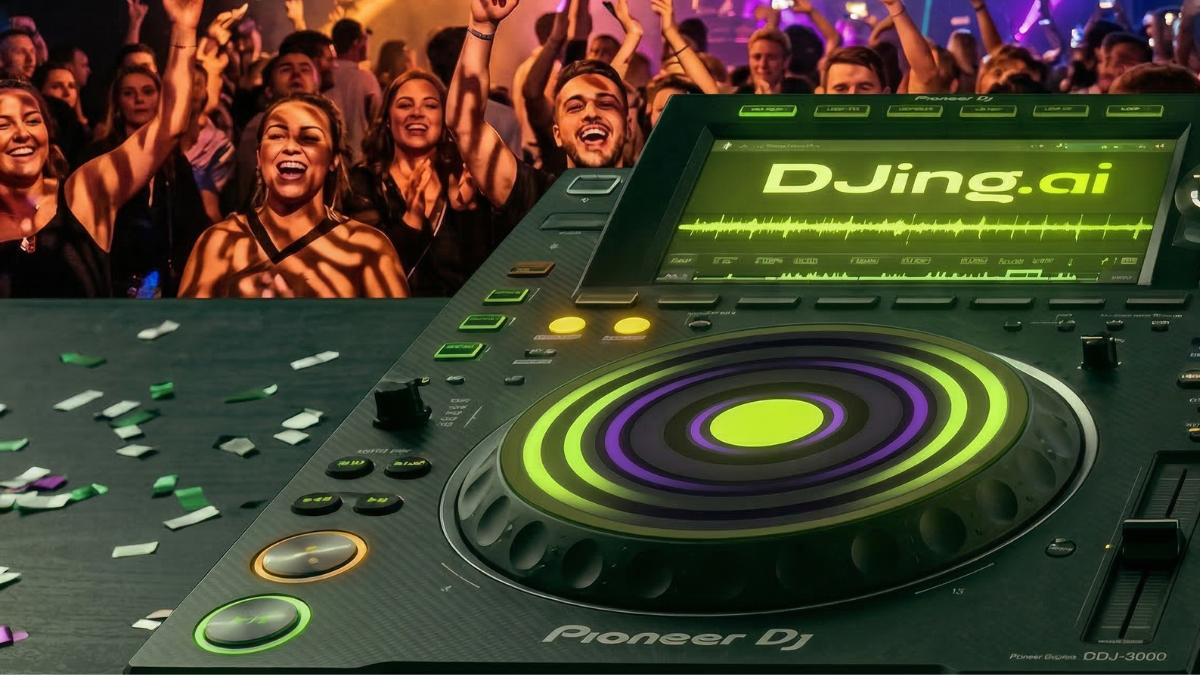
Let’s talk about it. The robots are coming for our jobs, right? That’s the chatter I hear, everywhere from the old-school vinyl heads to the digital-native bedroom producers. People are freaking out about AI DJing, acting like Skynet is about to drop a beat on humanity. And yeah, when you first dip your toes into The Dawn of AI DJing: An Introduction, it feels a little surreal.
But hold up. Take a deep breath. Because after years of hands-on, sweat-and-tears, beat-matching bliss, I’m here to tell you something absolutely crucial: they’re missing the point. Completely. AI DJing isn’t here to replace the human touch. It’s here to remind us just how damn vital that human touch truly is. And that, my friends, is something worth getting excited about!
When I first heard about AI algorithms analyzing tracks, predicting crowd energy, even creating “perfect” mixes, I wasn’t lying. A shiver went down my spine. This was back in 2023, maybe early 2024. My first thought? “Is this it? Is my decades of digging, practicing, and pouring my soul into sets all going to be boiled down to some lines of code?” I remember sitting there, staring at my decks (my beautiful, worn CDJs, still going strong), feeling a pang of fear. I tried out one of the early AI DJ platforms, just for kicks. It crunched numbers. It analyzed BPM, key, energy levels. It suggested transitions that were, objectively, flawless. No clashing keys. No awkward tempo jumps. Every mix was mathematically perfect. A machine could spin an entire night, technically, without a single hiccup.
And that’s when it hit me. Like a bass drop you didn’t see coming, right in the chest. It was perfect. And it was… kinda boring. Seriously. There was no grit. No surprise. No moment where the crowd collectively gasped because I dropped that obscure B-side at just the right second, pulling them from a trance into pure euphoria. The AI nailed the science. It completely missed the art.
See, DJing isn’t just about blending tracks. It’s about blending souls. It’s about that raw, unspoken conversation between you, the music, and the people in front of you. It’s an energy exchange, a feedback loop that an algorithm simply cannot replicate, not yet anyway. And maybe, just maybe, never will fully.
Think about it. You’re standing there, watching the crowd. They’re vibing. They’re dancing. But then you catch a glimpse of someone checking their phone. Or maybe the energy dips just a fraction. An AI sees data points: BPM, decibels. A human DJ, a real one, sees a shift in body language, a subtle change in the air. We *feel* it. That’s when you throw in that curveball, that unexpected track that completely changes the trajectory of the night. That’s when you take a risk. Maybe it’s an old classic, maybe it’s a brand-new track no one’s heard. But you *know* it’s the right move. That gut feeling? That intuition? That’s our superpower.
I remember this one outdoor gig, summer of ’25. The sun was setting, everything was golden. The crowd was amazing, but they were getting a little mellow, drifting towards a chill vibe. The set I had planned was more high-energy, building to a peak. An AI probably would have stuck to the plan, gradually increasing BPM, logically building. But I looked out, saw couples slow dancing, saw people just soaking in the moment. My heart told me to pivot. I dropped a deep, soulful house track, totally different from what I was supposed to play next. The BPM dropped significantly. It was a risk. But the crowd *loved* it. They leaned into it, swayed, connected on a deeper level. It felt like a warm hug. Then, when the moment was right, I slowly, deliberately, brought the energy back up. That spontaneous decision, that read of the room, that connection? That’s the human touch. That’s pure magic. An AI would have missed that connection. It wouldn’t have understood the subtle nuance of “golden hour” leading into “chill evening vibes” and the need for a sonic embrace before the full-on dance party resumed. We dive into this much more deeply when we talk about The Role of Emotion and Intuition in AI DJing, but trust me, it’s a huge piece of the puzzle.
So, where does AI fit into all this? It’s not the replacement, it’s the ultimate wingman! Imagine having a co-pilot that handles all the tedious stuff. Beat-matching? Done. Key analysis? Instantly. Creating perfect harmonic transitions? Absolutely. AI can free us up from the technical minutiae, allowing us to focus on what truly matters: creativity, connection, and those incredible, spontaneous moments.
Think of AI as a genius assistant for your prep work. You want to experiment with a new genre blend? Let AI sift through your library for harmonically compatible tracks. Need a quick mood-setter while you grab a coffee? AI can generate a perfect background mix. I’ve even used AI-powered tools to help me find obscure samples that fit a particular vibe I’m chasing. It’s like having an extra pair of hands, an extra brain, but *you* are still the conductor. You are still the artist. You are still the one making the decisions that move people.
For example, some new software now lets you feed it your track library and a target mood. It’ll suggest whole sequences, complete with FX and EQ settings, based on millions of data points about how people react to music. It’s wild. But then, you take those suggestions, twist them, inject your personality, add that unexpected acapella, layer that weird sound effect you found last week. That’s where the *art* happens.
It’s about making AI work for *us*. Not the other way around. We’re talking about tools that can help with Personalizing Your Sound: AI as a Mix Coach, giving you insights you might never have considered. Or even exploring The Future is Now: Emerging AI DJ Technologies to Watch, which could totally change how we interact with our sets. These aren’t threats. These are opportunities to become even *better* DJs. More creative. More connected. More free to innovate.
The human touch in DJing, my friends, is that spark. It’s the grit, the soul, the imperfect perfection that makes us real. It’s the ability to make a mistake and turn it into a moment of pure genius. It’s the improvisation, the crowd reading, the pure joy of sharing music that moves you. An AI can play a perfect song. A human DJ can play the *right* song. And there’s a massive, beautiful difference there.
This isn’t just my opinion. Experts are talking about this too. For instance, the very definition of “music performance” is being re-evaluated in the face of AI. It’s no longer just about hitting the right notes (or beats, in our case), but about the shared experience. As Dr. Emily Cross from the University of Glasgow’s Social Cognitive and Affective Neuroscience Lab explains, the human brain is wired to respond to human performance, recognizing and reacting to the subtle cues that signal genuine emotion and effort. This intrinsic connection to human expression is hardwired.[1] We’re not just listening to sounds; we’re witnessing a human story unfold. Similarly, recent discussions at tech and music conferences, like the ones covered by publications like Pitchfork, frequently emphasize that while AI can generate new forms of music, the *curation* and *presentation* (the DJ’s role) remain deeply human acts that convey meaning and foster community.[2]
So, don’t let anyone tell you the magic is gone. It’s not. The magic of DJing, that deep, satisfying feeling when you connect with a room, when you see those smiles and feet moving, that’s still ours. AI is just another tool in our ever-expanding arsenal. It’s like having a super-powered shovel, but you’re still the one digging the treasure. It doesn’t replace the joy of the hunt, or the thrill of finding that perfect gem.
Keep digging. Keep spinning. Keep connecting. The dance floor needs your heart more than it needs perfect algorithms. It needs *you*.