
Nobody tells you this when you’re starting out — when you’re still buying records with money you don’t have and lying awake at night thinking about transitions — nobody sits you down and says: *the brand is half the career.* Maybe more than half. It’s an uncomfortable thing to absorb if you got into DJing because you love music, because the craft itself felt like enough. It should be enough. But the DJ industry of 2026 doesn’t really care what should be true. It cares about attention — about whether someone scrolling a flyer at speed, half-distracted, stops or keeps moving. And whether they stop depends less on your back-catalogue and more on whether your visual identity, your digital presence, your entire projected self coheres into something instantly legible. Which is a lot to ask of someone who also has to, you know, actually DJ.
The good news — and it genuinely is good news, not the empty-reassurance kind — is that AI has arrived at exactly the right moment to absorb a substantial portion of that burden. Not as a gimmick. Not as a shortcut that produces mediocre results slightly faster. As a genuinely operational toolkit that’s reshaped what’s achievable for an independent artist without an agency, a design budget, or a marketing team. The full picture of how all this fits together lives in our guide on DJ Career Growth & AI Tools — but let’s get into the specifics.
The New Branding Imperative for DJs
Three to five seconds. That’s apparently all you get now — the window, according to industry analysts, within which a digital touchpoint either registers or evaporates. Three to five seconds before someone’s already moved on to the next thing, the next flyer, the next artist whose logo happened to catch their eye in a way yours didn’t. It’s a brutal little number. And it puts an almost impossible amount of pressure on first impressions — on the logo, the landing page, the thumbnail — things that used to feel like secondary concerns compared to, say, actually being good at the job.
Traditional branding processes were never built for this pace. Creative briefs, designer revisions, weeks of back-and-forth over font weights and hex codes — that model isn’t *wrong* exactly, it’s just slow in a way the current environment punishes. Speed and adaptability are the currency now. The ability to deploy something, test whether it’s working, and adjust — quickly — without hemorrhaging budget on each iteration. AI makes that kind of agility possible. Not in a reckless, slap-something-together way. In a genuinely strategic, test-and-refine way that serious brands have been adopting for years.
AI for Visual Identity: Crafting Logos That Stand Out
Your logo is — and I know this sounds grandiose but stay with me — a compression of your entire artistic identity into a single visual gesture. It’s the thing that appears on every flyer, every social post, every piece of merch, every email header. It accumulates meaning over time, or it doesn’t, depending on whether it was any good to begin with.
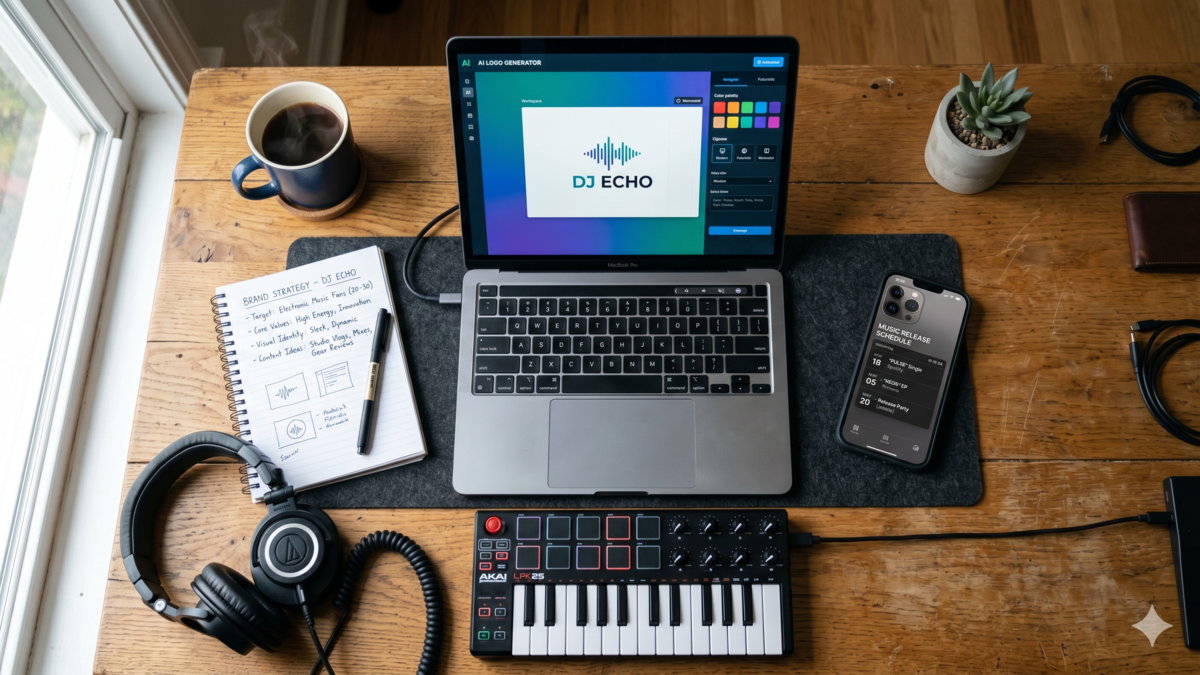
Historically, getting a logo worth using meant either knowing the right designer, spending real money, or settling for something that looked vaguely like every other DJ logo from that era. AI-powered platforms — Looka, LogoAI, and several newer entrants that have matured considerably since their early, slightly embarrassing iterations — have changed that calculation. These systems have processed thousands of design elements, typography pairings, color theory applications. You feed them inputs: your name, your genre, a handful of aesthetic descriptors. “Cold, industrial, Berlin-adjacent.” “Warm, organic, Afrobeats influence.” “Minimal. Almost nothing. Just the name.” And they generate options — dozens of them, quickly, in multiple configurations. Not all of them will be good. Some will be actively bad. But the ratio has improved dramatically, and the starting points they provide are often genuinely worth building on.
Does this replace a truly exceptional human designer for conceptual, never-seen-before work? Probably not. Not yet. Maybe not ever, for that specific ceiling. But most DJs don’t need the ceiling — they need something clean, professional, and distinctly *theirs*, generated without a six-week timeline and a four-figure invoice. Most platforms also produce accompanying brand kits: color palettes, font pairings, usage guidelines — the scaffolding that ensures your logo doesn’t live in isolation but anchors a coherent visual system. One caveat, and it matters: the quality of what you get is almost entirely determined by the quality of what you put in. Vague prompts produce vague logos. Be specific. Be ruthless about what feelings your brand is supposed to trigger.
Crafting Your Digital Hub: AI-Powered Websites
You need a website. That’s not an opinion, it’s infrastructure. Social platforms come and go — TikTok’s ongoing regulatory turbulence proved that rather conclusively — and building your entire presence on rented land is a strategic vulnerability that will eventually catch up with you. Your website is the one corner of the internet you actually own. It’s where the serious people go: promoters, booking agents, journalists, potential collaborators. People who want more than a bio in a sidebar.
Building one used to require either coding literacy or the financial willingness to hire someone who had it. AI website builders — Wix, Squarespace, and a crop of newer, more specialised tools that have emerged specifically for artists — have largely dissolved that barrier. The process is conversational now. What’s your genre? What do you need the site to do — bookings, EPK, music player, tour dates, all of the above? What’s the visual register? The AI constructs a functional, mobile-responsive site from those answers. It suggests layouts, proposes content structures, drafts placeholder copy for your “About” section that you’ll want to personalise but at least gives you something to react against rather than a blank page. A working site in an afternoon is genuinely achievable. An actually good one in a weekend.
But a site nobody finds is just an expensive business card. After the build comes discoverability — which is its own discipline, covered with proper depth at Optimizing Your DJ Online Presence with AI SEO Tools. Keyword identification, competitor ranking analysis, on-page optimisations: the unsexy machinery that determines whether a promoter Googling “techno DJ available [city]” finds you or someone else. And then there’s UX — some AI builders now analyze visitor behavior in near-real-time, identifying which sections hold attention and which lose it, then suggesting structural adjustments. Your site isn’t static; it’s learning. A 2025 Forrester study found that businesses integrating AI into their web workflows saw roughly a 15% improvement in lead conversion within the first year (Forrester Research, 2025) — and in DJ terms, lead conversion means booking inquiries, which means gigs.
Content Strategy Redefined: Engaging Your Audience
Here is where a lot of artists quietly give up. Not dramatically — there’s no moment of decision, no announcement. They just… post less. The gap between uploads stretches from a week to two weeks to a month, and by then the algorithm has effectively forgotten them and the audience has half-forgotten them too. It’s not laziness, it’s bandwidth. Creative bandwidth is finite, and after a week of music-making, gig prep, and administrative headaches, sitting down to write a thoughtful caption or draft a newsletter can feel genuinely impossible.
AI writing assistants — Jasper, Copy.ai, and frankly a dozen solid alternatives that have proliferated since 2023 — handle a lot of this volume. You supply a topic, a direction, a rough idea. “I played a rooftop set last week and something strange happened with the crowd during the third hour.” The AI helps you structure it, flesh it out, find the right register. It can draft social captions, email sequences, press release frameworks, blog post outlines — and it can do it in the voice you’ve trained it on if you invest a little time in that training. What it can’t supply is the actual detail, the specificity, the thing that happened. That’s yours. The AI is an editor and a scaffolding tool, not a ghostwriter in any meaningful sense. Your authentic perspective is still the irreplaceable ingredient.
Content calendars become manageable when AI is parsing trending topics in your corner of the music industry and surfacing timely angles. This connects directly to the predictive layer — understanding Predictive Analytics for DJs: Spotting Music Trends with AI means you can write about a sub-genre *before* the wave fully crests, positioning yourself as someone who saw it coming rather than someone reporting on what already happened. The difference between leading and following is often just timing.
And then there’s repurposing — which sounds mundane but is actually one of the higher-leverage things AI enables. A podcast interview becomes a transcription becomes a blog summary becomes a handful of pull-quotes for graphics becomes a newsletter item. One conversation, multiplied across five formats, touching different segments of your audience at different moments. The same hour of your time, distributed much further.
Ethical Considerations and Best Practices
This section exists because it should, not because it’s the fun part.
Originality is the first concern. AI tools are trained on vast datasets and while they generate ostensibly new outputs, the risk of producing something that echoes existing work a little too closely is real. Review everything. Run it through your own critical eye before it goes anywhere public. Second — and this is subtler — your brand identity has to remain genuinely yours. The AI should function as an amplifier of your artistic vision, not a replacement for having one. If you outsource the vision itself, what you end up with is technically competent and entirely characterless, which is arguably worse than rough-around-the-edges authentic.
Copyright is worth flagging, especially with AI-generated visuals — most reputable platforms have safeguards built in but the legal landscape here is still evolving (rapidly), and the responsibility ultimately sits with you as the user. And then there’s the environmental dimension — it’s not a reason to avoid these tools, but the computational footprint of large AI models is real and growing, and being a conscious participant in that conversation is part of being a responsible industry professional (Wikipedia, Environmental Impact of AI). Worth knowing. Worth thinking about occasionally.
Data-Driven Brand Refinement
Creation is only half of it. The other half — the part that separates artists who grow steadily from those who plateau — is iteration. And iteration requires data.
Once your AI-assisted brand elements are live and working, the same AI infrastructure that built them can monitor how they’re performing. Which logo variant got better engagement when tested across social? Which website layout converted more booking inquiries? Which content topics generated shares versus which ones generated silence? AI analytics can process all of this — run A/B tests on call-to-action placements, on headline variations, on the exact shade of your colour palette. It sounds obsessive. It kind of is, and that’s fine, because it means your brand is constantly moving toward more resonant rather than less. You stop making decisions based on what you *think* is working and start making them based on what demonstrably is. That shift — from instinct-led to evidence-informed — is where brand strategy gets genuinely interesting.
Conclusion
The case for investing in your brand as a DJ has never been stronger, and the friction involved in actually doing it has never been lower. That’s a rare and somewhat beautiful convergence. AI tools have removed most of the traditional barriers — cost, time, technical skill requirements — without removing the thing that actually matters, which is your distinct artistic identity and what you do with it. Logos, websites, content, analytics: all of it now lives within reach of an independent artist operating without institutional support. The canvas is there. The tools are there. What goes on the canvas — that’s still yours, entirely, in ways no algorithm is coming for anytime soon. Experiment with these tools without apology, adapt them to your specific needs, and then get back to the music, which was always the point. For the broader strategic context, the full picture is at DJ Career Growth & AI Tools.