
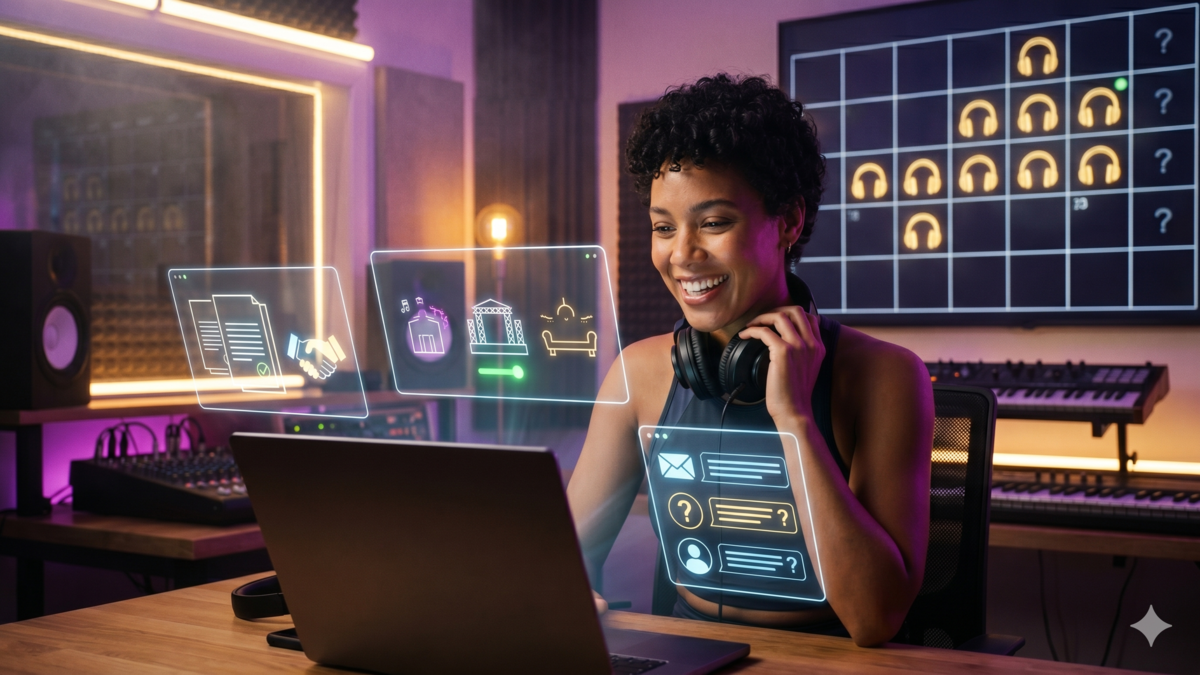
Something changed. Quietly, then all at once — the way most seismic shifts in creative industries tend to happen — the rules of professional DJing rewrote themselves. Having raw talent used to be enough. Having the right agent, the right connections, a handful of solid nights under your belt. That was the formula. It worked for a long time. But the landscape now is almost unrecognizable compared to even five years ago, and the artists still operating on the old assumptions are finding out the hard way. Event organizers want more than a good mix. They want market insight, brand coherence, a demonstrable track record — they want, essentially, to see that you’ve done your homework. Which is exhausting. Because most DJs got into this to make music, not to become their own marketing department. The administrative weight alone — chasing leads, writing pitches, managing contacts — can swallow the better part of a week. Time that should, by rights, be spent on music.
Enter 2026, and a tool that’s no longer theoretical. AI has crossed into the practical, the applied, the genuinely useful — and the DJ sector is starting to wake up to what that actually means. Not in a vague “the future is here” way, but in a concrete, granular, this-changes-how-I-work way. The integration of AI into DJ Career Growth & AI Tools is reshaping how artists approach the business side of things, and for DJs trying to increase the frequency *and* quality of their bookings — there are now actual, data-driven pathways to do that. Which is kind of extraordinary if you stop to think about it.
AI for Hyper-Targeted Market Research
Here’s the thing about market research: most DJs don’t do it. Not because they don’t care, but because doing it properly — manually — is almost impossible. You’d need to track local event calendars, monitor social media trends across multiple platforms, cross-reference streaming data, and somehow synthesize all of that into actionable insight. Nobody has time for that. Nobody.
AI does.
These algorithms can sift through immense, genuinely staggering volumes of data — social signals, streaming behavior, venue booking histories, geographic trends — and identify patterns that a human analyst would almost certainly miss. Location-specific genre demand becomes quantifiable. An AI platform can tell you, with reasonable confidence, that deep house is pulling consistent numbers at rooftop venues in a particular city during summer, or that Latin-inflected electronic music is gaining real traction at specific cultural festivals in a completely different market. That’s not intuition or industry gossip — it’s aggregate behavioral data. It’s the difference between throwing darts in the dark and turning the lights on.
Then there’s competitor analysis, which sounds cutthroat (maybe it is, a little) but is really just — knowing the terrain. AI can track other DJs in your area: their bookings, their social engagement, which venues keep returning to them. The purpose isn’t to copy anyone. It’s to find the gaps. Are there event types nobody’s servicing well? A particular sound a venue keeps reaching for but can’t quite land? That’s your opening, and the AI points you toward it.
Intelligent Lead Generation and Venue Matching
The gig hunt. God, the gig hunt. Anyone who’s spent an evening manually trawling event listings, venue websites, Facebook groups — you know the particular tedium of it. You scan the same platforms everyone else is scanning, hoping to spot something before it disappears into a flood of DMs from every other DJ in the city. It’s inefficient in a way that almost feels designed to wear you down.
AI functions here like a scout that never sleeps, never gets distracted, never misses a post because it was having a bad week. These platforms crawl the web continuously — identifying new venues, new promoters, emerging event series — and they learn your specific criteria. If you play techno and prefer industrial spaces, the system absorbs that and filters accordingly. It monitors relevant industry publications, booking platforms, news feeds, and flags opportunities as they surface. Some systems even analyze venue sound systems, typical crowd demographics, past lineups — to determine not just whether a gig exists, but whether it’s actually compatible with your sound. Qualified leads, not noise.
And then there’s the NLP stuff, which is — look, it sounds technical, but the practical application is simple and kind of remarkable. Natural language processing that parses event descriptions for keywords aligned with your genre, your experience level, your rough fee range. Imagine getting an alert: a promoter is looking for someone with a specific melodic techno profile for a weekly residency, here’s the venue, here’s the contact. That’s not a fantasy anymore. Forbes was writing about AI augmenting rather than replacing human professional roles back in late 2023 — what’s happened since then has only accelerated that argument.
Crafting Data-Driven Pitches and Proposals
A generic pitch email is essentially invisible. Promoters receive dozens — maybe hundreds — of these things and most of them read identically. “I’m a DJ with X years of experience and a passion for Y genre.” Fine. Sure. Next.
What actually cuts through is specificity. Knowing enough about a venue — its history, its tone, its audience — to write something that clearly wasn’t sent to fifty other people in a batch. AI can do the analytical groundwork for this. It can pull a venue’s event history, read their social media voice, profile their demographic. And then it helps you shape your language to match. If the room prides itself on genuinely underground bookings, your pitch should reflect that register — you can’t walk in talking about mainstream appeal. If their crowd skews young professionals on a Thursday night, the AI nudges your framing in that direction. It’s not manipulation exactly, it’s more like — translation. Speaking the language the decision-maker is already thinking in.
But the piece that really changes minds? Numbers. Hard data is almost unfairly persuasive. If you’ve been feeding the system performance data — social engagement post-event, even anonymized ticket or bar figures — AI can generate the kind of statistics that transform a pitch from a vibe into a business case. “Bar sales at my last three gigs were up 20% on the comparable week.” “My social reach increased 15% following my set at Venue X.” Promoters are not, at the end of the day, booking good music. They’re making business decisions. Demonstrate that you’re a business decision worth making. Meanwhile, the administrative scaffolding around all of this — tracking conversations, scheduling follow-ups, managing contacts — can be largely handled by tools built for exactly that purpose, covered extensively over at Streamlining DJ Business Admin with AI Assistants.
Predictive Booking and Performance Optimization
This is where it gets genuinely strange. In the best way.
The most sophisticated AI applications aren’t just finding gigs — they’re *predicting* them. Seasonality mapping that tells you, with increasing accuracy, which months will see elevated demand for specific sounds. Which holidays generate what kind of bookings. Which cultural moments (a film release, a sporting event, a summer festival season shift) ripple out into venue programming decisions. This foresight — and it really is foresight, not guesswork — lets you position yourself with promoters *before* the competition even knows the window is opening.
And then, post-gig, there’s the feedback loop. Which sounds clinical and maybe slightly uncomfortable, but the reality is useful: AI analyzing social sentiment around your performance. Did people respond to specific tracks? Were there murmurs of disappointment when the genre shifted? Aggregated, anonymized, objective feedback on your set that doesn’t depend on whether your friend is being politely dishonest or whether you got a sincere compliment at the door. This loops directly into the broader conversation happening at Automating Your DJ Setlist Creation with AI, where that same real-time feedback can start shaping future decisions dynamically. Harvard Business Review made the case back in 2023 that AI’s predictive capabilities were fundamentally reshaping strategic decision-making across sectors — anticipating shifts rather than reacting to them. DJs are, a bit surprisingly, living proof of that thesis.
Building a Stronger Online Presence and Brand
Your online presence is the first pitch you make to anyone. Before a single email is sent.
Content is the perennial problem — every artist knows they should be posting consistently, telling a coherent story across platforms, but the actual execution is tedious and time-consuming in a way that quietly drains the energy you need for making music. AI takes a significant chunk of that weight off. Generating social captions, drafting short-form posts, structuring a blog piece, sketching a video script — all anchored to your actual musical identity and tailored to what performs well on each specific platform. Optimal posting times. Hashtag strategy that isn’t just random guessing. Consistent messaging that reinforces rather than muddies the brand you’re trying to build.
Beyond content, AI-powered analytics can map the territory of influence in your niche — identifying tastemakers, relevant media outlets, potential collaborative partners. Not just getting noticed. Getting noticed by the *specific people* whose attention actually translates into something.
The Human Element Remains
Worth saying clearly: none of this replaces a DJ. It couldn’t if it tried — and the version that could wouldn’t be worth worrying about because it would be something else entirely, not DJing.
What AI handles is the data layer. The analysis, the lead generation, the administrative architecture, the optimization. What it *cannot* do is read a crowd’s energy at 1am when something unexpected happens. Cannot make the spontaneous call to abandon the prepared set because the room suddenly needs something else. Cannot build genuine relationships with promoters and peers over years of shared experiences. That territory stays human. Entirely, irreplaceably human.
AI provides the infrastructure. You provide the irreducible thing that makes any of this worth showing up for. And DJs who genuinely embrace this in 2026 — not anxiously, not skeptically, but as craftspeople who’ve always adapted to new instruments — are positioning themselves for something more sustainable, more strategic, and frankly more interesting than the old model ever allowed. It’s collaboration. A strange, lopsided, occasionally miraculous collaboration between human artistry and a machine that’s very, very good at finding the door you didn’t know was open.