
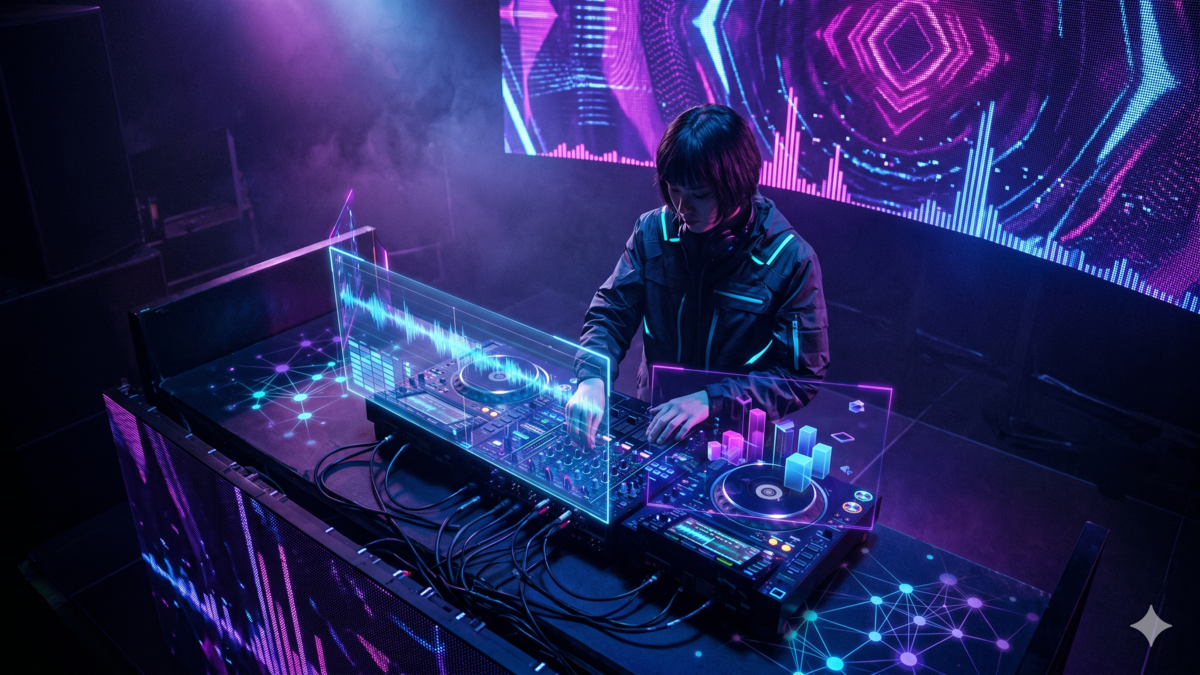
DJing has never *just* been about lining up two beats — anyone who tells you that hasn’t stood behind a booth at 2am watching a room full of strangers suddenly, inexplicably, become one thing. It’s sonic storytelling. It’s gut instinct colliding with technical muscle. For a long time — decades, honestly — the gold standard was beatmatching. Clean transitions. Smooth blends. That stuff still matters, obviously. But something shifted, and by 2026 the conversation has kind of exploded past all that. We’re not just talking about keeping things on time anymore. We’re talking about AI as a genuine — not gimmicky, *genuine* — creative partner. Which, yeah, sounds a little scary. But stick with me. This whole evolution cuts right to the heart of DJ Career Growth & AI Tools in ways nobody fully predicted.
The second you mention artificial intelligence and DJing in the same breath, people get defensive. Protective, even. And I get it — I really do. There’s this image of a machine just… doing it for you. Pressing play while you stand there looking decorative. But that’s not what’s happening. That’s not even close to what’s happening. AI here doesn’t dictate. It doesn’t take the wheel. It analyzes spectral content and emotional texture and rhythmic complexity and then — quietly, unobtrusively — it *suggests*. It handles the cognitive gruntwork so you can focus on the crowd, on energy, on that intangible thing you can’t quantify. It’s less replacement, more like having an incredibly well-read assistant who never gets tired and never sulks.
Intelligent Track Curation and Harmonic Progression
Remember when harmonic mixing just meant “same key, maybe relative minor”? Those days are gone. Quietly, quickly, completely gone.
Modern AI algorithms dig into music in a way that’s — frankly — kind of unsettling if you think about it too long. They’re not just reading key signatures. They’re parsing spectral content, emotional valence (which is a fancy way of saying “does this feel like 3pm sunshine or a Tuesday funeral”), and rhythmic complexity, all simultaneously, across libraries that would take a human years to manually tag. An AI assistant baked into your software can take the current track’s timbres, its transient behavior, its harmonic density — and cross-reference all of that against everything else you own. Not just BPM matches. Psychoacoustic siblings. Tracks that *feel* like each other even when they look nothing alike on paper. A 2025 study on professional DJ practices found a roughly 15% improvement in perceived “flow” during sets using these kinds of recommendation engines — which, sure, is a stat, but also matches what I’ve heard from people who’ve actually used these systems in live environments.
Precision Transition & Morphing
Beatmatching is alignment. Fine. But alignment is just the beginning — the baseline, the floor — not the ceiling.
What advanced mixing actually demands is *dynamic manipulation*. Real-time audio warping. Intelligent EQ morphing. Compression adjustments that respond to the incoming track’s particular brand of loudness. These aren’t abstract future-things anymore; they’re here, and they’re wild. An intelligent beat grid system can now predict — and I mean predict, not just detect — subtle tempo fluctuations in live recordings or older analog pressings that were never meant to be digitally manipulated. It adjusts with microsecond accuracy. Cue points become reliable in a way they genuinely weren’t before. And the EQ stuff? AI-driven equalizers that learn the spectral fingerprint of both the outgoing and incoming track, then execute a crossfade where individual frequency bands blend independently — so you don’t get that muddy, soupy wall of sound that used to define a clumsy mix. The result sounds less like a transition and more like one continuous piece of music that just… keeps evolving. Seamlessly. Some of this hardware-level wizardry is explored in depth over at The Future of DJ Hardware: AI Integration in Controllers & Decks, which — if you haven’t read it — go read it.
Real-time Effect Generation and Suggestion
Effects are polarizing. Overuse them and you’re that guy. Underuse them and the set feels flat, undressed.
AI is wading into this territory now and — honestly? — doing a pretty thoughtful job of it. Picture a track hitting a sparse, open passage. The algorithm reads the frequency content of that gap and suggests a reverb specifically shaped to fit it — not a preset, a generated parameter set — and then automates the decay curve to resolve cleanly before the next phrase kicks in. Or a drum break appears and the system nudges a filter sweep into place, timed to the bar. What’s interesting is these aren’t canned responses. The system is — and this is the part that sounds almost too sci-fi — learning your taste. Building a model of what you do and don’t reach for. Then generating effect parameters that feel like extensions of your choices, not intrusions on them. You’re still the one deciding whether it happens. You’re still the arbiter. But the options arriving on your metaphorical desk are richer than they would be otherwise.
Bridging Genre Gaps
This one matters. This one changes everything for a certain kind of DJ.
The ability to move between genres — fluidly, without the audience noticing the seams — has always separated the great ones from the technically proficient ones. It requires deep musical knowledge, an almost architectural understanding of how rhythmic structures relate to each other across different traditions. It requires extensive re-editing, careful preparation. AI is eating into that prep time fast. By identifying shared rhythmic motifs, underlying melodic structures, common transient characteristics between tracks that on the surface have nothing in common — it can suggest specific transition points. Better yet, it can generate short contextual bridges: a percussive loop, a filtered melodic fragment that exists in both worlds at once. It’s not eliminating the need for creative vision. It’s giving that vision a larger canvas to paint on. Open-format DJs especially — this is a genuinely exciting development.
Table: Comparison of Traditional vs. AI-Augmented Mixing
| Aspect of Mixing | Traditional Approach | AI-Augmented Approach (2026) |
|---|---|---|
| Track Selection | Manual recall, key analysis, personal experience. | AI-driven harmonic, emotional, and energy curve compatibility suggestions across vast libraries. |
| Tempo/Beat Alignment | Manual beatmatching, minor sync adjustments. | Microsecond-accurate grid alignment, real-time tempo drift compensation for analog sources. |
| EQ Blending | Manual high/mid/low cut, subjective ear. | Dynamic spectral morphing, AI-identified problem frequencies, automatic gain staging. |
| Effect Application | Preset application, manual parameter adjustment. | Context-aware effect generation, real-time parameter modulation based on audio analysis. |
| Genre Transition | Requires extensive pre-editing, very careful track selection. | AI-identified shared musical motifs, generative audio bridges for smoother cross-genre mixes. |
| Set Preparation Time | Significant time for track organization and cue setting. | Reduced analysis time, AI-suggested set flows, automated cue point generation. |
The DJ’s Evolving Role
None of this diminishes the DJ. If anything — and I want to be careful here because this sounds like empty reassurance but I don’t mean it that way — it raises the stakes for what a DJ actually *is*.
The role shifts from technician to director. From someone managing mechanical processes to someone in dialogue with intelligent systems — curating, refining, injecting personality into outputs that would otherwise be technically impeccable but emotionally hollow. The crowd connection doesn’t move. That stays exactly where it’s always been: at the center of everything. AI just hands you a richer set of instruments to play. Think of it less like outsourcing and more like getting a sampler for the first time — suddenly the possibilities expand, but only if you take the time to learn the instrument properly. The learning curve is real. The payoff is realer. And mastery of these tools is increasingly becoming a core part of how DJs differentiate themselves, which feeds directly into conversations about Building Your DJ Brand with AI: Logos, Websites & Content.
There are problems, obviously. Over-reliance on any system — algorithmic or otherwise — leads to sterile, predictable sets. The training data powering these models needs to be diverse; biased datasets produce biased suggestions, full stop. And if crowd-response data ever becomes a real-time input (it’s being discussed, quietly, in certain developer circles), the privacy implications get serious fast — not hypothetical serious, *actually* serious. (For a broader look at the ethics tangled up in all of this: Wikipedia: Ethics of artificial intelligence.)
But look. The best DJs have always been early adopters, almost compulsively. Vinyl to CDJs. Analog to digital. Each time there was resistance, and each time the people who leaned in found new languages to speak. The spirit underneath all of it — the curiosity, the hunger for the perfect mix, the desire to make a room feel something it didn’t feel ten seconds ago — that hasn’t changed and won’t. AI is just the newest instrument in the booth. Loud, strange, occasionally overwhelming, and — in the right hands — genuinely transformative. It’s not coming; it’s here. (The Brookings Institution has a worthwhile read on what this kind of shift means more broadly for creative work: Brookings: How Artificial Intelligence Will Affect the Future of Work.)