
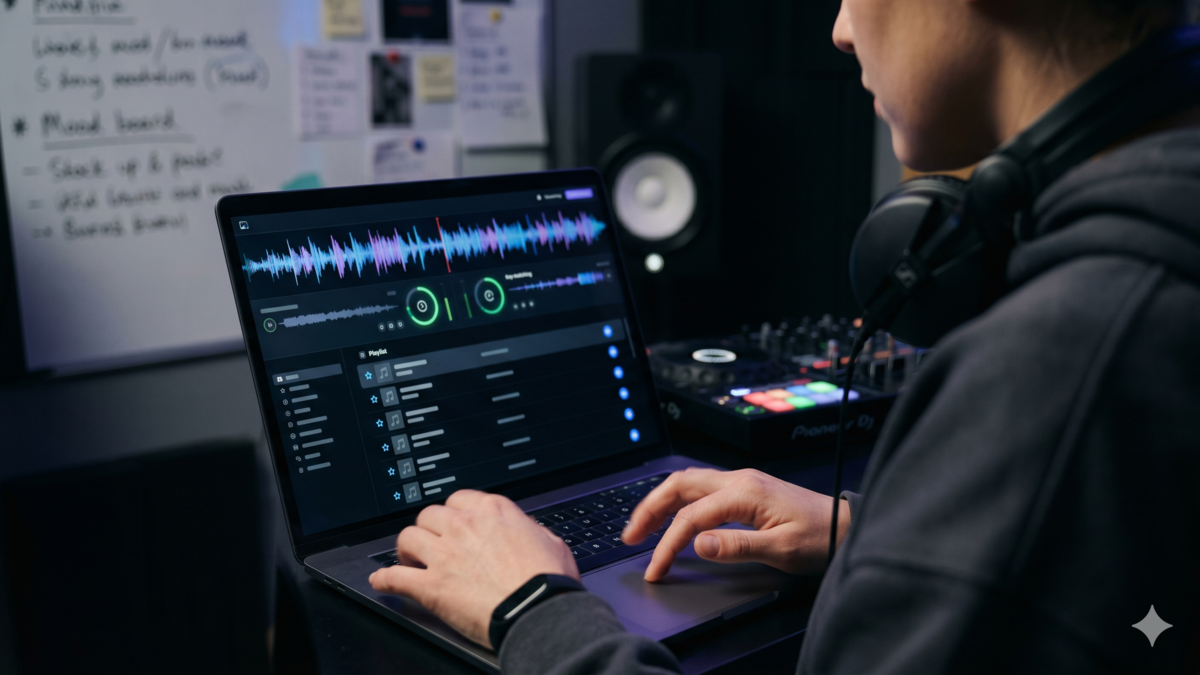
There’s a specific kind of exhaustion that sets in around the third hour of digging — and I don’t mean the good kind, the trance-like state where you’re deep in a record store and time stops making sense. I mean the screen-staring, tab-switching, preview-clicking exhaustion of trying to find *the track* in 2026, when the track could be literally anywhere, buried under the avalanche of releases that hit digital stores every single day. Thousands of them. Daily. Beatport alone processes enough new uploads each week to fill a library that would take a human listener months to get through — and that’s one platform. Multiply that across the full ecosystem and the math stops being daunting and starts being almost philosophical. An impossible abundance. Which is its own kind of poverty, if you think about it.
This is the central paradox facing serious DJs right now — and it’s not a small one. The opportunity has never been richer. Somewhere in that deluge of releases is the track that defines your next set, that becomes *your* track, the one audiences associate with your particular sound. But finding it, consistently, using the old methods? The endless manual dig, the limited network of trusted recommenders, the platforms built for passive listening rather than active performance curation — that model is creaking under its own weight. It’s not sustainable. And for DJs trying to actually grow — to use music curation as the strategic lever it genuinely is — there’s now a better architecture available. That’s what this is about, and it connects directly to the broader shift documented in DJ Career Growth & AI Tools.
The Curation Conundrum: Too Much Signal, Too Much Noise
The haystack metaphor doesn’t quite capture it anymore. It’s less like looking for a needle in a haystack and more like looking for a specific needle in a warehouse full of haystacks, where new haystacks are being delivered while you’re still searching the first one.
Traditional discovery methods — manual browsing, genre tags, “similar artists” carousels, what your network is playing — were built for a different volume of music. They work on the surface. They surface what’s popular, what’s algorithmically adjacent, what fits within the narrow corridors of human-assigned genre categories. What they consistently miss are the deeper structural connections that actually matter to a DJ: subtle tempo relationships, harmonic compatibility across genre boundaries, energy arc similarities between tracks that look nothing alike in a catalog. “Mixability” — that holistic, felt quality of whether two tracks can live in the same set — is not a tag. It’s not a filter option. It exists in the music itself, at a level of granularity that standard metadata simply doesn’t capture.
So you waste time. Enormous amounts of it. Previewing tracks that are almost right. Downloading things you play once. Missing records that would’ve been perfect because the algorithm served you something louder and more promoted instead.
AI Transforms Discovery: Beyond Simple Tags
Modern AI approaches music differently — at the level of the audio itself, not the label applied to it afterward. Machine learning models trained on vast sonic datasets don’t just read that a track is tagged “deep house” and move on. They *listen* — analyzing harmonic content, rhythmic complexity, timbral texture, perceived emotional valence, energy density, structural shape. Hundreds of distinct audio features per track, computed with the kind of systematic attention that human ears simply can’t sustain across thousands of releases a week.
What this produces is a form of musical understanding that cuts across the artificial boundaries of genre classification. An AI can identify a deep house track with a broken-beat element buried in the percussion — something a human curator scanning a release list would almost certainly scroll past — and recognize that specific rhythmic signature as a connecting tissue to other tracks, in completely different genres, that share that characteristic. Suddenly you have a transition possibility you would never have found manually. A connection that didn’t exist in any tag or category, only in the actual sound.
That’s not a marginal efficiency improvement. That’s a fundamentally different kind of curation.
Predictive Analytics: Spotting Trends Early
Here’s the thing about trends — by the time they’re obviously trends, you’ve already missed the interesting window. The artists and DJs who seem to consistently be *ahead* of things aren’t necessarily more talented or more connected. They’re often just operating with better information, earlier. They saw the wave forming before it broke.
AI makes this kind of early detection increasingly available to everyone, not just people with industry-insider networks. By continuously monitoring global consumption patterns, social engagement across independent platforms, emerging artist activity in specific scenes — AI models can identify nascent sounds and sub-genre formations before they hit mainstream saturation. Not what’s being pushed by major labels (that’s always available, always loud, never particularly interesting as a discovery). What’s gaining organic traction in smaller communities, what bassline processing technique is appearing more frequently across independent releases, what vocal approach is suddenly showing up in tracks from unconnected producers across three different countries. These micro-signals aggregate into pattern, and pattern becomes prediction.
You incorporate those sounds early. Your sets are reflecting where music is going rather than where it’s been. The difference, from an audience perspective, is enormous — even if they couldn’t articulate what they’re responding to.
Personalized Recommendation Engines: Refining Your Sonic Signature
Generic recommendations are — fine. Tolerable. About as useful as a stranger at a record store saying “oh, if you like that, you might like this” based on a thirty-second glance at your selections. Personalized AI recommendation engines are something categorically different. They absorb your actual library. They analyze what you play most, what sits at the core of your sets versus the periphery, what harmonic relationships you consistently gravitate toward, what drum sounds appear again and again across your selections. They build a model of your taste that is — and this is where it gets genuinely interesting — more granular than you could probably articulate yourself.
Imagine knowing that you have a very specific preference for progressive trance tracks with slightly melancholic arpeggios in a particular key range — not because you’ve ever described it that way, but because the AI mapped it from your listening behavior. And then imagine being served new releases that match that specific fingerprint, sourced from labels and territories you’d never have found on your own. That level of precision was not achievable before. It’s achievable now. Not perfectly, not without occasional misses, but with enough reliability to meaningfully change the economics of your digging time.
Metadata Enrichment: Smarter Organization
Slightly less glamorous than trend prediction, but honestly — possibly more immediately useful for day-to-day workflow. AI-powered metadata enrichment goes beyond the surface layer of genre, BPM, and artist name. It generates detailed harmonic analysis (key, mode, the specific quality of the harmonic content), energy gradient profiles (not just a single energy rating but a map of how the energy moves across the track’s structure), rhythmic density, and structural breakdowns — intro, build, drop, breakdown, outro — tagged automatically.
The practical payoff is enormous. Being able to search your library for “E minor, high energy, extended melodic breakdown over four minutes” and actually get useful results — that changes how you prepare, and it changes how you perform when something unexpected happens mid-set and you need a specific kind of track in thirty seconds. The library stops being an archive you navigate from memory and becomes something more like a responsive instrument.
Practical Applications in 2026: Tools for the Modern DJ
The tools have arrived. They’re not all equally good — the market is still shaking out, and some of what’s being marketed as “AI-powered” is closer to enhanced filtering — but the serious applications are genuinely transformative.
Intelligent record pools have moved well past human-curated “similar artist” sections. The better ones now predict your preferences from download history with enough accuracy to surface records you’d never have found independently. Library analysis tools exist — desktop applications, some of them remarkable — that map your entire local collection, identify stylistic clusters and harmonic relationships you’d never consciously noticed, reveal mixing possibilities hiding inside music you’ve owned for years. And audience preference analytics, drawing on social media engagement and streaming data, help you understand not just what you like but what your specific audience responds to — which is related but not identical, and the gap between those two things is worth knowing. This connects outward to AI-Powered Social Media Strategies for DJs, where track selection and content strategy start to inform each other in genuinely interesting ways.
The Data Behind the Decisions
For the technically curious — the infrastructure underlying all of this involves Convolutional Neural Networks and Recurrent Neural Networks processing raw audio files at scale, learning to identify patterns that correspond to musical characteristics across millions of tracks. CNNs are particularly effective at recognizing specific drum patterns and melodic motifs; RNNs handle the temporal dimension, the way musical characteristics evolve across a track’s structure. The Georgia Tech Center for Music Technology has been doing rigorous work in this space for years — their research illustrates how rapidly the accuracy and sophistication of these systems has improved (Georgia Tech Center for Music Technology). These models aren’t guessing. They’re computing probabilities based on statistical correlations between audio features and human response patterns, across datasets of a size that no individual human ear could process in several lifetimes.
The more data these systems ingest, the sharper their predictions become. Which means the tools available in 2027 will be meaningfully better than the ones available today. Which means early adoption isn’t just advantageous — it’s compounding.
The Human Element Remains Critical
Worth saying, and worth saying directly: none of this is about replacement. The instinct — that specific, non-transferable gut feeling about whether a track has *it*, whether it will do something to a room, whether it belongs in your story — that stays human. Completely. It can’t be modeled out of existence because it’s not a pattern, it’s a judgment, rooted in experience and context and the particular mystery of what moves people in a specific moment.
What AI removes is the friction between you and the tracks worth making that judgment about. It collapses the search space. It handles the analytical grunt work of discovery and organization so that when you’re standing in front of your library deciding what to play, you’re choosing from a genuinely curated set of options rather than whatever the algorithm of the day decided to surface. The canvas is richer. What you paint on it is still yours.
Best Practices for Integrating AI into Your Workflow
A few things learned from DJs who’ve actually integrated these tools seriously, rather than dabbling:
Start with one tool. Seriously — the temptation to adopt everything at once produces chaos, not clarity. Pick the application that addresses your most acute pain point (discovery, organization, trend tracking) and learn it properly before adding layers.
Feed it feedback, constantly. These systems learn from your corrections. A recommendation you mark as irrelevant trains the model just as much as one you act on. The more signal you give, the more accurate the suggestions become. It’s a relationship, not a vending machine.
Filter everything through your aesthetic, always. AI will find you tracks that are technically compatible with your sound profile. Not all of them will serve your *artistic* vision, and that distinction matters. Use the suggestions as raw material, not final answers.
Combine approaches. The DJs producing the most interesting music discoveries tend to use AI and manual digging together — the AI for breadth and pattern recognition, the manual dig for the serendipitous, unexplainable find that no model would have surfaced. Hybrid approaches consistently outperform either method alone.
And then — this is the part people underestimate — think about how these musical insights radiate outward. Understanding what tracks resonate with specific demographics isn’t just set preparation information. It’s brand information. It informs your pitch to venues, your content strategy, your positioning. It intersects with everything from AI for DJ Contract Management and Legal Protection, where data-backed market knowledge strengthens your rate negotiations, to Optimizing Your DJ Online Presence with AI SEO Tools, where aligning content with detected musical trends compounds your visibility. The intelligence flows through the whole operation.
The future of DJing is not less creative for any of this — it’s more so. More informed, more precise, more capable of the kind of bold choices that only become possible when you’re not spending half your bandwidth on the mechanical work of finding and organizing music. Harvard Business Review mapped this dynamic across industries in 2023, and the pattern holds for creative fields just as much as commercial ones (Harvard Business Review). Ignoring these tools isn’t an aesthetic choice anymore. It’s just leaving capability on the table. And the competition isn’t leaving anything on the table.