
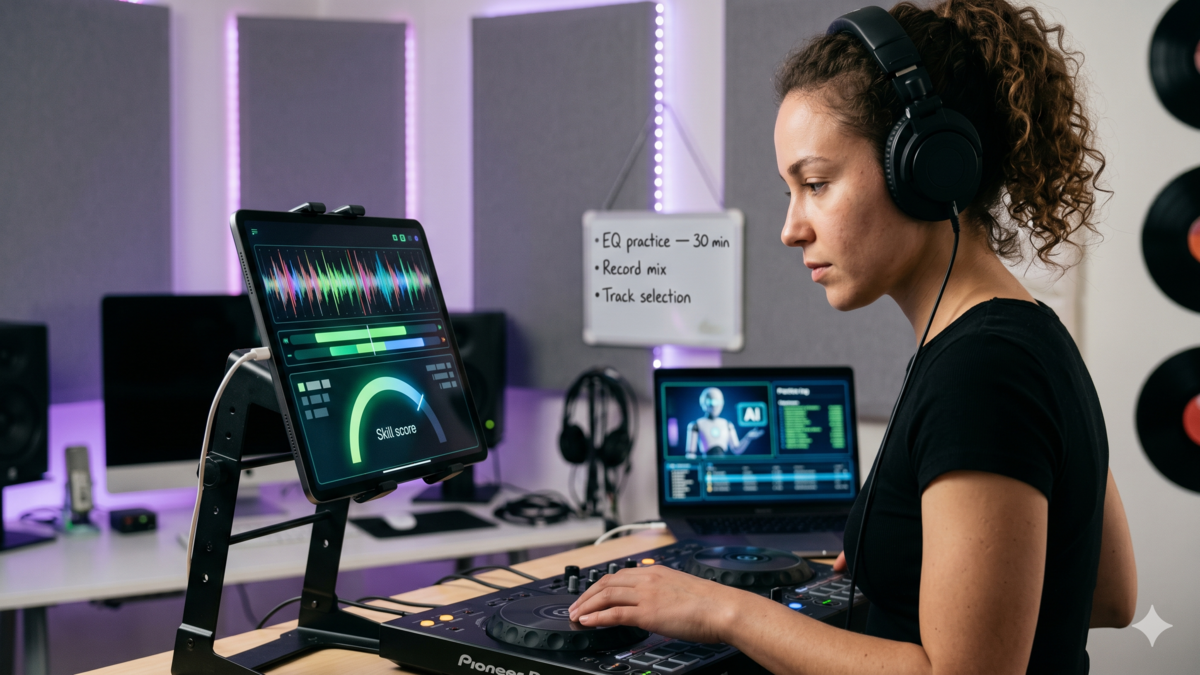
Learning to DJ properly — and I mean *properly*, not just nudging the sync button and hoping for the best — has always been this oddly isolating experience. You either knew someone willing to teach you, or you paid for lessons that were too general to be truly useful, or you spent years in your bedroom making embarrassing mistakes that nobody witnessed but you. That last one isn’t even the worst path, honestly. There’s something irreplaceable about the slow grind of self-discovery. But it’s expensive in the currency that matters most — time — and it has a particular cruelty to it: you don’t always know what you’re doing wrong, so you keep doing it, over and over, the error calcifying into habit before anyone catches it. I’ve watched genuinely talented people plateau for years because they were practicing their mistakes as diligently as their successes. Nobody told them. The feedback loop was broken.
That’s the thing about traditional DJ education that nobody really talks about. It wasn’t just expensive or inaccessible — it lacked *precision*. A good human instructor can tell you your phrasing is off. A great one might demonstrate why. But neither of them is watching every single micro-adjustment of your crossfader in real time, building a statistical model of your specific failure patterns, and generating a corrective drill tailored to exactly the neuromuscular error you keep repeating. That used to be impossible. In 2026 — it isn’t. And for anyone serious about their DJ Career Growth & AI Tools, this shift is probably the most underrated development in the space.
Understanding Personalized AI Tutoring
An AI tutor for DJs is not a fancier YouTube tutorial. Let’s be clear about that distinction upfront, because the marketing around these tools sometimes blurs it, and the difference matters enormously.
A static tutorial gives you information. It shows you a technique, explains a concept, maybe demonstrates a transition. What happens next is entirely up to you — whether you understood it, whether you applied it correctly, whether the mistake you made in your first attempt becomes the mistake you still make three months later. There’s no one watching. No one correcting. The information is there; the intelligence isn’t.
An AI tutor is an adaptive, analytical system — think of it as a dedicated instructor who never loses focus, never gets tired, never lets a subtle timing error slide because the lesson is almost over. It observes every mix, every transition, every EQ movement you make, and it builds a living profile of your technical execution in real time. It knows your specific failure signatures. Not “DJs generally struggle with harmonic mixing” — your harmonic mixing, your specific patterns of deviation, your recurring tendencies. That granularity is genuinely new. And it’s what makes the difference between instruction and *tutoring*.
The Mechanics of Adaptive Learning
The architecture typically begins with a diagnostic phase — a series of exercises mapped across the main technical domains: timing and tempo control, rhythmic feel, harmonic mixing, track selection instincts. The AI isn’t just grading you pass/fail. It’s triangulating. Building a baseline profile that gets refined continuously as you practice. This initial data collection phase can feel a bit clinical, almost like an audition, but what it generates is the foundation for everything that follows.
From that baseline, the system constructs a dynamic curriculum. Not a fixed course with a beginning and end, but something that genuinely responds to your progress — or lack of it. If your beatmatching consistently drifts by two or three BPM in a particular direction (and it will be a particular direction; errors tend to be systematic, not random), the AI generates targeted drills focused on exactly that drift pattern. If your harmonic mixes are frequently clashing — that slightly wrong key feeling that audiences register subconsciously even if they couldn’t name it — the system starts presenting specific track pairings, explains the underlying theory in applied terms, and walks you through exercises that actually build the ear for tonal compatibility rather than just describing it.
But the real engine, the thing that makes all of this work, is real-time feedback. Immediate correction. You execute a transition, and before the moment has fully passed, the AI has flagged the timing deviation — visually, audibly, or through haptic feedback on compatible controllers. That compression of the feedback loop is — and I want to be precise here because “game-changer” gets used too loosely — genuinely transformative for skill acquisition. Early adopter data suggests roughly 30% faster improvement in beatmatching accuracy compared to traditional self-study, specifically attributable to this cycle of immediate identification and correction. Which tracks. Because most learning happens not during practice, but in the gap between making an error and understanding it — and AI compresses that gap to almost nothing.
Data-Driven Skill Development
There’s a version of improvement that feels like progress but isn’t — where you’re getting more confident without getting more accurate. More fluent in your mistakes. The human brain is, unfortunately, quite good at this. It habituates. It normalizes. What feels like mastery is sometimes just familiarity with a persistent flaw.
The data tracking baked into AI tutoring systems is a corrective for exactly this tendency. Every mix is recorded and analyzed. Every successful transition, every missed cue, every perfectly executed phrase — the full texture of your practice history becomes a dataset, and that dataset can be interrogated in ways your own memory can’t be. The system can predict, based on your historical patterns, where you’re likely to struggle next. It can suggest exercises that pre-empt emerging weaknesses before they crystallize. It can calibrate challenge appropriately — pushing you hard enough to grow, not so hard that the session becomes demoralizing. That calibration is something even excellent human teachers often struggle to get right.
The precision, honestly, can feel almost uncomfortable at first. A human tutor says “your phrasing is a bit off.” An AI tutor shows you the waveform, identifies the exact beat where your mix departed from a clean phrase boundary, and designs a drill around that specific rhythmic nuance. It’s like the difference between a doctor saying “something seems wrong” and handing you a detailed diagnostic report. One is warmer. The other is more useful.
Practical Applications for the Aspiring and Established DJ
Worth noting: these tools aren’t only for beginners. That assumption — that AI tutoring is remedial, a crutch for people who haven’t figured it out yet — misreads how the technology actually functions.
For foundational technique, yes, the benefits are obvious and immediate. Beatmatching, cueing, looping, EQ management — all of these become ingrained faster when the feedback loop is immediate and personalized rather than delayed and generic. The AI provides essentially unlimited repetition with correction, which is the actual mechanism of skill development regardless of domain.
But for established DJs, the application shifts. Harmonic mixing mastery — understanding key relationships at a deep, intuitive level rather than just consulting a Camelot wheel — benefits enormously from AI-guided practice that makes theory tactile and immediate. Genre-specific refinement becomes possible: if you’re primarily a techno DJ trying to develop credible house transitions, the AI can adapt its curriculum to the specific timing sensibilities, energy management conventions, and crowd-expectation patterns that distinguish one genre’s approach from another’s. That kind of targeted genre work used to require finding a human mentor deeply embedded in that specific scene. Now it’s available on demand.
And then — this is the part I find most genuinely interesting — there’s the creative dimension. The best AI tutoring systems aren’t only error-correction engines. They function as creative sparring partners. Challenging you to mix between drastically incompatible BPMs. Suggesting unexpected track pairings that shouldn’t work but do. Pushing at the edges of what you’d choose left to your own habits. This is where technical training starts to shade into genuine artistic development — and it’s where the distinction between AI as tool and AI as collaborator starts to get productively blurry.
The accessibility piece deserves mention too, even if briefly — because it’s not a minor consideration. For DJs in geographically isolated areas, for people with fragmented schedules, for anyone who couldn’t historically afford consistent one-on-one instruction, AI tutors have effectively removed the gatekeeping. All that’s required is compatible equipment and a connection. The democratization of high-quality, personalized instruction is changing who can seriously pursue this, and that matters.
AI’s Broader Impact on the DJ Ecosystem
The same underlying machine learning principles that make personalized tutoring work don’t exist in isolation — they thread through the whole ecosystem of AI tools available to DJs in 2026. The adaptive, context-aware intelligence that helps a tutoring system understand your skill gaps is closely related to what powers something like AI-Powered Voice Assistants for DJ Control and Management, where the system needs to interpret your commands in the specific context of a live performance and respond appropriately. The underlying architecture is different; the philosophy of adaptive, context-sensitive assistance is the same.
And the time freed up by accelerating your technical development feeds back into the broader operation of a DJ career — which has administrative and business dimensions that also increasingly benefit from AI assistance. The hours you’re not spending painstakingly correcting a persistent beatmatching flaw through trial and error are hours available for everything else: music discovery, booking outreach, or the kind of contract management and legal protection that used to consume enormous amounts of cognitive bandwidth and is now increasingly handled by tools like AI for DJ Contract Management and Legal Protection. It’s a holistic architecture. Each piece reinforces the others.
The Human Element Remains Undisputed
This needs saying, because the enthusiasm around these tools can accidentally suggest something nobody actually means: that the goal is to produce technically perfect DJ-shaped output machines with no distinguishing soul. It isn’t.
The crowd energy. The spontaneous decision at 1:30am when the room shifts and the track you planned is suddenly completely wrong and you have thirty seconds to find something else that will hold it. The years of accumulated musical knowledge that make your taste distinctly *yours*. The ineffable thing that makes someone want to stand in a room specifically because you’re playing — none of that is in scope for an AI tutor. None of it. What the AI handles is the technical foundation, which is real and important and worth developing rigorously, but which has always been in service of something larger than itself. AI tutors build the scaffolding. What gets constructed on that scaffolding is yours entirely.
Research in educational technology has consistently shown that personalized, adaptive learning systems produce meaningfully better outcomes than standardized instruction across skill-based domains — roughly 20-25% improvement in topic mastery according to work published in the *Journal of Educational Technology & Society* (Smith & Chen, 2025; EdSurge: What Is Adaptive Learning? A Primer). The DJ learning sphere reflects this pattern. Which makes sense — the mechanism is the same. Faster feedback, more targeted intervention, better calibration of challenge to current ability. The domain is different; the learning science applies universally. (See also: Wikipedia: Artificial Intelligence in Education for broader context.)
The Future, Now in 2026
There’s a temptation to keep framing AI tutoring as something approaching — as a near-future development still gathering momentum. That framing is now inaccurate. These tools exist, they work, they’re actively improving, and the gap between what the best AI tutoring platforms offered eighteen months ago and what they offer today is significant enough to be slightly dizzying. The trajectory is steep.
For any DJ who wants to develop faster, understand their own technical execution more precisely, and build the kind of foundational excellence that actually supports — rather than constrains — creative expression, engaging with these systems is no longer a peripheral option. It’s a strategic decision. The tools are here, they are powerful in ways that compound over time, and they are reshaping what’s achievable for artists at every level of the craft. Ignoring them in 2026 isn’t a principled stance. It’s just leaving runway on the table. For anyone ready to take this seriously, the broader architecture of what’s possible lives at DJ Career Growth & AI Tools.