
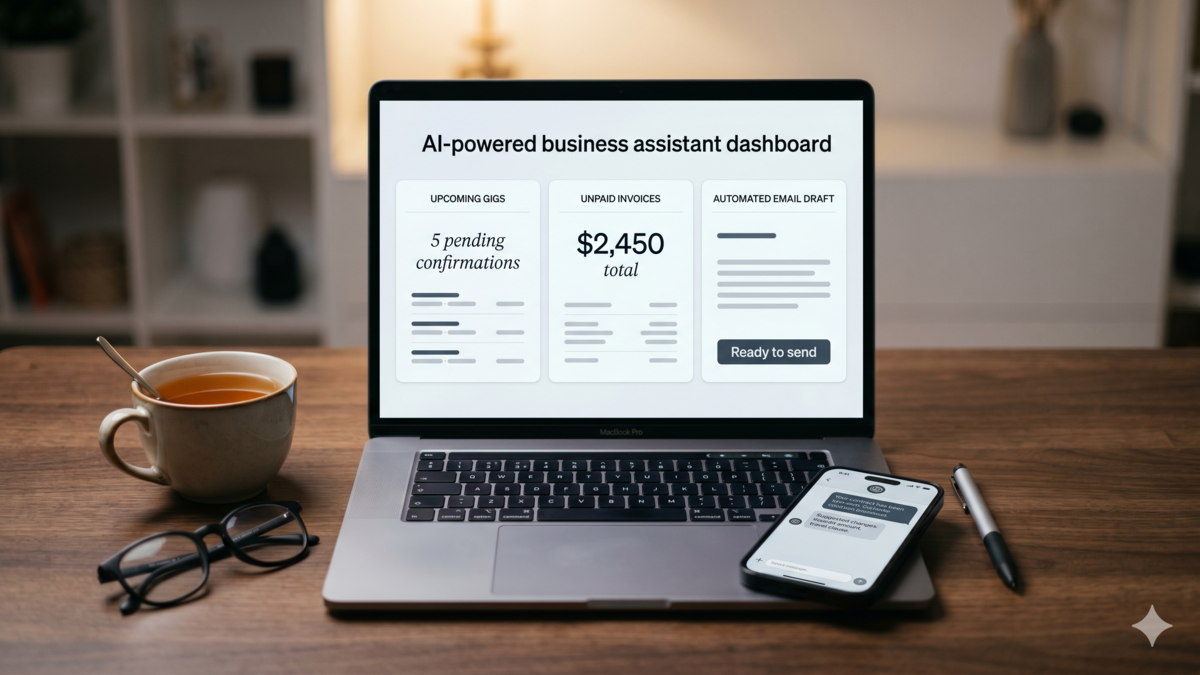
There’s a particular kind of Sunday afternoon dread that every working DJ knows. The gig was Saturday night — it went well, maybe better than well, maybe there were moments where the room became something alive and collective and extraordinary — and then Monday is coming, and with it: the invoice you haven’t sent, the contract you need to follow up on, the Instagram post you meant to schedule three days ago, the booking inquiry from Friday that’s sitting unanswered in your inbox like a small accusation. The creative high and the administrative hangover, arriving together, every single time. It’s a specific exhaustion. The kind that doesn’t come from the work you love but from the scaffolding around it — the relentless, unglamorous machinery of running a business that happens to involve art.
This has been the silent tax on professional DJing for as long as anyone can remember. Not the mixing, not the music selection, not even the gig procurement — those feel like *the job*. The administrative weight is something else. Booking inquiries, contract drafts, invoicing, social media calendars, travel logistics, follow-up emails at 11pm because the client is in a different timezone and apparently doesn’t sleep — collectively these consume hours that should, by any reasonable accounting, be spent on music. In 2026, that calculus is finally, genuinely, changing. AI assistants have crossed from theoretical convenience into operational reality, and for DJs serious about the long game, our guide on DJ Career Growth & AI Tools maps out how all of this connects. But let’s get into the specifics, because the specifics are where it gets interesting.
Transforming Client Communication and Booking Workflows
It’s 2am. An inquiry comes in — someone wants a DJ for a corporate event in six weeks, they have questions about rates and availability and whether you do requests (ugh, always requests), and they want a response quickly because they’re also talking to three other DJs and the responsive one tends to win. Historically, that email waits until morning. Maybe until after coffee. Maybe until a version of you that’s slightly more functional has had time to compose something professional rather than something that reflects the specific fraying quality of 2am brain.
AI-powered chatbots handle this now. Immediately, intelligently, without the fraying. They field the initial inquiry — common questions about availability, package options, rates, logistics — and they do it in a voice you’ve calibrated, not some generic corporate-bot monotone. Research has consistently shown that businesses using AI for initial client communication see response time reductions of around 25%, which translates directly into higher conversion rates. For a solo DJ operating without an assistant, that’s not a marginal improvement. That’s potentially the difference between getting the gig and losing it to someone who just happened to be awake.
And it extends further than the first message. An AI assistant that cross-references your calendar against client preferences, surfaces available slots, generates a preliminary quote from your rate templates, drafts a contract — and sends it for e-signature — all from a single incoming inquiry. The back-and-forth collapses. The details stop slipping through cracks. And you, somehow, find yourself thinking about the performance itself rather than the paperwork surrounding it. Which is — honestly? — a kind of luxury that feels almost suspicious after years of the alternative.
Marketing and Social Media: Precision, Not Guesswork
Consistent content. The two words that make most independent DJs quietly want to lie down on the floor and stare at the ceiling. It’s not that the content doesn’t exist — every gig generates material, every set has moments worth sharing — it’s that transforming raw experience into polished, platform-optimized, strategically timed posts requires a different kind of energy than the gig itself, and that energy is often the first thing to go.
AI assistants are absorbing substantial portions of this burden. They analyze which of your previous posts actually performed — not which ones you felt best about, but which ones generated the engagement that matters — and they identify patterns: optimal posting times for your specific audience, content formats that convert, caption approaches that resonate with the particular demographic that books you. They generate caption drafts, promotional copy, even short video edits from existing footage with text overlays and audio snippets, in minutes rather than hours. Your voice is still there — you review, you refine, you add the specific detail that only you could add. But the blank-page paralysis that kills consistency? Gone.
Targeted advertising gets sharper too. AI algorithms analyzing demographic data and engagement patterns can identify potential clients with a precision that manual ad targeting simply can’t match — you reach the right people, at the right moment, with messaging calibrated to actually land. Some DJs are finding real creative synergy by connecting these marketing tools with their music discovery workflows via AI for DJ Music Curation, so that what they’re promoting actually reflects where their sound currently lives. Which sounds obvious, but the gap between a DJ’s actual current sound and their online presence is, in practice, often wider than anyone intends.
Financial Management: Accuracy and Clarity
Nobody — nobody — got into DJing because they love invoicing. And yet the invoicing has to happen, or the whole enterprise stops making economic sense. The financial layer of a DJ business is critically important and almost universally neglected, not from carelessness but from the very human tendency to deprioritize the thing that feels least like the actual work. Which creates a quietly accumulating problem: delayed payments, murky expense tracking, tax season arriving like an ambush, no clear picture of whether the business is actually profitable or just busy.
AI-driven financial automation is genuinely, almost embarrassingly, good at this stuff. Invoices generated and dispatched the moment a booking is confirmed or completed. Payment status tracked automatically, polite reminders deployed when due dates approach — without you having to remember, without you having to send the slightly awkward “just following up” email. Expense categorization from linked accounts or scanned receipts, producing real-time financial snapshots that make your actual financial position legible at any moment rather than a quarterly reckoning. As Forbes reported in late 2023, AI’s capacity to automate financial tasks while freeing professionals for higher-level analysis has been demonstrated convincingly across industries. For a DJ, the translation is simple: less time wrestling with spreadsheets, more time behind the decks. The dashboard is always there. The dread about what the numbers might say starts to dissolve when you can see them clearly, all the time, without effort.
Content and Asset Management: Your Digital Archive, Sorted
Years of gigging produces an archaeology of digital assets. Music libraries sprawling across multiple drives. Promotional photos from photographers whose names you’ve half-forgotten. Clips from that festival set two summers ago that you keep meaning to edit properly. Client testimonials buried in email threads. The whole accumulation representing real value — promotional, practical, professional — that’s almost completely inaccessible because it’s organized by the logic of urgency rather than the logic of use. Where things landed when you were tired, not where you’d look for them when you need them.
AI-powered asset management cuts through this. Automatic tagging and categorization based on content, date, context, client — granular enough that “high-energy outdoor set, summer 2025, crowd shots” surfaces the right material immediately rather than requiring twenty minutes of folder archaeology before a client meeting. Audio tracks analyzed for BPM, genre, energy profile, mood — metadata generated automatically that makes your library actually functional rather than just large. This connects naturally into how smart DJs are using Automating Your DJ Setlist Creation with AI tools, where that same rich metadata informs intelligent set building. The assets you’ve accumulated over years of work stop being a disorganized archive and start being a responsive, searchable resource. That transformation is — it sounds small but it genuinely isn’t — significant.
Logistics and Event Planning: Precision Execution
Every single gig is a small logistics operation. Equipment checklist. Load-in time. Venue contact. Travel route accounting for traffic. Soundcheck window. Where to park the car with the gear without getting a ticket — weirdly specific, perpetually stressful. The mental load of holding all of this simultaneously, across a calendar with multiple upcoming events at different venues with different requirements, is real and cumulative. It’s the kind of thing that doesn’t feel overwhelming on any single day but quietly drains cognitive resources that could be used for, you know, the music.
AI assistants function here as a personal event coordinator that doesn’t require a salary. Comprehensive itineraries compiled from booking confirmations, contracts, and venue specifications. Automated reminders dispatched to you and relevant parties at the right intervals. For overlapping or sequential events, proactive identification of scheduling conflicts and optimized travel routing — flagged in advance, not discovered the morning of. Research on project management software — which AI increasingly enhances and extends — consistently shows that structured advance planning significantly reduces failure rates and last-minute crises (Wikipedia: Project Management Software). For a DJ, a smooth operational execution isn’t just about personal comfort. It’s what creates the conditions for a genuinely good performance. You can’t do your best creative work when you’re simultaneously managing a logistical crisis.
Implementing AI: A Strategic Approach
Here’s the honest version of how to actually start: don’t try to transform everything at once. The temptation, once you understand the scope of what’s available, is to overhaul the whole operation simultaneously — new tools for every workflow, all integrated, all running in parallel. This is how people burn out on tools that would otherwise serve them well. It’s the software equivalent of joining a gym and going every day for two weeks before stopping completely.
Start with the bottleneck that’s actually costing you the most. Not the most interesting one — the most painful one. Is it client communication eating your evenings? Financial tracking that’s always three months behind? Social media that’s been “consistent” in theory and nonexistent in practice? Find that specific point of friction, implement an AI solution for it specifically, and live with it long enough to learn it properly. Build from there. A phased approach consistently yields better adoption than a wholesale transformation.
What’s worth being clear about, throughout all of this: the goal isn’t to make the DJ role more robotic. It’s the precise opposite. Every hour returned from administrative overhead is an hour available for the things that actually can’t be automated — the music, the relationships, the creative development, the particular human attentiveness that makes a set resonate rather than merely function. The AI handles the mechanics. You remain the visionary. Which sounds like a line, but in practice — in actual daily practice — it’s a genuine reorientation of where your energy goes. And for anyone who’s felt the creeping sense that the business of DJing is slowly consuming the art of it, that reorientation is worth quite a lot. Everything worth building in this career is explored in more depth at DJ Career Growth & AI Tools. The tools are here. The hours are waiting to be reclaimed.