
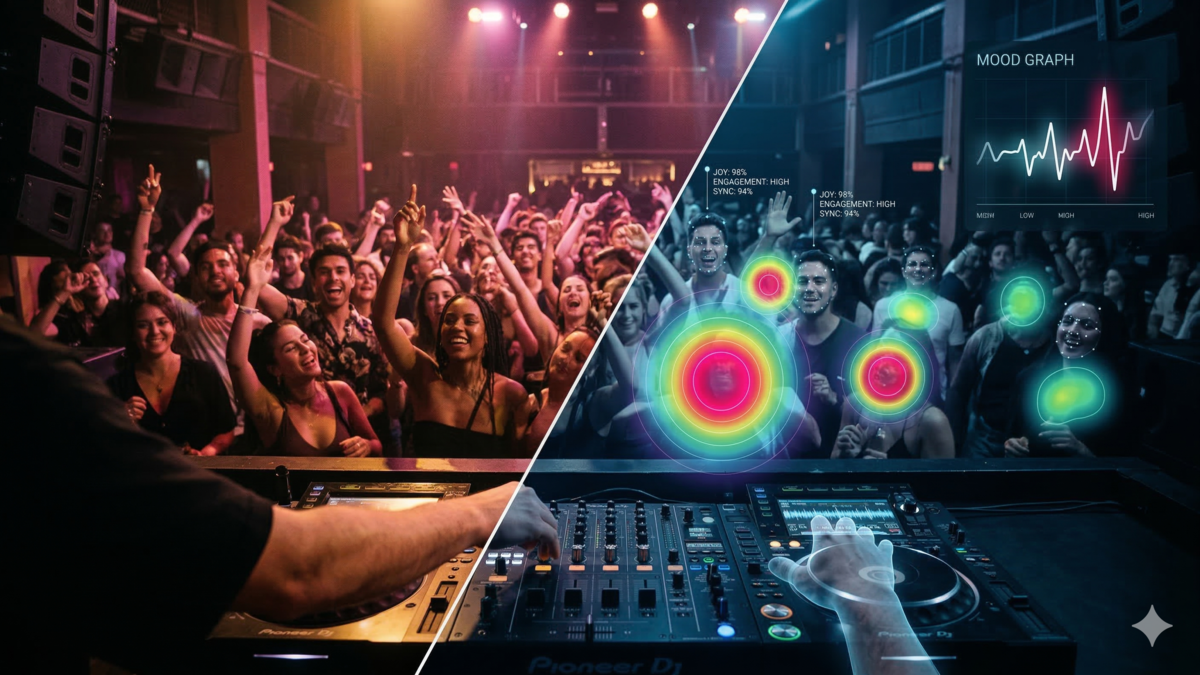
There’s a moment — and every DJ who’s played a proper room knows exactly the moment I mean — where you stop *performing* and start *listening*. Not to the music, you’re always listening to the music. To the room. To the specific frequency of four hundred people collectively deciding whether they’re in or out. You feel it in your chest before you consciously register it. The energy either has a ceiling or it doesn’t. The floor is either responding or it’s politely enduring. And for decades, your only instrument for measuring this was your own nervous system — practiced, refined, occasionally brilliant, and also completely subjective and sometimes catastrophically wrong. You’d misread a room. Play confidently into a vibe that wasn’t there. Realize three tracks too late that something shifted and you missed it.
That’s changing. In 2026, those instincts — the ones you spent years calibrating — are getting a genuinely extraordinary upgrade, and the DJs who understand what AI-powered audience analytics actually offers are operating at a level of crowd connection that borders on unfair. Not because the technology replaces the feeling. But because it confirms it, challenges it, and occasionally reveals things your nervous system missed entirely. The full strategic picture lives at DJ Career Growth & AI Tools, but the specifics here are worth sitting with. Because they’re weirder and more useful than you might expect.
The Data Layer: What AI Sees That You Don’t
Think of it less like surveillance and more like — you know that thing where you can sense the barometric pressure dropping before a storm? This is the technological version of that. A layered sensory architecture that reads the collective body of a crowd the way a skilled meteorologist reads atmospheric data. Multiple input streams, synthesized into something coherent.
Social media signals come first — pre-event buzz, sentiment analysis on hashtag mentions, follower demographic breakdowns that tell you something real about who’s coming before they arrive. Streaming and playback data from platforms like Spotify and Apple Music, aggregated across the relevant locale or event type, mapping genre appetite at population scale. Ticketing and point-of-sale systems contributing anonymized demographic profiles, purchase patterns, typical group sizes. All of this before anyone steps through the door.
Then the on-site layer, which is where it gets genuinely interesting — maybe slightly unsettling if you haven’t thought through the privacy architecture, but we’ll get there. AI systems processing crowd noise in real time: applause levels, vocalization patterns, the collective acoustic signature of four hundred people responding to a specific transition. Correlating those signals with precise moments in the music to produce objective engagement metrics. And non-intrusive video analysis — compliant with regulations, tracking aggregated movement patterns and density maps rather than individual faces — that quantifies collective kinetic response. Not who is dancing. How many bodies are moving, at what intensity, in which areas of the room, and how that changes second by second as your set develops.
Wi-Fi and Bluetooth probes rounding it out: anonymous device detection offering crowd density readings, flow patterns, even repeat visitor identification — all without personal identification, all feeding into machine learning models that are continuously correlating musical elements, tempo shifts, lighting cues, with measurable changes in collective engagement. The output is a real-time dashboard. The crowd’s pulse, displayed with statistical clarity, visible at a glance from behind the decks.
Precision Performance: How Analytics Refines Your Set
Here is where the abstract becomes practical — and honestly, almost disorienting in how useful it is once you actually see it working.
Imagine a visualization of your crowd’s energy rendered minute by minute, discreetly visible on your booth display. Not a vague impressionistic read — a specific, data-backed graph of engagement over time, tied to your tracklist. If a particular sub-genre consistently produces a 15% engagement drop within thirty seconds of introduction — for *this* crowd, at *this* venue, on *this* night — the system flags it. You adapt. You pull from the pool of tracks that the same data shows reliably elevate energy for this specific audience rather than a generic one.
The implications cascade outward. Dynamic set structuring becomes possible in a way it never quite was before: the AI identifies moments when the crowd’s collective state is primed for a genre shift or an intensity escalation, helping you hit those transitions at the exact right instant rather than a bar too early or two tracks too late. Micro-genre identification reveals preferences you’d never have articulated yourself — you think you’re playing house, but the data shows that tracks in a specific BPM range with a particular harmonic density consistently outperform everything else by 20%. You lean into that nuance. You didn’t know it existed. Now you do.
And the real-time feedback loop — this, more than anything, is what changes the game. Did that vocal edit land? Did the tempo lurch you just executed resonate or confuse? The data tells you within seconds, while there’s still time to respond. Not as post-mortem analysis you apply to the next gig. Right now, in the moment, while the crowd is still in the room.
Beyond the Booth: Strategic Benefits for DJs
The historical data these systems accumulate over time becomes — and I want to resist the word “asset” because it’s become kind of hollow, but I can’t find a better one — it becomes a genuinely powerful asset for building a career, not just performing well at individual gigs.
Targeted event promotion gets sharper when you have actual demographic data from previous events. If your analytics show disproportionately strong engagement from 25-34 year olds with a demonstrated taste for indie dance, you don’t guess at your next ad campaign. You target it with the specificity that makes marketing actually work rather than just vaguely function. Venue-specific profiling means you arrive at each room having built a detailed picture of its typical crowd — not a generic party set, but a curated selection of tracks calibrated to what has historically moved people in that specific space. The difference, experienced from the floor, is felt even if it can’t be named.
For promoters and agents managing multiple DJs, the aggregated data has its own strategic value — identifying which artists genuinely connect with which crowd types, which DJs perform best at which point in an evening, what combinations of factors produce the events that people leave talking about. And perhaps most unexpectedly: the sponsorship angle. Concrete, demonstrable data on audience demographics and engagement metrics transforms a pitch for brand partnership from a subjective claim into an objective business case. You can show a potential sponsor exactly who was in the room, how engaged they were, and for how long. In an industry where electronic music’s economic scale is genuinely vast — Wikipedia’s overview of Electronic Dance Music captures the scale of its global economic impact — competitive differentiation increasingly requires this kind of data-backed positioning.
Ethical Considerations and Implementation
Worth addressing directly, because the privacy implications of any technology that watches and listens to crowds should be examined carefully rather than glossed over in the enthusiasm of capability.
Robust audience analytics systems operate on aggregated, anonymized data. Individual identification is not the objective and — in any properly designed system operating under GDPR, CCPA, or comparable frameworks — is actively prevented. The goal is collective behavioral understanding, not surveillance. Understanding that four hundred people in aggregate responded this way to that transition is categorically different from knowing that a specific individual did. The distinction matters legally, ethically, and practically.
But DJs adopting these tools carry a responsibility to understand how the data is being handled, not just to enjoy the outputs. Transparency from platform providers is non-negotiable. And awareness of the data lifecycle — how long it’s retained, what it’s used for beyond your immediate dashboard, who else has access — is part of operating these tools responsibly rather than naively.
When handled well, the benefits are clear and the risks manageable. This technology also layers naturally with other AI tools in the ecosystem — the real-time crowd insights informing decisions that are then executed more fluidly with AI-Powered Voice Assistants for DJ Control and Management, or — and this is a context where audience analytics become even more critical — applied to the remote performance environment of Virtual DJing & AI: Remote Performances and Digital Events, where you’ve lost the physical cues entirely and data becomes the only sensory channel available for reading engagement.
The Future is Measured
Something worth sitting with: the most celebrated DJ sets in history were, almost certainly, the product of exceptional crowd-reading. The legendary nights people still talk about years later — those happened when the DJ and the room were in extraordinary communication, each responding to the other in a feedback loop of almost telepathic precision. That wasn’t guesswork. It was a skill, operating at its highest expression.
AI audience analytics doesn’t replace that skill. It amplifies the conditions that allow it to operate. It converts some of the uncertainty — the signals you might miss when you’re tired, or nervous, or three hours in and starting to lose objectivity — into clarity. It moves you from reacting to anticipating. From occasionally guessing right to more consistently knowing. The artistic vision stays yours; the tools for executing it with precision just got considerably sharper.
The era of pure intuition, of flying entirely blind and proud of it — that era isn’t ending, exactly. It’s evolving. The DJs who will define the next phase of this craft are the ones who can hold both things simultaneously: the felt, embodied, mysterious human knowing of what a room needs, and the data-backed clarity of whether they got it right. That combination — those two things working together — is genuinely exciting, even if it takes a moment to stop finding it slightly strange. For everything that sits around this, the broader strategic framework is at DJ Career Growth & AI Tools. The next drop could be the most informed, and the most felt, of your career.